The Big Question
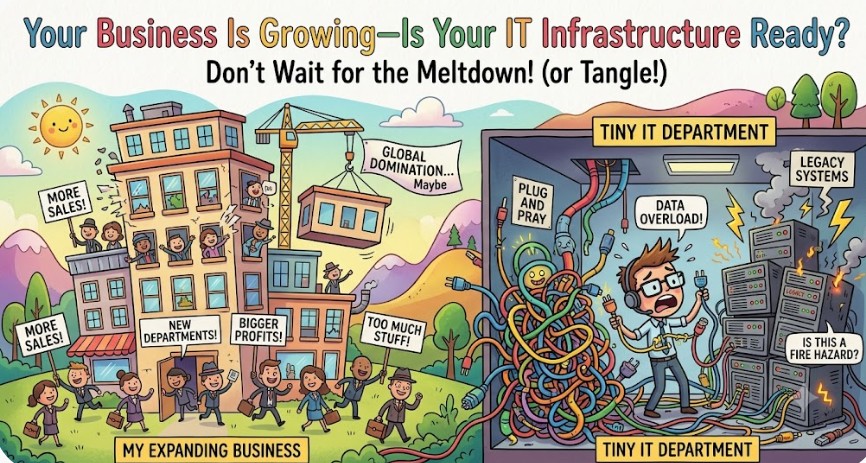
Here's something that keeps sharp founders up at night: What if the very thing you're chasing—growth—is quietly breaking the systems that got you this far?
It's a paradox most businesses don't see coming. In the early days, everything is improvised. You spin up a server, connect a few tools, hire a developer who sets up a basic architecture and moves on. It works. It scales—to a point. Then one day, it doesn't.
The warning signs are subtle at first. A page loads a little slower. A sync job takes longer than usual. A customer mentions downtime. You brush it off—growing pains, you tell yourself. But these aren't growing pains. They're early warnings. And if you ignore them long enough, they turn into something far worse: lost customers, damaged reputation, and emergency spending that makes proactive planning look cheap by comparison.
So the real question isn't whether your business will grow. It's whether your IT infrastructure can grow with it—or whether your success will expose everything you never built properly in the first place.
Why Growth Breaks Infrastructure (And Why Nobody Sees It Coming)
Let's be honest about why this problem is so common. In the early stages, infrastructure is an afterthought. You're focused on product, customers, and revenue. IT is a cost center, not a growth driver. So you do the minimum—enough to keep things running, not enough to keep them running well.
That approach works. Until it doesn't. Here's what actually happens as businesses grow:
Traffic Multiplies, Architecture Doesn't
A system built for 100 concurrent users behaves very differently at 1,000 or 10,000. Database connections run out. Memory gets exhausted. A single server that handled everything now chokes under load. Scaling isn't just "add more servers"—it requires architectural changes that are painful to make after the fact.
Data Volumes Explode
Growth means more customers, more transactions, more of everything. Databases that performed fine with thousands of records slow to a crawl with millions. Backups take longer. Queries that returned instantly now take seconds. Reports that ran overnight never finish.
Security Exposure Increases
A small business is a small target. A growing business is a bigger one. Suddenly you're handling more sensitive data, more payment information, more personal details. Compliance requirements kick in. The security shortcuts you took early on become real liabilities.
Team Coordination Gets Complicated
When five people share a codebase and a server, coordination is easy. When fifty people across multiple teams deploy to shared infrastructure, chaos creeps in. Without proper DevOps, environments, and deployment pipelines, every release becomes a gamble.
Downtime Costs More
When you're small, an hour of downtime is annoying. When you're growing, an hour of downtime during peak hours means lost revenue, broken customer trust, and contracts that don't get renewed. The cost of failure scales with your business—but the infrastructure often doesn't.
The uncomfortable truth: most growing businesses discover their infrastructure limits only when they hit them. By then, fixing the problem is urgent, expensive, and disruptive. The alternative—preparing for growth proactively—is dramatically cheaper and far less painful.
Cost Based on Website Type
If you're assessing whether your infrastructure needs investment, here's what different levels of readiness typically cost.
Basic Informational Website ($1,000 - $5,000): Simple sites with low traffic. Basic hosting, maybe a CDN, and standard security. Growth rarely stresses this category, but even here, planning for traffic spikes matters.
E-commerce Website ($10,000 - $80,000): This is where infrastructure readiness becomes critical. Traffic spikes during sales, payment processing reliability, inventory sync, and database performance all demand proper architecture. Underbuilt e-commerce infrastructure costs real money in abandoned carts and failed transactions.
SaaS Platform ($50,000 - $250,000+): Multi-tenant architecture, high availability, auto-scaling, monitoring, and disaster recovery. SaaS businesses live or die on uptime. Infrastructure investment here isn't optional—it's the foundation of customer trust.
Enterprise Application ($300,000 - $1,500,000+): Full-scale infrastructure with redundancy, geographic distribution, advanced security, and dedicated DevOps. At this level, infrastructure becomes a competitive advantage, not just a requirement.
The pattern holds across every category: infrastructure costs scale with growth, but the cost of fixing broken infrastructure after the fact is always higher than building it right the first time.
Breakdown by Developer Type (2020 - 2026 Rates)
The cost of hiring developers and engineers who can build growth-ready infrastructure has shifted significantly over the past six years.
2020-2022: The DevOps Premium
During this period, DevOps and infrastructure engineers commanded serious premiums. Cloud expertise—especially AWS, Azure, and GCP—was scarce and expensive. Companies paid top dollar for engineers who could architect scalable systems, and many smaller businesses simply couldn't afford them.
2023-2024: The Platform Era
Managed platforms like Vercel, Railway, Render, and Supabase democratized infrastructure. Developers could deploy scalable applications without deep DevOps knowledge. This lowered the barrier to entry but created a new problem: many businesses built on platforms they didn't understand, leaving them vulnerable when they outgrew those platforms' limits.
2025-2026: The Maturity Correction
Today, the market has matured. Infrastructure expertise is more widely available, and the cost of building scalable systems has dropped—not because engineers are cheaper, but because the tools and patterns are better understood.
Current rates reflect this:
-
US-based infrastructure/DevOps engineers: $100+ per hour
-
Canada-based: $55 per hour
-
India-based: $35 per hour
-
Pakistan-based: $25-30 per hour
The premium for genuine infrastructure expertise remains significant—typically 20-30% above general developers—because the value is measurable in uptime, performance, and the emergencies that never happen.
Why Prices Changed in 2026
Several forces have reshaped infrastructure economics this year.
Cloud Costs Became a Boardroom Issue
Cloud spending that was once invisible now commands executive attention. Companies are optimizing aggressively, moving workloads to cheaper providers, and demanding engineers who understand cost-efficient architecture. This has shifted demand toward engineers who can build scalable systems without runaway cloud bills.
AI Workloads Changed Everything
AI features—recommendations, chatbots, predictive analytics—require infrastructure that traditional web applications never needed. GPUs, vector databases, real-time inference. Businesses now need infrastructure that can handle AI workloads, and that expertise commands a premium.
Open-Source Infrastructure Matured
Tools like Kubernetes, Terraform, and modern observability platforms have matured dramatically. What once required specialized engineers can now be managed by well-trained generalists. This has lowered costs while raising baseline expectations.
The Talent Pool Globalized
Infrastructure expertise now exists globally at every price point. Businesses aren't limited to expensive local engineers—they can build teams anywhere.
Pro Tips to Save Money in 2026
1. Audit Before You Upgrade
Before spending on new infrastructure, understand what you already have. Many businesses overpay for resources they don't use and underpay for the ones they need. A thorough audit often reveals immediate savings.
2. Use Managed Services Strategically
Managed databases, managed Kubernetes, managed monitoring—these services cost more per unit but save enormous amounts in engineering time. Use them where they provide the most leverage.
3. Build for Your Next Stage, Not Your Last
Don't over-engineer for scale you don't have. But don't under-build for growth you're actively pursuing. The sweet spot is infrastructure that handles your next 12-18 months comfortably.
4. Invest in Observability Early
You can't fix what you can't see. Monitoring, logging, and alerting aren't luxuries—they're the early warning system that prevents small problems from becoming emergencies.
5. Automate Everything You Can
Manual processes don't scale. Automation—deployment, testing, scaling, backups—pays for itself many times over as your business grows.
6. Consider Global Talent for Infrastructure Roles
Infrastructure expertise exists globally. India-based engineers with strong DevOps and cloud skills cost 60-65% less than US-based equivalents while delivering comparable quality.
Questions to Ask Before Hiring
Before hiring infrastructure engineers or consultants, ask these questions.
"How would you assess our current infrastructure?"
Good engineers start with diagnosis, not prescriptions. They'll want to understand what you have before recommending changes.
"What's the most common infrastructure mistake you see?"
Their answer reveals what they value. "Not monitoring" or "no disaster recovery" tells you they think about resilience. "Using the wrong cloud provider" might mean they're selling something.
"How do you balance cost and reliability?"
Infrastructure is full of tradeoffs. Engineers who understand this will discuss them honestly rather than promising everything.
"What happens when something breaks at 2 AM?"
This tests whether they've thought about operations, not just architecture. Good answers include runbooks, on-call rotations, and incident response.
"How would you prepare us for 10x growth?"
Their answer reveals whether they think strategically about scaling or just tactically about today's problems.
"What would you do in your first 30 days?"
A concrete, prioritized plan shows genuine thinking. Vague answers show the opposite.
Why Delhi is a Great Hub for AI Development
Delhi NCR has become a serious center for AI and infrastructure talent—and that matters for businesses building growth-ready systems.
Talent Density: Delhi NCR hosts thousands of startups and benefits from premier institutions like IIT Delhi and IIIT Delhi. The region produces engineers with strong cloud, DevOps, and infrastructure fundamentals at scale.
Cost Advantage: Building an infrastructure team in India costs approximately 10x less than in the US. For DevOps and cloud roles, India-based engineers deliver comparable quality at 60-65% lower cost.
Infrastructure Maturity: The infrastructure gap that once made India challenging has closed. Modern tooling, cloud services, and high-speed connectivity are all accessible.
Global Standards: Indian engineering teams increasingly build for global markets, adopting international best practices in reliability, security, and scalability.
Policy Positioning: Delhi is India's policy center, strategic for companies navigating data regulations and compliance requirements.
What We Offer
At our firm, we've spent five years building AI solutions and infrastructure that scales. We understand that growth exposes weaknesses—and we help businesses prepare before those weaknesses become emergencies.
Our Services Include:
-
Infrastructure Assessment: Comprehensive audits of your current systems, identifying risks, bottlenecks, and quick wins.
-
Scalable Architecture Design: Building infrastructure that grows with your business, not against it.
-
DevOps Implementation: CI/CD pipelines, automation, monitoring, and everything that makes deployment safe and fast.
-
Cloud Optimization: Reducing cloud costs while improving performance and reliability.
-
AI-Ready Infrastructure: Preparing your systems for AI workloads—GPUs, vector databases, and real-time inference.
-
Ongoing Support: Monitoring, incident response, and continuous improvement.
We've seen what breaks when businesses grow. We've helped fix it. And we've helped others avoid it entirely. Our team combines India-based engineering excellence with global delivery standards—cost advantages without quality compromises.
Frequently Asked Questions
How do I know if my infrastructure is ready for growth?
Key warning signs: slow performance under increasing load, frequent downtime, manual processes that don't scale, security concerns, and a nagging feeling that things are held together with duct tape. If you're experiencing any of these, it's time for an assessment.
How long does it take to upgrade infrastructure?
It depends on scope. A focused optimization might take 2-4 weeks. A full architecture redesign can take 3-6 months. The key is phasing—you don't have to do everything at once.
Will upgrading infrastructure disrupt my business?
Not if it's done properly. Good engineers plan migrations carefully, test thoroughly, and phase changes to minimize risk. The disruption of not upgrading is usually worse.
How much should I budget for infrastructure?
A rough guideline: 10-20% of your technology budget should go to infrastructure. For fast-growing businesses, this can be higher. Underinvesting here always costs more later.
What's the difference between infrastructure and DevOps?
Infrastructure is the systems themselves—servers, databases, networks. DevOps is the practice of managing and improving those systems. Both matter for growth.
Can I just move everything to the cloud and solve this?
The cloud helps, but it's not magic. Poorly architected cloud infrastructure is just as problematic as poorly architected on-premise infrastructure—and often more expensive. Architecture matters more than location.
How do I prioritize infrastructure investments?
Start with what's most likely to break and what would hurt most if it did. Security and reliability first, then performance, then optimization. A good assessment will give you a prioritized roadmap.
Do I need to hire full-time infrastructure engineers?
Not necessarily. For many businesses, a combination of managed services and part-time or contract expertise works well. Full-time hires make sense when infrastructure is core to your competitive advantage.
What about AI—do I need special infrastructure for that?
If you're building AI features, yes. GPUs, vector databases, and real-time inference infrastructure are different from traditional web infrastructure. Plan for it before you need it.
Frequently Asked Questions
What industries do you work with?
We work across e-commerce, SaaS, financial services, healthcare, and professional services. The common thread is growth—businesses that are scaling and need infrastructure that keeps up.
Do you offer infrastructure assessments as a standalone service?
Yes. A standalone assessment typically takes 2-3 weeks and gives you a clear picture of your current state, risks, and recommendations. Many clients start here before committing to larger engagements.
How is pricing structured?
We offer fixed-price proposals for well-defined projects and time-and-materials for exploratory work. Infrastructure projects typically range from $10,000 to $100,000 depending on scope and complexity.
Can you work with our existing team?
Absolutely. We often collaborate with internal teams, providing specialized expertise while your team owns day-to-day operations. This hybrid approach is often the most cost-effective.
What if we've already had infrastructure problems?
That's often when we get called. We help businesses recover from incidents, fix root causes, and build systems that prevent recurrence. There's no judgment—only solutions.
How do you handle security?
Security is built into everything we do—from architecture design to deployment practices. We follow industry best practices and can help you meet specific compliance requirements.
Your Growth Shouldn't Break You
Growth is supposed to be a good thing. It shouldn't feel like your business is held together with hope and duct tape. It shouldn't mean crossing your fingers every time traffic spikes. It shouldn't mean choosing between serving customers and keeping the lights on.
The businesses that scale successfully aren't the ones that got lucky. They're the ones that prepared. They invested in infrastructure before it became an emergency. They built systems that grew with them instead of against them.
The question isn't whether your business will grow. It's whether your infrastructure is ready when it does.
Let's make sure it is.