The Big Question
Let me ask you something uncomfortable: When was the last time a data insight actually changed a decision you made?
Not a report you glanced at. Not a dashboard someone built that nobody opens. An actual insight—something your data told you that you didn't already know—that led to a concrete action and a measurable result.
If you're struggling to remember, you're not alone. Most businesses are drowning in data but starving for intelligence. They've invested in analytics tools, hired data analysts, built dashboards—and yet decisions still get made on gut feeling, experience, and the loudest voice in the room.
Here's the hard truth: having data is not the same as being data-driven. Collecting information is not the same as extracting intelligence. And in 2026, with AI capabilities advancing faster than most businesses can keep up, the gap between companies that truly use their data and those that just store it is becoming a chasm.
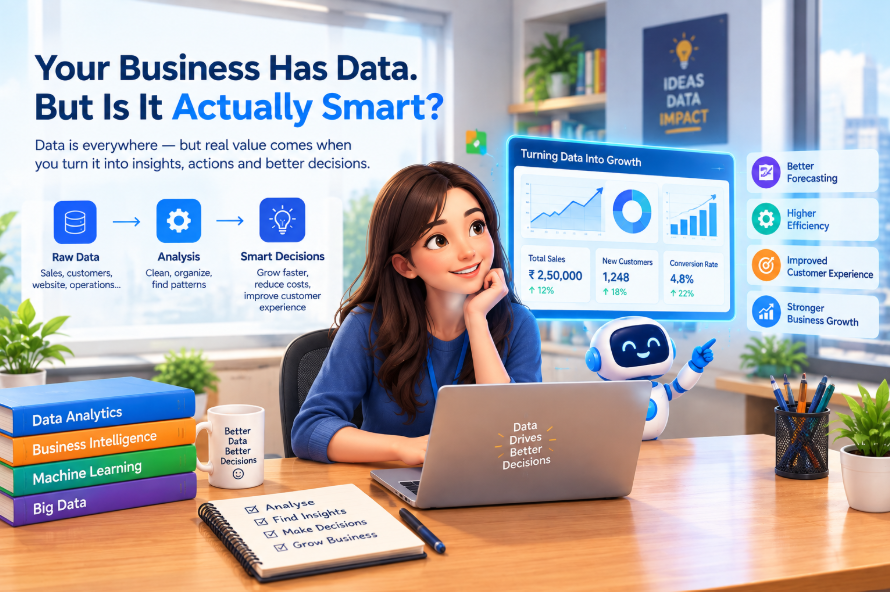
Your business has data. But is it actually smart? That's the question this post will help you answer—honestly.
What "Smart Data" Actually Means
Let's clear up the confusion. "Smart data" isn't a buzzword or a product you buy. It's a state of maturity—a way of operating where data actively informs and improves decisions at every level.
Here's what distinguishes smart data from regular data:
Regular Data: You have it. It sits in databases, spreadsheets, and SaaS tools. You can pull reports when asked. It tells you what happened.
Smart Data: It's connected, cleaned, and contextualized. It flows into the places where decisions happen. It tells you what's happening, what's likely to happen, and what you should do about it.
The difference is not about volume. It's about actionability. A small business with a well-designed data pipeline that feeds daily decisions is smarter than an enterprise with petabytes of unused logs.
Smart data has three characteristics:
1. It's Accessible
The people who need data can actually get it. Not through a request to the data team that takes three days. Not through a complex BI tool nobody understands. Through the tools they already use, in formats they can act on.
2. It's Trusted
When someone looks at a number, they believe it. There's no debate about whose report is right. The definitions are consistent, the pipelines are reliable, and the data quality is maintained.
3. It's Actionable
Every data point connects to a decision. Not "here's a chart"—but "here's what this means and what you should consider doing." Smart data doesn't just inform. It enables action.
Most businesses have data. Very few have smart data. The gap between those two states is where competitive advantage lives.
Cost Based on Website Type
If you're looking to build systems that turn your data into intelligence, costs vary based on what you're working with.
Basic Informational Website ($1,000 - $4,000): Simple sites with minimal data needs. You might add basic analytics tracking and a simple dashboard. Smart data capabilities are limited but possible—tracking visitor behavior, identifying high-value pages, understanding traffic sources.
E-commerce Website ($12,000 - $70,000): This is where smart data starts delivering real ROI. Customer segmentation, product recommendation engines, inventory optimization, and marketing attribution all become possible. The investment scales with data complexity and integration requirements.
SaaS Platform ($50,000 - $200,000+): SaaS businesses live on data. User behavior analytics, churn prediction, feature adoption tracking, and expansion revenue modeling are essential. Smart data here means understanding exactly which users are thriving, which are struggling, and why.
Enterprise Application ($250,000 - $1,200,000+): Large-scale intelligent data systems with real-time processing, multi-source integration, and advanced AI capabilities represent the high end. These systems don't just report—they predict, recommend, and increasingly act autonomously.
The honest truth: most businesses over-invest in tools and under-invest in making data smart. A simple, well-designed data pipeline feeding a focused set of decisions outperforms an expensive BI suite nobody uses.
Breakdown by Developer Type (2020 - 2026 Rates)
The cost of building intelligent data systems has shifted significantly over the past six years.
2020-2022: The Specialist Premium
During this period, data engineering and analytics required genuine specialists. Data engineers commanded $140,000-$180,000 annually in the US. Analytics engineers were scarce. Building a smart data pipeline meant hiring expensive talent and investing in complex infrastructure.
2023-2024: The Tool Explosion
A wave of tools democratized data work. dbt made transformation accessible. Modern data stacks (Fivetran, Snowflake, Looker) reduced infrastructure burden. The cost of building data pipelines dropped by roughly 30-40%, but the skill required to use these tools well remained high.
2025-2026: The AI Acceleration
AI has fundamentally changed the economics of smart data. AI-assisted data preparation, automated anomaly detection, and natural language querying have reduced the technical barrier. The talent pool has expanded globally, and the cost of intelligence has dropped dramatically.
Current rates:
-
US-based data engineers/analytics engineers: $85+ per hour
-
Canada-based: $50 per hour
-
India-based: $35 per hour
-
Pakistan-based: $25-30 per hour
For a mid-complexity smart data project (pipeline + warehouse + dashboard + basic AI layer), a US team might quote $100,000-$200,000. An India-based team delivers comparable quality at $30,000-$60,000.
Why Prices Changed in 2026
Several forces have reshaped the economics of smart data this year.
AI Made the Hard Parts Easier
Data cleaning, transformation, and anomaly detection—traditionally the most time-consuming parts of data work—are now increasingly automated. AI tools can profile data, suggest transformations, and flag quality issues. This has reduced the labor required to build smart data systems.
The Token Economy Rewrote the Math
The cost of AI inference has collapsed. Tasks that once required expensive custom models now run on commodity LLMs at negligible cost. Natural language querying—"show me customers who haven't purchased in 90 days and have open support tickets"—is now accessible to any business.
Open-Source Ate the Stack
Open-source tools now handle most of what proprietary platforms once monopolized. Airbyte, dbt, Metabase, Superset—the open-source data stack is mature and capable. Businesses can build smart data systems without enterprise software licenses.
Talent Went Global
Data skills are no longer concentrated in Silicon Valley. India produces hundreds of thousands of data-literate engineers annually. The supply-demand imbalance that kept costs high has corrected.
The Definition of "Smart" Expanded
In 2020, "smart data" meant good dashboards. In 2026, it means AI-powered insights, predictive capabilities, and automated recommendations. The scope has expanded, but so has the efficiency of delivering it.
Pro Tips to Save Money in 2026
1. Start with Decisions, Not Data
The biggest mistake is starting with your data and asking "what can we learn?" Start with your decisions and ask "what data would make this decision better?" This focus prevents expensive data projects that don't change anything.
2. Fix Data Quality Before Adding Intelligence
AI on bad data produces confident nonsense. Before investing in advanced analytics, ensure your basic data is clean, consistent, and trusted. This foundation is unglamorous but essential.
3. Use Open-Source Tools Aggressively
The open-source data stack is mature enough for most businesses. Unless you have specific enterprise requirements, open-source tools deliver 90% of the value at 10% of the cost.
4. Build for Self-Service
Every question that requires a data team request is a question that gets asked less often. Invest in making data accessible to the people who need it. Self-service analytics pays for itself in decision velocity.
5. Leverage AI for the Tedious Work
Data cleaning, documentation, and exploration are increasingly automatable. Use AI to handle the parts of data work that don't require human judgment.
6. Consider Global Talent for Data Engineering
Data engineering skills exist globally. India-based data engineers with strong SQL, Python, and pipeline experience cost 60-65% less than US equivalents.
Questions to Ask Before Hiring
Before you hire a data partner or team, ask these questions. The answers will reveal whether they understand smart data or just data.
"How do you decide what data to collect?"
The answer should center on decisions, not volume. Smart data partners start with business questions, not data sources.
"How do you ensure data quality?"
Look for specifics: validation rules, monitoring, anomaly detection, and clear ownership. Vague answers about "best practices" are red flags.
"How will our team actually use this?"
Smart data isn't just built—it's adopted. Ask how they'll drive usage, train your team, and ensure the system actually changes decisions.
"What happens when the data is wrong?"
Every data system has errors. The question is whether there's a process for detecting, investigating, and correcting them.
"How do you measure success?"
The answer should involve business outcomes, not technical metrics. "We'll build a data warehouse" isn't success. "We'll reduce customer churn by 15%" is.
"What's your approach to AI in data?"
In 2026, any data partner should have a clear perspective on where AI helps and where human judgment remains essential.
Why Delhi is a Great Hub for AI Development
Delhi NCR has emerged as a genuine center for AI and data innovation—and it's not by accident.
Talent Density: The region hosts over 8,000 active startups and benefits from premier institutions like IIT Delhi and IIIT Delhi. The talent pipeline for data engineering and AI is deep and growing.
Cost Advantage: Building a data team in India costs approximately 10x less than in the US. For smart data projects, India-based teams deliver comparable quality at 60-65% lower cost.
Infrastructure Maturity: Cloud services, high-speed connectivity, and modern data tooling are all accessible in Delhi. The infrastructure gap that once existed has closed.
Global Standards: Indian data teams increasingly build to international standards, adopting best practices in data governance, security, and scalability.
Policy Positioning: Delhi is India's policy center, making it strategic for companies navigating data regulations and compliance requirements.
What We Offer
At our firm, we've spent five years building AI and data solutions that actually get used. We understand that smart data isn't about technology—it's about decisions.
Our Services Include:
-
Data Strategy & Assessment: Understanding where you are, what data you have, and what decisions you're trying to improve.
-
Data Pipeline Development: Building reliable, scalable pipelines that turn raw data into usable intelligence.
-
Analytics & Dashboarding: Creating systems that people actually use, not just look at.
-
AI-Powered Insights: Applying machine learning and LLMs to generate predictive and prescriptive intelligence.
-
Data Team Augmentation: Embedding data engineers and analysts into your existing team.
-
Training & Enablement: Helping your team become genuinely data-driven, not just data-aware.
We've seen what works and what doesn't. We know that data projects fail when they're disconnected from decisions. We build differently because we've learned.
Frequently Asked Questions
What's the difference between business intelligence and smart data?
Business intelligence typically means reporting—dashboards, charts, historical analysis. Smart data goes further: it's predictive, actionable, and embedded in decision workflows. BI tells you what happened. Smart data tells you what to do next.
How long does it take to build a smart data system?
A focused project—one key decision area—can show value in 6-10 weeks. A comprehensive system across multiple functions takes 3-6 months. The timeline depends on data readiness and how many decisions you're trying to improve.
Do I need a data warehouse?
Not necessarily. Small businesses can often work effectively with operational databases and lighter tools. A warehouse makes sense when you have multiple data sources, significant volume, or complex analytical needs.
How much data do I need to start?
Less than you think. Smart data isn't about volume—it's about relevance and quality. Many businesses generate useful insights from modest datasets if the data is clean and connected to decisions.
What if our data is messy?
Most data is. That's normal. The first phase of any smart data project is usually data quality assessment and cleaning. It's unglamorous but essential.
How do we know if it's working?
Define success metrics before you start. Are decisions faster? More accurate? Are you catching problems earlier? Is revenue or retention improving? If you can't measure impact, you can't claim success.
Can you work with our existing tools?
Yes. We integrate with existing data stacks, BI tools, and workflows. We're not here to replace everything—we're here to make what you have smarter.
What about data privacy and security?
We implement industry-standard security practices and ensure compliance with relevant regulations. Data governance is part of every project, not an afterthought.
Why should we work with you instead of building in-house?
You might not need us long-term. Many clients use us to build the initial system, then take ownership. We're here to get you to smart data faster, not to create dependency.
Frequently Asked Questions
What industries do you work with?
We've built smart data systems for e-commerce, SaaS, financial services, healthcare, and professional services. The common thread is a willingness to make decisions based on evidence.
Do you offer pilot projects?
Yes. For new clients, we often start with a focused pilot on one decision area. This proves value before larger commitments. Pilots typically run 6-8 weeks.
How is pricing structured?
Fixed-price for well-defined projects, time-and-materials for exploratory work. Most smart data projects fall in the $20,000-$80,000 range depending on complexity and scope.
Can you help us figure out where to start?
Yes. We offer discovery engagements where we assess your data landscape, identify high-impact opportunities, and recommend a prioritized roadmap.
Your Data Is Talking. Are You Listening?
Every business has data. Few have intelligence. The gap between those two states is where competitive advantage lives—and it's growing wider every year.
The question isn't whether you have data. It's whether that data is making you smarter, faster, and better. If it's not, you're not just missing an opportunity. You're falling behind.