The Big Question
Here's a question every CTO, startup founder, and hiring manager should be asking in 2026: If AI can now write your frontend components and scaffold your backend APIs in minutes, what actually makes a full stack developer valuable?
The answer, increasingly, is the database layer.
Think about it. AI tools can generate a React component, a REST endpoint, or a login form faster than any human. But ask an AI to design a database schema that scales to millions of users, optimizes complex queries across multiple tables, handles transactions correctly under concurrent load, and migrates safely without downtime—and you'll quickly discover the limits of automation. Database work requires judgment, experience, and a deep understanding of how data behaves under real-world conditions.
Yet here's the uncomfortable truth: most full stack developers treat databases as a black box. They learn enough SQL to run basic queries, maybe use an ORM to avoid writing raw SQL, and never think about indexes, query plans, or normalization. This works fine—until it doesn't. Until the app slows to a crawl, until a migration corrupts data, until a simple feature takes three times longer because the underlying data model is wrong.
So the question isn't whether database knowledge matters. It's why so many full stack developers neglect it, and what it costs businesses when they do.
Why Database Knowledge Separates Good Developers from Great Ones
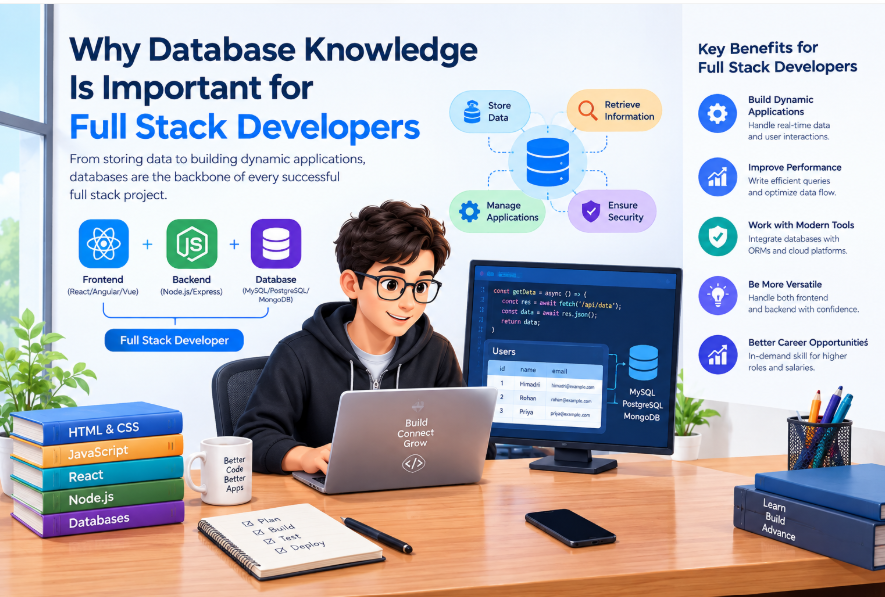
Let's be honest about what "full stack" has come to mean. Too often, it means "can touch both frontend and backend code." But the developers who command respect across the industry share something deeper: they understand that data is the foundation of every application, and everything else—the UI, the APIs, the business logic—exists to serve it.
Here's why database knowledge matters across every layer of development:
It Shapes Your Data Model—And Your Entire Application
The way you structure your database determines everything downstream. A poorly normalized schema leads to data duplication, inconsistency, and painful migrations. An over-normalized schema leads to complex joins that kill performance. A developer who understands database design makes these tradeoffs consciously. One who doesn't inherits problems they can't see yet.
It Determines Application Performance
Most application slowdowns trace back to the database. N+1 queries. Missing indexes. Full table scans. These aren't exotic problems—they're everyday issues that database-literate developers catch during development, not after users complain. A developer who can read a query execution plan is worth ten who can't.
It Affects Security
SQL injection remains one of the most common and dangerous vulnerabilities in web applications. Developers who understand databases instinctively know how to use parameterized queries, how to manage database permissions, and how to protect sensitive data at rest. This isn't optional knowledge—it's a security requirement.
It Enables Better Architecture Decisions
Should you use PostgreSQL or MongoDB? When does it make sense to denormalize? How do you handle data consistency across microservices? These are architecture questions, and they're fundamentally database questions. Developers without database depth make these decisions based on trends and blog posts rather than understanding.
It Accelerates Development
Counterintuitively, developers who understand databases move faster. They write efficient queries the first time. They design schemas that accommodate future features. They debug data issues quickly because they know where to look. The developer who "saves time" by avoiding database learning pays for it repeatedly.
The pattern is clear: database knowledge isn't a specialization. It's a core competency that makes every other skill more effective.
Cost Based on Website Type
If you're hiring full stack developers with genuine database expertise, the cost varies based on what you're building.
Basic Informational Website ($500 - $3,000): Simple sites with minimal data needs—a contact form, maybe a blog. Database requirements are light. Most developers can handle this without deep database knowledge, though even here, proper form handling and data validation matter.
E-commerce Website ($8,000 - $60,000): This is where database knowledge starts paying dividends. Product catalogs, inventory management, order processing, and customer data all demand thoughtful schema design. A developer who doesn't understand transactions, indexing, and query optimization will build something that works for 100 orders and collapses at 10,000.
SaaS Platform ($40,000 - $180,000+): Multi-tenant architectures, complex relationships, high concurrency, and evolving schemas make database expertise essential. SaaS applications live or die on their data layer. Hiring developers without database depth here is a recipe for expensive rewrites.
Enterprise Application ($200,000 - $1,000,000+): At this scale, database architecture becomes a dedicated discipline. Distributed databases, replication, sharding, backup and recovery strategies—these require deep specialization. Full stack developers here need at least working knowledge of these concepts to collaborate effectively with database engineers.
The lesson across all categories: database knowledge isn't a cost center. It's an investment that reduces total cost of ownership by preventing problems that are expensive to fix later.
Breakdown by Developer Type (2020 - 2026 Rates)
The cost of hiring full stack developers with database expertise has shifted significantly over the past six years.
2020-2022: The Specialization Premium
During this period, developers who understood databases commanded significant premiums. A full stack developer with strong SQL skills might earn 20-30% more than one without. PostgreSQL and MongoDB specialists were in high demand, and companies struggled to find developers who could handle both application code and database design.
2023-2024: The ORM Illusion
The rise of ORMs (Object-Relational Mappers) like Prisma, TypeORM, and Sequelize created a strange dynamic. Developers could build applications without writing raw SQL, and many did. But this created a generation of developers who couldn't debug database issues when ORMs generated inefficient queries. Companies began realizing that ORM proficiency wasn't the same as database understanding.
2025-2026: The Reckoning
Today, the market has corrected. Employers have learned—sometimes painfully—that database knowledge matters. Job postings for full stack developers increasingly list "strong SQL skills," "database design experience," and "query optimization" as requirements, not nice-to-haves.
Current rates reflect this:
-
US-based full stack developers with database depth: $95+ per hour
-
Canada-based: $50 per hour
-
India-based: $35 per hour
-
Pakistan-based: $25-30 per hour
The differential between developers with and without database expertise remains significant—typically 15-25%—because the value they deliver is measurable in performance, reliability, and reduced technical debt.
Why Prices Changed in 2026
Several factors have reshaped the economics of hiring database-literate developers this year.
AI Wrote the Easy Code
AI tools now handle the boilerplate: CRUD operations, simple queries, standard schema generation. This has devalued developers who only knew how to write basic code. But AI struggles with the hard parts of databases—optimizing complex queries, designing schemas for scale, handling edge cases in transactions. The premium for human database expertise has increased even as general coding has been commoditized.
Data Volumes Exploded
Applications that once handled thousands of records now handle millions. What worked at small scale fails at large scale. Companies are paying for developers who understand indexes, partitioning, and query optimization because their applications are hitting limits they didn't anticipate.
The Cost of Getting It Wrong Increased
A database mistake in 2020 might have meant a slow page load. In 2026, with real-time applications, integrated AI systems, and user expectations of instant response, database problems mean lost customers and revenue. The stakes have risen, and so has the value of getting data right.
Database Landscape Diversified
PostgreSQL, MySQL, MongoDB, Redis, Elasticsearch, DynamoDB, Supabase, Neon—the options have multiplied. Developers who understand the tradeoffs between them are increasingly valuable. One-size-fits-all database thinking is a liability.
Pro Tips to Save Money in 2026
1. Test Database Skills During Hiring
Don't trust resumes. Give candidates a real database problem—design a schema for a specific use case, optimize a slow query, explain how they'd handle a migration. Developers with genuine database knowledge will stand out immediately.
2. Invest in Training Your Existing Team
Your current developers may have gaps in database knowledge, but they understand your systems. A structured training program on SQL optimization, indexing, and schema design often costs less than hiring new developers and delivers comparable results.
3. Hire for Database Depth in Key Roles
You don't need every developer to be a database expert. But your team leads and architects should be. Having one or two deeply database-literate developers who can review others' work and set standards pays dividends.
4. Use ORMs Thoughtfully, Not Blindly
ORMs are tools, not replacements for understanding. Ensure your team knows what SQL the ORM generates, when to drop to raw queries, and how to debug performance issues the ORM hides.
5. Consider Global Talent for Database Roles
Database expertise exists globally. India-based developers with strong SQL and database design skills cost 60-65% less than US-based equivalents while delivering comparable quality for most workloads.
6. Prioritize Database Design Before Development
The cheapest database mistake is the one you prevent. Invest in schema design and review before writing application code. An hour of database planning saves days of refactoring.
Questions to Ask Before Hiring
Before you hire a full stack developer, ask these questions. The answers will reveal whether their database knowledge is real or superficial.
"Walk me through how you'd design a schema for [specific use case]."
Listen for how they think about relationships, normalization, indexing, and future scalability. Developers with genuine knowledge will ask clarifying questions and discuss tradeoffs. Others will jump to a generic answer.
"How do you debug a slow query?"
The answer should mention execution plans, indexes, and specific tools. If they say "I add a cache" without discussing the underlying query, they're avoiding the real problem.
"What's the difference between a database and a data warehouse?"
This separates developers who understand data systems from those who just know how to connect to a database. The answer reveals whether they think about data strategically.
"How do you handle database migrations in production?"
Migrations are where database knowledge meets real-world consequences. Good answers discuss zero-downtime strategies, rollback plans, and testing approaches.
"When would you denormalize?"
This question tests whether they understand the tradeoffs between correctness and performance. There's no single right answer—but there are many wrong ones.
"How do you prevent SQL injection?"
The answer should be immediate and specific: parameterized queries, prepared statements, input validation. If they hesitate, that's a red flag.
Why Delhi is a Great Hub for AI Development
Delhi NCR has become a genuine center of gravity for AI and software development—and database expertise is part of that story.
Talent Density: Delhi NCR hosts over 8,000 active startups and benefits from premier institutions like IIT Delhi and IIIT Delhi. The region produces developers with strong fundamentals, including database knowledge, at scale.
Cost Advantage: Building a development team in India costs approximately 10x less than in the US. For database-focused roles, India-based developers deliver comparable quality at 60-65% lower cost.
Infrastructure Maturity: The infrastructure gap that once made India challenging for cutting-edge development has closed. Cloud services, high-speed connectivity, and modern development tooling are all accessible.
Global Delivery Standards: Indian development teams increasingly build for global markets from day one, adopting international best practices in database design, security, and scalability.
Policy Positioning: Delhi is India's policy center, making it strategic for companies navigating data regulations, localization requirements, and compliance frameworks.
What We Offer
At our firm, we've spent five years building AI solutions and development teams that ship. We understand that database knowledge isn't optional—it's foundational.
Our Services Include:
-
Full Stack Development: Teams with genuine database expertise, not just ORM familiarity.
-
Database Design & Optimization: Schema design, query optimization, migration strategy, and performance tuning.
-
AI-Powered Development: Combining AI efficiency with human expertise where it matters most—data architecture.
-
Staff Augmentation: Database-literate developers who integrate with your existing team.
-
Technical Consulting: Architecture reviews, database audits, and scaling strategies.