The Big Question
Every business leader faces the same fundamental problem: the future is uncertain, but the stakes of getting it wrong have never been higher.
Should you stock more inventory for Q4? Which customers are about to leave? Where should you allocate your marketing budget next quarter? For decades, these questions were answered with a mix of intuition, experience, and gut feeling. Sometimes it worked. Often, it didn’t.
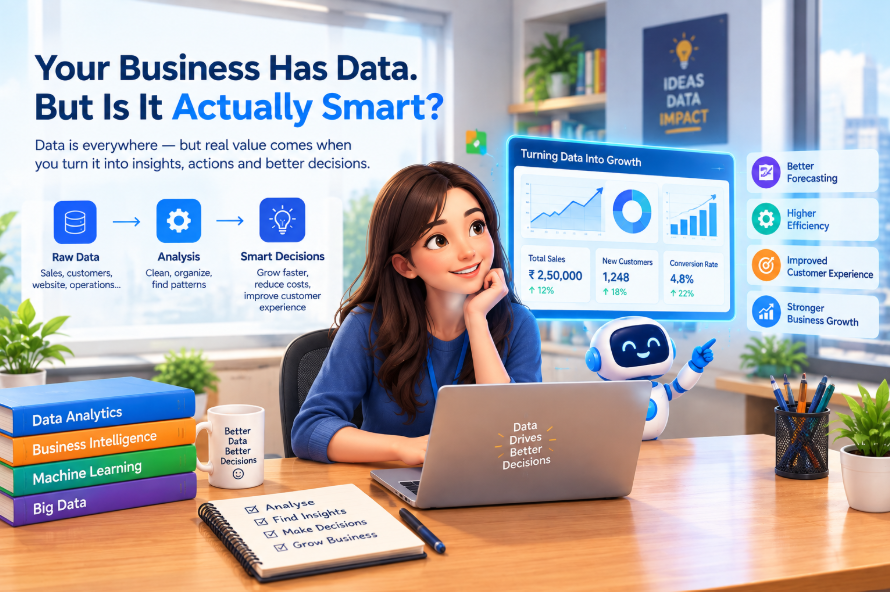
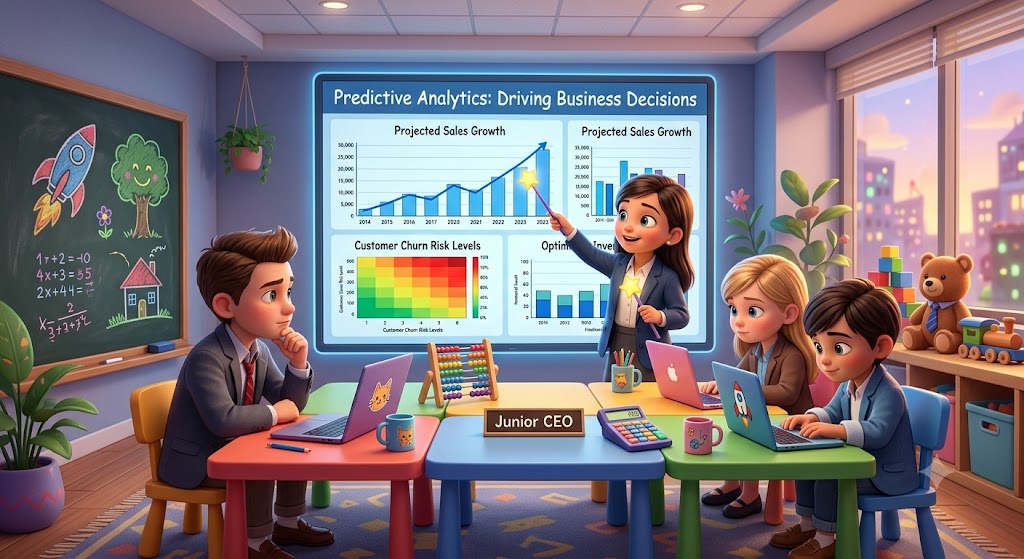
Predictive analytics changes this equation entirely. Instead of looking in the rearview mirror to understand what happened, businesses now use advanced statistical models and machine learning algorithms to forecast what’s likely to happen next. The technology has moved from the realm of data scientists at Fortune 500 companies to something accessible to mid-market businesses and ambitious startups.
The question isn’t whether predictive analytics can help your business. It’s whether you can afford to ignore it while your competitors don’t.
What Predictive Analytics Actually Does (And Why It Matters)
Before diving into costs and implementation, let’s clarify what we’re actually talking about.
Predictive analytics sits between descriptive analytics (what happened?) and prescriptive analytics (what should we do about it?). It uses historical data, statistical algorithms, and machine learning techniques to identify the likelihood of future outcomes. Think of it as a weather forecast for your business—not a guarantee, but a probability-based guide that’s infinitely more reliable than looking out the window and guessing.
The applications span virtually every business function:
Sales Forecasting: Instead of relying on sales reps’ optimistic projections, predictive models analyze historical patterns, seasonality, market conditions, and pipeline data to generate accurate revenue forecasts. Businesses using predictive sales analytics report forecast accuracy improvements of 20-40%, which translates directly to better inventory management, staffing decisions, and cash flow planning.
Customer Retention: One of the most powerful applications is churn prediction. By analyzing behavioral patterns—login frequency, support ticket volume, engagement metrics, purchase history—predictive models can identify customers who are about to leave before they’ve made the decision. This gives businesses a window to intervene with retention offers, personalized outreach, or product improvements.
Risk Management: Financial institutions use predictive analytics to assess credit risk in real-time. Insurance companies use it to detect fraudulent claims. Supply chain managers use it to anticipate disruptions before they cascade into full-blown crises. The common thread: identifying risk factors early enough to act.
Marketing Optimization: Which channel deserves more budget? Which message will resonate with which segment? Predictive models analyze past campaign performance and customer behavior to answer these questions with statistical confidence rather than educated guesses.
The technology works by finding patterns humans miss. A human analyst might notice that sales spike every December. A predictive model notices that sales spike every December, but only in regions where temperatures drop below a certain threshold, and only when the previous quarter’s marketing spend exceeded a specific amount, and only for customers who made their first purchase more than 18 months ago. That level of pattern recognition is where the real value lives.
Cost Based on Website Type
If you’re considering adding predictive analytics to your digital presence, the cost varies dramatically based on complexity and integration depth.
Basic Informational Website ($2,000 - $5,000): A simple brochure-style website doesn’t typically need predictive analytics. However, adding basic visitor behavior tracking and simple lead scoring can be done affordably. This might include predicting which visitors are most likely to convert based on page engagement patterns.
E-commerce Website ($15,000 - $75,000): This is where predictive analytics starts delivering measurable ROI. Product recommendation engines, customer lifetime value prediction, churn risk scoring, and inventory demand forecasting are all applicable. The investment scales with product catalog size and data complexity.
SaaS Platform ($50,000 - $200,000+): SaaS businesses have rich behavioral data and clear metrics for success (activation, retention, expansion). Predictive models for user churn, expansion revenue opportunities, and feature adoption prediction are standard. The complexity comes from integrating predictions into the product experience itself.
Enterprise Application ($250,000 - $1,200,000+): Large-scale systems with multi-domain analytics, real-time prediction requirements, and regulatory compliance needs represent the high end. These systems often combine predictive analytics with prescriptive capabilities, generating not just forecasts but recommended actions.
The honest truth: most businesses should start smaller than they think. A focused predictive model solving one specific problem—like churn prediction for your top 100 accounts—often delivers more value than a sprawling analytics initiative that never quite ships.
Breakdown by Developer Type (2020 - 2026 Rates)
The cost of building predictive analytics has shifted dramatically over the past six years, driven by two opposing forces: the explosion of AI talent and the commoditization of certain model types.
2020-2022: The Specialist Era
During this period, predictive analytics required genuine data science expertise. Hiring a machine learning engineer in the US cost $150,000-$200,000 annually. Freelance data scientists charged $100-$200 per hour. Projects took 6-12 months because everything had to be built from scratch—data pipelines, feature engineering, model training infrastructure.
2023-2024: The Framework Revolution
Libraries like scikit-learn, XGBoost, and PyTorch matured. Cloud platforms (AWS SageMaker, Google Vertex AI) abstracted away infrastructure complexity. The cost of building a standard predictive model dropped by roughly 40%. More importantly, the required skill set broadened—full-stack developers with some ML knowledge could build functional predictive systems.
2025-2026: The AI-Assisted Present
Today, the landscape looks fundamentally different. AI coding assistants accelerate development. Pre-trained models can be fine-tuned for specific use cases with far less data than before. The global talent pool has expanded dramatically.
Current rates tell the story:
-
US-based AI engineers: $90+ per hour
-
Canada-based: $45 per hour
-
India-based: $35 per hour
-
Pakistan-based: $25-30 per hour (for comparison)
For a mid-complexity predictive analytics project (churn model + recommendation engine + dashboard), a US team might quote $80,000-$150,000. An India-based team with equivalent skills quotes $25,000-$50,000 for the same scope. The quality gap, while not entirely eliminated, has narrowed significantly—particularly for standard predictive modeling tasks.
Why Prices Changed in 2026
Several forces converged to reshape predictive analytics pricing this year.
The Token Economics Paradox
Per-token prices for large language models collapsed by 98% between 2022 and 2026. GPT-4-equivalent performance now costs roughly $0.40 per million tokens, down from $20. Yet enterprise AI bills tripled over the same period. The reason: agentic AI systems consume vastly more tokens per task than simple API calls. A linear workflow in 2023 might have used 1,000 tokens. An orchestrated agentic system in 2026 uses 30,000+ for the same outcome.
For predictive analytics specifically, this means the model inference cost is often negligible. The real cost is in data preparation, feature engineering, integration, and ongoing maintenance.
Open-Weight Model Commoditization
Open-weight models now account for approximately 61% of top-model token traffic. The average cost of open-weight models sits at $0.83 per million tokens versus $6.03 for proprietary alternatives. For businesses willing to self-host or use managed open-source solutions, the cost of the “intelligence” layer has never been lower.
The Talent Cost Correction
In 2020, AI talent commanded a massive premium because it was scarce. In 2026, India alone produces 1.5 million engineers annually, and a growing percentage have AI/ML expertise. The supply-demand imbalance that kept rates artificially high has corrected—not eliminated, but corrected.
Frontier vs. Commodity Bifurcation
The market has split. Frontier models (GPT-6, Claude Fable) cost $10-$50 per million tokens. Commodity models cost under $1. For most predictive analytics use cases—forecasting, scoring, classification—commodity models deliver 95% of the value at 2% of the cost.
Pro Tips to Save Money in 2026
1. Start with a Pilot, Not a Platform
The biggest money-waster in predictive analytics is building infrastructure before proving value. Start with a single, high-impact use case. Build the simplest possible model that generates actionable predictions. Prove ROI. Then expand.
2. Use Open-Weight Models for Standard Tasks
Unless your predictive use case requires frontier-level reasoning (most don’t), open-weight models like Llama, Mistral, or DeepSeek deliver excellent results at a fraction of the cost.
3. Invest in Data Quality, Not Model Complexity
The dirty secret of predictive analytics: a simple logistic regression on clean, well-engineered features often outperforms a deep neural network on messy data. Spend your budget on data preparation before model architecture.
4. Leverage Global Talent Strategically
An India-based team can deliver equivalent quality for standard predictive modeling at 60-65% less cost than US-based teams. For complex, novel problems requiring frontier research, US or European specialists may justify their premium. For standard implementations, global talent is the smarter economic choice.
5. Consider Pre-Built Solutions First
Before commissioning custom development, evaluate whether existing tools (Salesforce Einstein, HubSpot predictive scoring, Google Analytics 4 predictive audiences) solve your problem. Custom builds make sense when your use case is genuinely differentiated.
6. Plan for Maintenance from Day One
Predictive models decay. Customer behavior changes. Market conditions shift. Budget 20-30% of initial development cost annually for model retraining, monitoring, and adjustment. Building without this budget is building to fail.
Questions to Ask Before Hiring
Before you commit budget to a predictive analytics partner, ask these questions. The answers will tell you more than any portfolio or case study.
“Show me a live predictive system you’ve shipped, not a demo.”
Demos are easy. Production systems that handle real data, real edge cases, and real failure modes are hard. If they can’t show you something running, they haven’t shipped.
“What happens when the model is wrong?”
Every predictive model is wrong sometimes. The question is: does the system have guardrails? Does it flag low-confidence predictions? Is there a human review process? Vendors who haven’t thought about failure modes have never shipped production AI.
“Who actually writes the code?”
Many agencies subcontract development. You’re paying agency rates for junior contractors. Ask directly who will be working on your project, and whether you’ll have direct access to them.
“What’s NOT included in this quote?”
The honest vendors answer this fast. Data cleaning? Ongoing support? Model retraining? Integration with your existing systems? Get the complete picture before signing.
“How will we measure success?”
Before any code is written, you should agree on specific metrics. Prediction accuracy? Revenue impact? Cost savings? Time saved? Vague goals lead to vague outcomes.
“What’s your change control process?”
Scope will change. Every project encounters unknowns. Vendors without a clear change control process either haven’t managed complex projects or plan to use scope creep as a profit center.
Why Delhi is a Great Hub for AI Development
When OpenAI chose Delhi for its first India office in late 2025, it validated what many in the industry already knew: Delhi NCR has become a genuine center of AI gravity.
The reasons are both structural and specific:
Talent Density: Delhi NCR—encompassing Delhi, Gurugram, and Noida—hosts over 8,000 active startups. The region benefits from premier engineering institutions (IIT Delhi, IIIT Delhi) that feed a continuous pipeline of technical talent. With India producing 1.5 million engineers annually, the raw material for AI development is abundant.
Cost Advantage Without Quality Compromise: Building an AI startup in India costs approximately 10x less than in the US. For predictive analytics specifically, an India-based team delivers comparable quality at 60-65% lower cost. The historical quality gap between Indian and Western development teams has narrowed dramatically, particularly for applied AI.
Infrastructure Maturation: The infrastructure gap that once made India a challenging location for cutting-edge development has largely closed. Cloud services, high-speed connectivity, and specialized AI compute are all accessible. OpenAI’s decision to lease physical space in Delhi signals confidence in the local ecosystem’s ability to support serious AI work.
Policy Positioning: Delhi is India’s policy center. For AI companies that need to navigate regulatory landscapes, understand data localization requirements, or engage with government stakeholders, proximity to the capital is strategic. OpenAI explicitly chose Delhi over Gurugram or Noida to be “firmly embedded in the heart of India’s policymaking and innovation ecosystem”.
The Global Ambition Shift: Indian founders are increasingly building for global markets from day one, not just for India. This shift in mindset—combined with cost advantages and technical depth—makes Delhi an increasingly compelling base for AI companies serving international clients.
What We Offer
At our firm, we’ve spent five years building AI solutions that actually ship. Not proofs of concept. Not demos that impress in meetings but fail in production. Solutions that solve real problems for real businesses.
Our Predictive Analytics Services Include:
-
Sales & Revenue Forecasting: Custom models that analyze your historical data, pipeline activity, and market signals to predict revenue with statistical confidence.
-
Customer Churn Prediction: Identifying at-risk customers before they leave, with actionable retention recommendations.
-
Demand Planning: Inventory and resource optimization based on predictive demand modeling.
-
Lead Scoring: Ranking prospects by likelihood to convert, so your sales team focuses on the right opportunities.
-
Risk Assessment: Credit risk, fraud detection, and operational risk modeling.
We build on the foundation of five years of production AI experience. We’ve seen what works and what doesn’t. We know that clean data beats complex models. That a simple solution that ships beats an elegant solution that doesn’t. That business value, not technical sophistication, is the only metric that matters.
Our team combines India-based engineering excellence with global delivery standards. We offer the cost advantages of Delhi NCR without the quality compromises that once defined offshore development.
Frequently Asked Questions
How long does it take to build a predictive analytics solution?
For a focused, single-use-case model: 4-8 weeks from data access to production deployment. For multi-model systems with integration complexity: 3-6 months. The timeline depends primarily on data readiness—clean, accessible data accelerates everything.
Do I need a data scientist on staff to use predictive analytics?
No. We build systems that generate predictions your team can act on without understanding the underlying mathematics. The output is business intelligence, not academic research. We do recommend having someone who owns the model’s business application.
What data do I need to get started?
More than you think, less than you fear. For churn prediction, you need customer transaction history, engagement data, and outcome labels (who actually churned). For sales forecasting, you need historical revenue, pipeline data, and ideally external factors (seasonality, market conditions). We can often work with existing data you haven’t fully utilized.
How accurate are predictive models?
Accuracy varies by use case and data quality. Churn prediction typically achieves 75-85% accuracy. Demand forecasting can reach 90%+ for stable products. The honest answer: accuracy depends on how predictable your specific domain is, and how much signal exists in your data. We’ll give you realistic expectations before you commit.
Will this integrate with our existing systems?
Yes. We build APIs and connectors that bring predictions into your existing workflows—CRM, ERP, marketing platforms, or custom applications. The goal is actionable intelligence where decisions actually happen.
What happens after the model is deployed?
Predictive models need monitoring and maintenance. We offer ongoing support including performance monitoring, retraining schedules, and model updates as your business evolves. Budget 20-30% of initial development cost annually for this.
Can you work with our existing data team?
Absolutely. We often collaborate with internal data teams, providing specialized predictive modeling expertise while they own data infrastructure and business integration. This hybrid approach is often the most cost-effective.
How do you handle data privacy and security?
We implement industry-standard encryption, access controls, and data handling procedures. For India-based clients, we ensure compliance with applicable data protection regulations. For international clients, we adhere to GDPR, CCPA, and other relevant frameworks as required.
What makes your approach different from other AI vendors?
We’ve been building production AI systems for five years. We’ve seen the failures—the over-engineered solutions that never ship, the models that impress in demos but fail on real data, the projects that deliver technical elegance but no business value. We build differently because we’ve learned what doesn’t work. We start with business outcomes, use the simplest tools that solve the problem, and measure success in your metrics, not ours.
Frequently Asked Questions
What industries do you work with?
We’ve built predictive analytics solutions across e-commerce, SaaS, financial services, healthcare, and professional services. The common thread isn’t industry—it’s data availability and a willingness to make decisions based on evidence rather than intuition.
Do you offer pilot projects?
Yes. For new clients, we often start with a scoped pilot focused on one specific predictive use case. This proves value before larger commitments. Pilots typically run 4-6 weeks and cost $5,000-$15,000 depending on scope.
How is pricing structured?
We offer fixed-price proposals for well-defined projects and time-and-materials for exploratory work. Most predictive analytics projects fall into the $15,000-$60,000 range depending on complexity, data integration requirements, and ongoing support needs.
What if we already have some analytics in place?
We can augment existing systems rather than replacing them. Many clients have dashboards and reporting but lack forward-looking capabilities. Adding predictive layers to existing infrastructure is often the most efficient path.
Can you help us figure out which use case to start with?
Yes. We offer a discovery engagement where we analyze your data landscape, identify high-impact predictive opportunities, and recommend a prioritized roadmap. This typically takes 2-3 weeks.
Your Data Is Talking. Are You Listening?
The businesses that will thrive in 2026 and beyond aren’t the ones with the most data—they’re the ones who know how to extract actionable intelligence from it. Predictive analytics isn’t a luxury or a research project. It’s a competitive necessity.
The question is simple: Do you want to keep guessing, or do you want to know?
Let’s build something that actually works.