The job title "AI engineer" is rapidly becoming outdated. Three years ago, the role barely existed. Today, it has already split into at least 10 distinct specializations, each requiring fundamentally different skill sets, workflows, and operating models . What employers are actively competing for now are specific capabilities, not a single generalist role. The World Economic Forum ranks AI and machine learning specialists among the three fastest-growing roles globally, projecting roughly 85% growth by 2030 . However, the mistake most companies make is posting a single job description listing eight specializations and a salary that pays for one, then wondering why the role sits open for months .
If you are planning your AI career or wondering how to progress once you are in the field, you need to understand this new reality. The traditional career ladder has compressed, even entry-level jobs now require traditionally senior skills such as judgment, strategic thinking, and decision-making from day one . This guide provides a comprehensive breakdown of the AI engineer career path in 2026, covering the different levels, specializations, skills required, and a realistic progression strategy.
The 5 Levels of the 2026 AI Engineer
The career progression is no longer a simple "junior to senior" path. It is a shift from using AI to engineering AI systems to governing AI at scale . Here are the five levels that define the modern AI engineer's career:
Level 1: The Prompt Executor (Reactive Engineer)
This engineer relies heavily on AI for code generation without deeply understanding architecture, edge cases, or long-term system impact. Delivers fast output but often creates fragile systems and hidden technical debt .
What they can do:
-
Call LLM APIs with basic prompts
-
Build simple chatbots or prototype applications
-
Generate code with AI assistance
What they lack:
-
Deep understanding of system design
-
Evaluation frameworks
-
Production deployment experience
Level 2: The AI-Dependent Debugger (Assisted Engineer)
Understands core programming fundamentals but depends on AI to reason through problems and debug issues. Improves speed yet struggles with system-level trade-offs and complex failures .
What they can do:
-
Write production-quality code with AI assistance
-
Debug basic issues using AI tools
-
Understand ML/LLM fundamentals
What they lack:
-
Ability to design complex systems independently
-
Deep understanding of trade-offs (cost, latency, accuracy)
Level 3: The Validating Integrator (Reliable Engineer)
Uses AI as a draft assistant but applies strong validation, testing, and architectural thinking before shipping to production. Focuses on reliability, maintainability, and controlled AI assistance .
What they can do:
-
Build RAG systems and agent workflows
-
Design evaluation frameworks
-
Deploy and monitor AI in production
-
Make architectural decisions
What they need to develop:
-
Multi-agent orchestration
-
System-level governance
-
Enterprise integration
Level 4: The Agentic Architect (Systems Engineer)
Designs AI-powered systems rather than just features, building multi-agent workflows, evaluation pipelines, memory layers, and infrastructure-aware architectures that scale .
What they can do:
-
Architect enterprise AI systems
-
Lead multi-agent orchestration
-
Design MLOps/LLMOps pipelines
-
Set technical direction for AI
Level 5: The Principal Governor (AI Systems Leader)
Operates at the governance and strategic level, defining system intent, safety guardrails, economic viability, and long-term AI infrastructure direction for the organization .
What they can do:
-
Define AI strategy for the organization
-
Set safety and governance standards
-
Align AI with business outcomes
-
Lead AI teams across multiple projects
AI Engineer Career Progression
A typical career path for AI engineers follows this progression :
Software Engineer → Junior AI Engineer → AI Engineer → Senior AI Engineer → Lead AI Engineer → AI Architect → Head of AI
| Level | Focus | Typical Responsibilities |
|---|---|---|
| Junior AI Engineer | Learn the fundamentals | Works on specific components, integrating an LLM API, building a basic RAG pipeline, writing evaluation scripts under guidance |
| AI Engineer | Own features | Owns end-to-end feature design and building AI-powered modules, choosing the right models and tools, ensuring reliability |
| Senior AI Engineer | Lead projects | Leads complex projects, makes architectural decisions, mentors junior engineers, balances performance, cost, and reliability trade-offs |
| Lead AI Engineer | Coordinate multiple initiatives | Oversees multiple AI initiatives, coordinates across teams, sets technical standards |
| AI Architect | Set strategy | Designs overall AI strategy and infrastructure, governance, scalability planning |
| Head of AI | Executive leadership | Leadership role responsible for AI strategy at the organizational level |
The Specialization Split: 2026 AI Roles
In 2026, "AI engineer" is no longer a single role it is a category containing multiple distinct specializations. Here are the key roles emerging in 2026 :
AI Automation Engineer
Wires AI into operational workflows. Connects AI capabilities to business processes and existing systems .
Key skills: Workflow automation, API integration, process mapping, business logic.
LLM Engineer
Builds and integrates large language model applications. The core role for generative AI product development.
Key skills: LLM APIs, prompt engineering, RAG, LangChain, fine-tuning.
RAG Engineer
Owns the retrieval layer. Specializes in connecting LLMs to private data through vector databases and retrieval strategies .
Key skills: Vector databases, embeddings, chunking strategies, hybrid search, evaluation .
AI Agent Engineer
Designs autonomous systems with tools like LangGraph and MCP. This is the fastest-growing specialization .
Key skills: Multi-agent orchestration, tool calling, agent frameworks, memory systems, guardrails .
LLMOps Engineer
Introduces versioning, monitoring, and deployment discipline for LLM applications .
Key skills: Model serving, observability, CI/CD for models, cost optimization, model governance .
AI Safety Engineer
Red-teams AI systems to identify reliability and compliance risks .
Key skills: Red-teaming, adversarial testing, security assessment, governance.
AI Solutions Architect
Aligns complex AI systems with customer environments and operational requirements. Bridges business and technical AI implementation .
Key skills: System design, enterprise integration, security, compliance .
AI Infrastructure & Platform Engineer
Designs and maintains the systems that allow AI models and agents to run reliably at scale: cloud infrastructure, GPUs, vector databases, orchestration frameworks, and monitoring tools .
Key skills: Cloud infrastructure, GPU optimization, distributed systems, observability .
AI Product Manager
Manages evaluation-driven roadmaps for AI products. Translates AI capabilities into business value .
Key skills: Product strategy, evaluation, stakeholder management, AI capabilities.
How to Progress: Practical Steps
From Junior to AI Engineer
What to focus on:
-
Build real projects (RAG systems, agents)
-
Learn evaluation frameworks
-
Understand production deployment
-
Master prompt engineering and RAG
Project examples:
-
Knowledge base search system
-
RAG-powered chatbot with citations
-
AI agent with tool use
From AI Engineer to Senior
What to focus on:
-
Lead complex projects
-
Make architectural decisions
-
Balance performance, cost, and reliability trade-offs
-
Mentor junior engineers
Project examples:
-
Multi-agent orchestration system
-
Production MLOps pipeline
-
AI evaluation framework
From Senior to Lead/Architect
What to focus on:
-
Set technical standards for AI
-
Coordinate across teams
-
Design enterprise AI strategy
-
Oversee multiple AI initiatives
Project examples:
-
Enterprise AI reference architecture
-
AI governance framework
-
Multi-model integration strategy
Skills and Salary Progression
| Level | Key Skills | Typical Salary Range (India) |
|---|---|---|
| Junior AI Engineer | Python, LLM APIs, basic RAG | ₹8–15 LPA |
| AI Engineer | RAG, agents, LangChain, deployment | ₹15–30 LPA |
| Senior AI Engineer | Architecture, evaluation, MLOps | ₹30–60 LPA |
| Lead/Architect | System design, governance, strategy | ₹60 LPA – 1.2 Cr+ |
Salaries vary by experience, location, company type, and specific skills. Senior AI/GenAI engineering talent is scarce globally, with US FAANG/top 1% compensation reaching $350K+ . Offshore rates for senior roles in India range from $40K–$90K ($33–75 LPA) .
Challenges and Opportunities
Challenges
-
Rapid technology changes: New models, frameworks, and tools are released constantly. Adaptability matters more than memorization .
-
Continuous learning: Unlike some software engineering specializations that stabilize over time, AI Engineering requires ongoing learning .
-
Competition: More people are entering the field, making demonstrable hands-on project experience essential to stand out .
-
Ethical AI: Increasing need to think about bias, data privacy, model transparency, and responsible deployment as part of system design .
Opportunities
-
Early mover advantage: Because the field moves fast, early movers who build real skills are positioned to grow into senior and leadership roles as the field matures .
-
High salary premium: AI skills carry a substantial premium compared to traditional software engineering.
-
Career clarity: The career path is well-defined, even if the field is changing rapidly .
-
Specialization options: Many distinct roles allow you to find your niche.
Frequently Asked Questions (FAQs)
How long does it take to become an AI engineer?
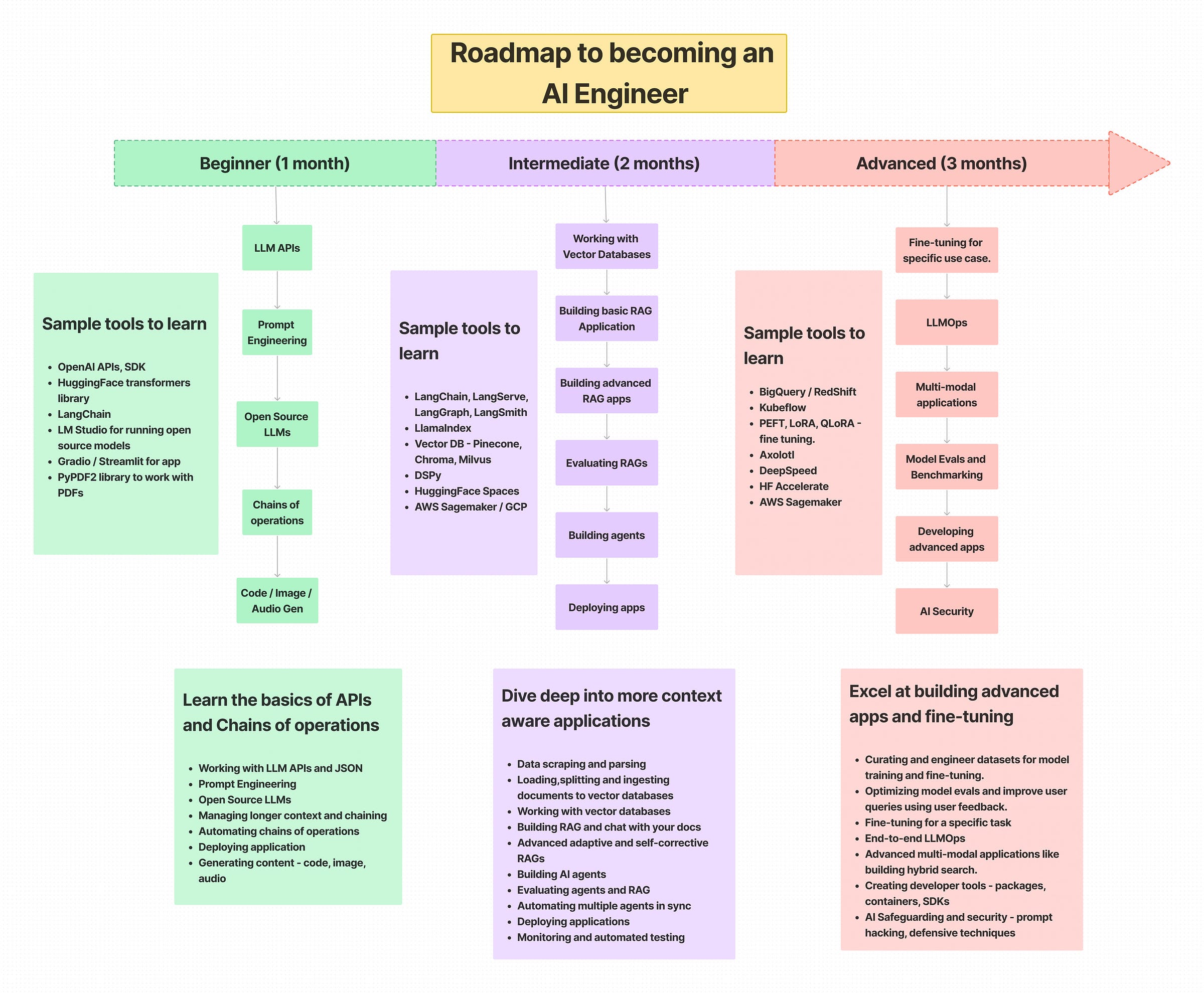
With consistent effort (4-6 hours daily), you can become job-ready in 8-12 months. A software engineer with Python experience can complete the roadmap in 6 months; someone starting from zero may need 12-18 months.
What is the most in-demand AI role in 2026?
AI Agent Engineer is the fastest-growing specialization, with roles like LLM Engineer and RAG Engineer also in high demand . AI Infrastructure & Platform Engineers are also becoming increasingly critical .
What is the career progression for an AI engineer?
Software Engineer → Junior AI Engineer → AI Engineer → Senior AI Engineer → Lead AI Engineer → AI Architect → Head of AI .
Do I need a degree to progress in AI engineering?
About 71% of employers now prioritize skills over formal degrees. Demonstrable technical capability, open-source contributions, and practical project experience are increasingly valued.
What is the entry-level AI job market like?
The junior-level market is competitive because many candidates have completed online courses but lack production experience. However, entry-level roles increasingly require higher-order skills like judgment and strategic thinking .
What is the future of AI engineering roles?
"AI engineer" is already splitting into multiple specializations: LLM engineer, RAG engineer, AI agent engineer, LLMOps engineer, AI automation engineer, and AI safety engineer, among others .
Build Your AI Engineering Career with Coding Now – Gurukul of AI
The AI engineering career path in 2026 is clear: start with a strong foundation, build specialization, and progress through increasing levels of responsibility and strategic thinking. At Coding Now – Gurukul of AI, we offer industry-oriented programs designed to take you from beginner to job-ready AI professional.
Our curriculum covers the exact skills that will help you progress through the career levels from Python and ML fundamentals to advanced topics like RAG, AI agents, and production deployment. You will build practical, real-world projects and receive comprehensive career support.
With the AI job market growing rapidly and 71% of employers prioritizing skills over degrees, there has never been a better time to invest in your AI career.