The Big Question
Here's a question that trips up even experienced business leaders: What's the actual difference between a website and a web app—and why does it matter which one you build?
On the surface, they look similar. Both live in browsers. Both have URLs. Both involve design and code. Most people use the terms interchangeably without thinking twice.
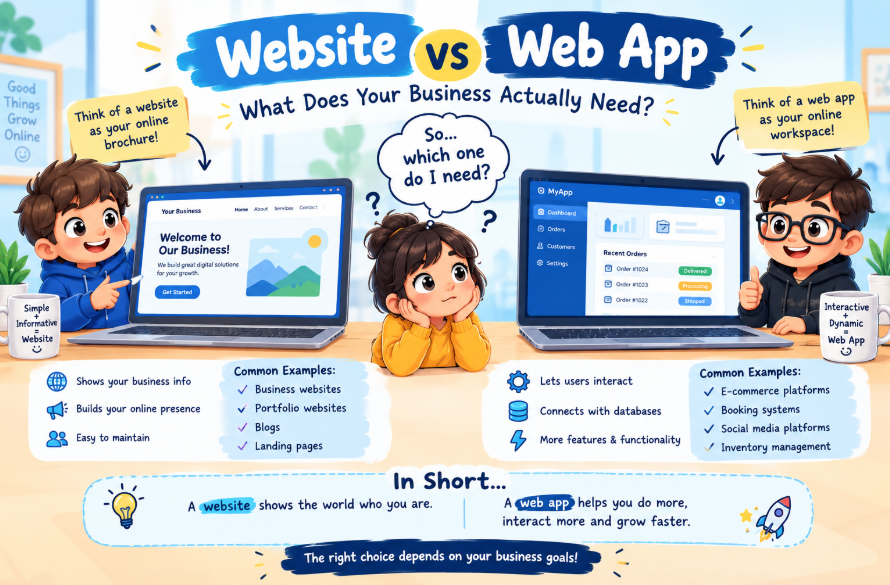
But the distinction matters enormously. A website is primarily about information—presenting content to visitors. A web app is primarily about interaction—enabling users to accomplish tasks. A restaurant's menu page is a website. A banking portal where you transfer money is a web app. The technology, the cost, the team, and the timeline are all different.
Choosing wrong has real consequences. Build a website when you needed a web app, and you'll quickly hit limitations that require expensive rebuilding. Build a web app when a website would suffice, and you'll overspend on complexity you don't need.
So the real question isn't which one is better. It's which one your business actually needs—and how to tell the difference before you invest.
At CodingNowAI, we've spent five years building both websites and web applications. Here's what we've learned about helping businesses make the right choice.
Website vs Web App: The Real Difference
Let's start with clear definitions, then explore why the distinction matters.
What Is a Website?
A website is a collection of pages designed to present information to visitors. The primary purpose is communication—sharing content, describing services, showcasing products, establishing credibility. Users consume what's there; they don't typically create, modify, or manipulate data.
Websites typically include:
-
Homepage and landing pages: Presenting your business, services, or offerings
-
About and contact pages: Building trust and enabling communication
-
Blog or content sections: Sharing information, establishing authority
-
Portfolio or gallery pages: Showcasing work
-
Basic forms: Contact forms, newsletter signups
The defining characteristic of a website is that it's primarily one-directional. You publish, visitors read. Interaction is limited to navigation and simple form submissions.
What Is a Web App?
A web app is software that runs in a browser and enables users to accomplish tasks. The primary purpose is functionality—letting users create accounts, manage data, complete transactions, collaborate, or perform complex operations. Users don't just consume; they interact, manipulate, and generate.
Web apps typically include:
-
User authentication: Accounts, logins, profiles, permissions
-
Data management: Creating, reading, updating, deleting records
-
Business logic: Rules, workflows, calculations, processing
-
Real-time features: Notifications, live updates, collaboration
-
Integration: Connecting with external systems, APIs, payment processors
-
Dashboards and reporting: Visualizing data, tracking metrics
The defining characteristic of a web app is that it's interactive and stateful. Users log in, do things, and expect the system to remember and respond.
Why the Line Sometimes Blurs
Modern websites increasingly include app-like features. A marketing site might have a customer portal. An e-commerce store might have user accounts, order tracking, and personalized recommendations. Meanwhile, some web apps have marketing pages that function like websites.
This doesn't mean the distinction is meaningless. It means many businesses need both—a website for information and a web app for functionality—often under the same domain.
Why Choosing Right Matters
The cost difference between a website and a web app is significant—often 5-10x. The team composition is different. The timeline is different. The ongoing maintenance requirements are different.
Choosing wrong means either:
-
Underbuilding: Starting with a website when you needed a web app, then facing expensive rebuilding when you hit limitations
-
Overbuilding: Investing in a web app when a website would have achieved your goals at a fraction of the cost
The right choice depends entirely on what your business actually needs to accomplish.
Cost Based on Website Type
Here's what different levels of investment typically look like across websites and web apps.
Basic Informational Website ($2,000 - $8,000): Simple sites with static content—homepage, about, services, contact. Maybe a blog. Built with templates or simple custom design. Minimal ongoing maintenance.
Business Website with CMS ($8,000 - $25,000): More complex sites with content management, multiple pages, SEO optimization, and basic integrations. Marketing teams can update content without developer involvement.
E-commerce Website ($15,000 - $80,000): Online stores with product catalogs, shopping carts, payment processing, and order management. This sits between a website and a web app—it has significant functionality but focused on transactions.
Basic Web App ($25,000 - $80,000): Applications with user accounts, data management, and core functionality. Think simple dashboards, booking systems, or internal tools. Custom development with ongoing maintenance needs.
Complex Web App ($80,000 - $300,000+): Full-featured applications with multiple user roles, complex workflows, integrations, real-time features, and significant scale requirements. These require dedicated teams and ongoing development.
Enterprise Web Application ($300,000 - $1,500,000+): Large-scale systems with complex requirements, high security needs, integration with enterprise systems, and multi-team development. These are major investments with correspondingly major returns.
The honest truth: most businesses should start smaller than they think. A focused website or simple web app that solves one real problem often delivers more value than a sprawling platform that never ships.
Breakdown by Developer Type (2020 - 2026 Rates)
The cost of hiring developers for websites and web apps has shifted significantly over the past six years.
2020-2022: The Specialization Era
During this period, website development and app development were distinct career paths. Website developers focused on WordPress, Wix, and similar platforms. App developers focused on React, Node, and custom code. Rates for app developers were significantly higher due to complexity and scarcity.
2023-2024: The Framework Convergence
Modern frameworks like Next.js blurred the line. Developers could build both marketing sites and functional apps with the same tools. This made full-stack skills more valuable and reduced the need for separate specialists. Rates for developers who could do both commanded a premium.
2025-2026: The Efficiency Era
Today, AI tools handle much of the boilerplate for both websites and web apps. The premium has shifted to developers who understand architecture, performance, and business requirements—not just those who can write code.
Current rates reflect this:
-
US-based website developers: $75+ per hour
-
US-based web app developers: $95+ per hour
-
US-based full-stack developers: $100+ per hour
-
Canada-based: $50-60 per hour
-
India-based: $30-40 per hour
-
Pakistan-based: $25-30 per hour (for comparison)
For a mid-complexity website, a US team might quote $20,000-$40,000. For a mid-complexity web app, $80,000-$150,000. An India-based team with equivalent skills quotes 60-65% less for the same scope.
At CodingNowAI, we've built our delivery model around this reality—combining India-based talent with global standards.
Why Prices Changed in 2026
Several forces converged to reshape development pricing this year.
AI Wrote the Easy Code
AI tools now handle boilerplate—basic layouts, simple components, standard CRUD operations. This has devalued developers who only knew how to write basic code. But AI struggles with the hard parts—complex state management, system architecture, performance optimization. The premium for human expertise has increased even as general coding has been commoditized.
The No-Code/Low-Code Shift
Platforms like Webflow, Bubble, and Retool have made it possible to build websites and simple apps without traditional development. This has reduced costs for basic projects while raising expectations for custom work.
The Talent Cost Correction
In 2020, development talent commanded a massive premium because it was scarce. In 2026, India alone produces 1.5 million engineers annually. The supply-demand imbalance that kept rates artificially high has corrected.
The Production Gap
The market has split between developers who can build demos and those who can ship production systems. The latter command premium rates because production experience is genuinely scarce—and genuinely valuable.
Pro Tips to Save Money in 2026
1. Start with Your Actual Need, Not Your Ambition
The biggest money-waster is building more than you need. Start with the simplest solution that addresses your core requirement. You can always add complexity later—it's much harder to remove it.
2. Consider No-Code/Low-Code First
For simple websites and basic apps, platforms like Webflow, Bubble, or Glide can deliver results at a fraction of custom development costs. Custom development makes sense when your needs are genuinely differentiated.
3. Build for Your Next Stage, Not Your Last
Don't over-engineer for scale you don't have. But don't under-build for growth you're actively pursuing. The sweet spot is something that handles your next 12-18 months comfortably.
4. Leverage Global Talent Strategically
An India-based team can deliver equivalent quality at 60-65% less cost than US-based teams. For complex, novel problems, specialists may justify their premium. For standard implementations, global talent is the smarter economic choice.
5. Invest in Planning Before Development
A clear scope prevents expensive iterations. Spend time understanding requirements before writing code. An hour of planning saves days of rework.
6. Plan for Maintenance from Day One
Websites and apps need ongoing care. Security updates, content changes, feature additions, performance improvements. Budget 15-30% of initial development cost annually for this.
For more practical tips on building cost-effective solutions, check out the resources at CodingNowAI.
Questions to Ask Before Hiring
Before you commit budget to a development partner, ask these questions.
"Based on what I've described, do I need a website or a web app?"
This is the most important question. A good partner will ask clarifying questions about your goals, users, and functionality before recommending an approach. If they jump straight to a solution without understanding your needs, be cautious.
"Show me a live project you've shipped, not a demo."
Demos are easy. Production systems that handle real users, real data, and real edge cases are hard. If they can't show you something running, they haven't shipped.
"What happens when something breaks?"
Every system fails sometimes. The question is: how do you detect it, diagnose it, and fix it? Good answers include monitoring, support processes, and incident response.
"Who actually writes the code?"
Many agencies subcontract development. You're paying agency rates for junior contractors. Ask directly who will be working on your project.
"What's NOT included in this quote?"
The honest vendors answer this fast. Content creation? Testing? Deployment? Ongoing support? Get the complete picture before signing.
"How will we measure success?"
Before any work begins, you should agree on specific metrics. Traffic? Conversions? User engagement? Revenue impact? Vague goals lead to vague outcomes.
Why Delhi is a Great Hub for AI Development
When OpenAI chose Delhi for its first India office in late 2025, it validated what many in the industry already knew: Delhi NCR has become a genuine center of tech gravity.
The reasons are both structural and specific:
Talent Density: Delhi NCR—encompassing Delhi, Gurugram, and Noida—hosts over 8,000 active startups. The region benefits from premier engineering institutions (IIT Delhi, IIIT Delhi) that feed a continuous pipeline of technical talent. With India producing 1.5 million engineers annually, the raw material for development is abundant.
Cost Advantage Without Quality Compromise: Building a development team in India costs approximately 10x less than in the US. For website and web app development specifically, an India-based team delivers comparable quality at 60-65% lower cost. The historical quality gap has narrowed dramatically.
Infrastructure Maturation: The infrastructure gap that once made India challenging has largely closed. Cloud services, high-speed connectivity, and modern development tooling are all accessible.
Policy Positioning: Delhi is India's policy center. For companies navigating regulatory landscapes and data localization requirements, proximity to the capital is strategic.
The Global Ambition Shift: Indian founders are increasingly building for global markets from day one, not just for India. This shift in mindset—combined with cost advantages and technical depth—makes Delhi an increasingly compelling base for development teams serving international clients.
CodingNowAI is proud to be part of this ecosystem, building world-class websites and web applications from the heart of Delhi NCR.
What We Offer
At CodingNowAI, we've spent five years building websites and web apps that actually ship. Not demos. Not prototypes. Solutions that serve real users and real business needs.
Our Development Services Include:
-
Website Development: Modern, responsive, SEO-optimized websites that establish credibility and communicate effectively.
-
Web App Development: Custom applications with user accounts, data management, and the functionality your business needs to operate.
-
E-commerce Solutions: Online stores with product catalogs, payment processing, and order management.
-
CMS Implementation: Content management systems that let your team update content without developer involvement.
-
API Development and Integration: Connecting your systems with external services and platforms.
-
Ongoing Support: Maintenance, updates, and improvements as your needs evolve.
We build on the foundation of five years of production experience. We've seen what works and what doesn't. We know that the simplest solution that ships beats the most elegant solution that doesn't. That business value, not technical sophistication, is the only metric that matters.
Our team combines India-based engineering excellence with global delivery standards. We offer the cost advantages of Delhi NCR without the quality compromises that once defined offshore development. Learn more about our work at CodingNowAI.
Frequently Asked Questions
What's the difference between a website and a web app?
A website primarily presents information—visitors read and navigate. A web app primarily enables interaction—users log in, perform tasks, and manipulate data. A restaurant menu page is a website. A banking portal is a web app.
Which one does my business need?
It depends on your goals. If you need to present information, establish credibility, or share content, a website may suffice. If you need users to accomplish tasks, manage data, or interact with systems, you need a web app. Many businesses need both.
Can a website become a web app?
Yes, but it's often more expensive than building it right the first time. Adding functionality to a site built for information presentation often requires significant restructuring. Planning ahead saves money.
How long does it take to build a website?
For a simple informational website: 2-4 weeks. For a complex business website with CMS and integrations: 6-12 weeks. Timeline depends primarily on scope and content readiness.
How long does it take to build a web app?
For a basic web app: 2-4 months. For a complex web app with multiple features: 6-12+ months. Timeline depends primarily on complexity and integration requirements.
How much does a website cost?
Simple websites range from $2,000-$8,000. Business websites with CMS range from $8,000-$25,000. E-commerce sites range from $15,000-$80,000. Costs depend on complexity, design requirements, and integrations.
How much does a web app cost?
Basic web apps range from $25,000-$80,000. Complex web apps range from $80,000-$300,000+. Enterprise applications can exceed $500,000. Costs depend on functionality, scale, and ongoing needs.
Do I need separate developers for websites and web apps?
Not necessarily. Full-stack developers can handle both. For complex projects, specialists often deliver better results. For simpler projects, full-stack developers are often more cost-effective.
Will this integrate with our existing systems?
Yes. We build APIs and connectors that integrate with existing systems—CRM, ERP, payment processors, and custom applications. Integration is often a significant part of development work.
What happens after launch?
Websites and apps need ongoing care. We offer support including content updates, security patches, performance improvements, and feature additions. Budget 15-30% of initial development cost annually for this.
How do you handle security?
Security is built into everything we do—from architecture design to deployment practices. We follow industry best practices and can help you meet specific compliance requirements.
What makes your approach different from other development vendors?
We've been building production systems for five years. We've seen the failures—the over-engineered solutions that never ship, the projects that deliver technical elegance but no business value. We build differently because we've learned what doesn't work. We start with business outcomes, use the simplest tools that solve the problem, and measure success in your metrics, not ours.
Frequently Asked Questions
What industries do you work with?
We've built websites and web apps across e-commerce, SaaS, financial services, healthcare, and professional services. The common thread isn't industry—it's a need for reliable, effective digital solutions.
Do you offer pilot projects?
Yes. For new clients, we often start with a scoped pilot focused on a specific feature or module. This proves value before larger commitments. Pilots typically run 4-6 weeks and cost $5,000-$15,000 depending on scope.
How is pricing structured?
We offer fixed-price proposals for well-defined projects and time-and-materials for exploratory work. Most projects fall into the $10,000-$100,000 range depending on complexity, integration requirements, and ongoing support needs.
What if we already have a website or app?
We can augment existing systems rather than replacing them. Many clients have partial implementations that need completion, optimization, or extension. Building on what you have is often more efficient than starting over.
Can you help us figure out what we need?
Yes. We offer discovery engagements where we analyze your requirements, recommend the right approach, and provide a prioritized roadmap. This typically takes 1-2 weeks.
Where can I learn more about your work?
Visit us at CodingNowAI to explore our portfolio, read case studies, and get in touch. We're always happy to talk about what the right solution looks like for your business.
Build What You Actually Need
The worst outcome isn't building the wrong thing—it's building it twice. Starting with a website when you needed a web app, or a web app when a website would have sufficed, costs time, money, and momentum.
The businesses that succeed digitally are the ones that understand what they actually need before they invest. They don't chase trends. They don't overbuild. They build the right thing, at the right time, for the right reasons.
The question is simple: Do you know what your business actually needs?
Let's figure it out together.