The Big Question
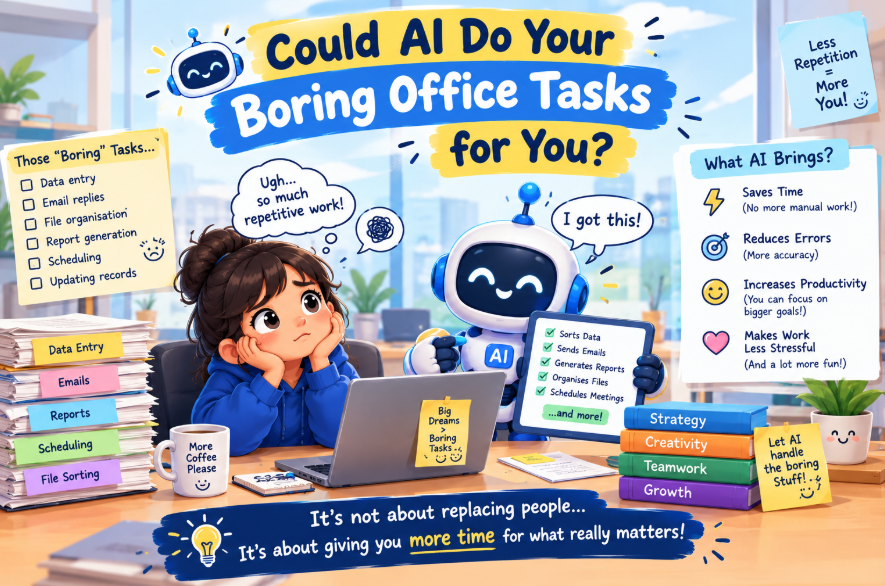
Here's a question that keeps forward-thinking leaders up at night: If AI can handle the boring work, why are so many teams still drowning in it?
It's a paradox of the modern workplace. The technology exists. AI tools can draft emails, summarize documents, schedule meetings, analyze data, answer customer questions, and automate workflows. These capabilities aren't experimental—they're production-ready and increasingly affordable.
Yet walk into most offices in 2026, and you'll still find talented people spending their days on work that adds little value. Copying data between systems. Manually sorting through emails. Compiling reports that nobody reads. Scheduling meetings that could have been messages. The boring tasks that consume hours and drain energy.
The gap isn't technology. It's adoption. It's knowing what's possible, where to start, and how to integrate AI into workflows without disrupting everything. It's understanding that AI isn't about replacing people—it's about removing the friction that keeps people from doing their best work.
So the real question isn't whether AI can transform your office. It's whether you're ready to let it.
At CodingNowAI, we've spent five years helping businesses integrate AI into their operations. Here's what we've learned about turning boring tasks into smart work.
What AI Actually Does in Modern Offices
Let's move past the buzzwords and talk about what AI actually does in offices today.
Automating Repetitive Tasks
The most immediate impact of AI is eliminating repetitive work. Data entry, document processing, email sorting, calendar management, report generation—tasks that once consumed hours can now be automated or dramatically accelerated.
AI-powered tools can read documents, extract information, and populate systems automatically. They can categorize emails, draft responses, and flag what needs attention. They can schedule meetings across time zones, resolve conflicts, and send reminders. The cumulative time savings across an organization are enormous.
Enhancing Communication
AI is changing how teams communicate. Meeting transcription and summarization tools capture what was discussed and what was decided, eliminating the need for manual note-taking. Translation tools break down language barriers. Writing assistants help craft clearer, more effective messages.
The result isn't just faster communication—it's better communication. Fewer misunderstandings. Clearer action items. Less time spent reconstructing what was said.
Supporting Decision-Making
AI excels at finding patterns in data that humans miss. It can analyze sales trends, identify at-risk customers, forecast demand, and surface insights that inform better decisions. Instead of waiting for monthly reports, leaders can access real-time intelligence.
This doesn't mean AI makes decisions. It means humans make better decisions because they have better information, faster.
Personalizing Customer Interactions
AI enables personalization at scale. Customer service chatbots handle routine inquiries instantly. Recommendation engines suggest relevant products or content. Email systems deliver personalized messages based on behavior and preferences.
The result is a customer experience that feels tailored, not mass-produced—without requiring humans to manually personalize every interaction.
Freeing Humans for Higher-Value Work
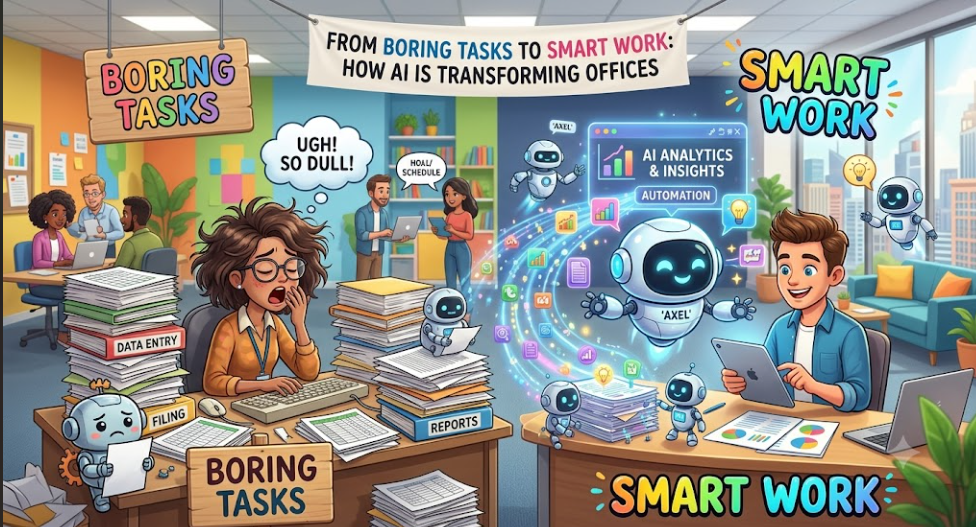
The ultimate benefit of AI in the office isn't automation—it's liberation. When boring tasks are handled by machines, humans can focus on work that requires creativity, judgment, empathy, and relationship-building. The work that actually matters.
This is the shift from boring tasks to smart work. Not replacing people, but removing the friction that keeps people from contributing their best.
Cost Based on Website Type
If you're looking to bring AI capabilities into your business, here's what different levels of investment typically look like.
Basic Informational Website ($1,500 - $5,000): Simple AI features like chatbots, contact form automation, or basic analytics. These are typically built on existing APIs with minimal custom development.
E-commerce Website ($10,000 - $60,000): Product recommendations, intelligent search, customer service automation, and demand forecasting. These require integration with existing systems and some custom work.
SaaS Platform ($40,000 - $200,000+): AI features embedded in the product experience—predictive analytics, intelligent automation, natural language interfaces. These require significant engineering and ongoing iteration.
Enterprise Application ($250,000 - $1,500,000+): Full-scale AI systems with custom models, complex integrations, and production reliability requirements. These are multi-team efforts with ongoing operational needs.
The honest truth: most businesses should start smaller than they think. A focused AI implementation that solves one real problem often delivers more value than a sprawling initiative that never ships.
Breakdown by Developer Type (2020 - 2026 Rates)
The cost of hiring AI talent has shifted dramatically over the past six years.
2020-2022: The Specialist Premium
During this period, AI skills were scarce and expensive. Machine learning engineers commanded $150,000-$200,000 annually in the US. Projects took months because everything had to be built from scratch.
2023-2024: The Framework Revolution
Libraries and platforms matured. Cloud AI services made capabilities accessible without deep ML expertise. The cost of building standard AI features dropped by 40%. More importantly, the required skill set broadened—full-stack developers could integrate AI capabilities.
2025-2026: The System Era
Today, the market has matured. AI development looks more like software engineering than research. What commands premium rates is system design, integration expertise, and production experience.
Current rates reflect this:
-
US-based AI engineers: $90+ per hour
-
Canada-based: $50 per hour
-
India-based: $35 per hour
-
Pakistan-based: $25-30 per hour (for comparison)
For a mid-complexity AI project (workflow automation + chatbot + integration), a US team might quote $80,000-$150,000. An India-based team with equivalent skills quotes $25,000-$50,000 for the same scope.
At CodingNowAI, we've built our delivery model around this reality—combining India-based talent with global standards.
Why Prices Changed in 2026
Several forces converged to reshape AI development pricing this year.
The Token Economics Paradox
Per-token prices for large language models collapsed by 98% between 2022 and 2026. Yet enterprise AI bills tripled. The reason: agentic systems consume vastly more tokens per task. A simple prompt in 2023 might have used 1,000 tokens. An orchestrated workflow in 2026 uses 30,000+ for the same outcome.
For most office AI applications, model inference cost is negligible. The real cost is in data preparation, system design, integration, and ongoing maintenance.
Open-Weight Model Commoditization
Open-weight models now account for approximately 61% of top-model token traffic. The average cost of open-weight models sits at $0.83 per million tokens versus $6.03 for proprietary alternatives. For businesses willing to self-host or use managed open-source solutions, the cost of intelligence has never been lower.
The Talent Cost Correction
In 2020, AI talent commanded a massive premium because it was scarce. In 2026, India alone produces 1.5 million engineers annually, and a growing percentage have AI expertise. The supply-demand imbalance that kept rates artificially high has corrected.
The Production Gap
The market has split between developers who can build demos and those who can ship production systems. The latter command premium rates because production experience is genuinely scarce—and genuinely valuable.
Pro Tips to Save Money in 2026
1. Start with a Pilot, Not a Platform
The biggest money-waster in AI is building infrastructure before proving value. Start with a single, high-impact use case. Build the simplest possible solution that delivers results. Prove ROI. Then expand.
2. Automate One Workflow at a Time
Don't try to transform everything at once. Pick one repetitive workflow—email triage, document processing, report generation—and automate it completely. Success breeds confidence and funding for the next project.
3. Use Open-Weight Models for Standard Tasks
Unless your use case requires frontier-level reasoning (most don't), open-weight models like Llama, Mistral, or DeepSeek deliver excellent results at a fraction of the cost.
4. Invest in Integration, Not Just Intelligence
The value of AI comes from integration with your existing systems. A chatbot that can't access your knowledge base is useless. A workflow automation that doesn't connect to your CRM creates more work, not less.
5. Leverage Global Talent Strategically
An India-based team can deliver equivalent quality for standard AI development at 60-65% less cost than US-based teams. For complex, novel problems, specialists may justify their premium. For standard implementations, global talent is the smarter economic choice.
6. Plan for Maintenance from Day One
AI systems need monitoring and maintenance. Models update. Data shifts. Budget 20-30% of initial development cost annually for monitoring, retraining, and adjustment.
For more practical tips on building cost-effective AI systems, check out the resources at CodingNowAI.
Questions to Ask Before Hiring
Before you commit budget to an AI development partner, ask these questions.
"Show me a live AI system you've shipped, not a demo."
Demos are easy. Production systems that handle real data, real edge cases, and real failure modes are hard. If they can't show you something running, they haven't shipped.
"How do you handle integration with existing systems?"
The value of AI comes from connecting to your workflows and data. Good answers include specific approaches to APIs, data pipelines, and system integration. Vague answers reveal inexperience.
"What happens when the AI is wrong?"
Every AI system is wrong sometimes. The question is: does it have guardrails? Does it flag low-confidence outputs? Is there a human review process? Vendors who haven't thought about failure modes have never shipped production AI.
"Who actually writes the code?"
Many agencies subcontract development. You're paying agency rates for junior contractors. Ask directly who will be working on your project.
"What's NOT included in this quote?"
The honest vendors answer this fast. Data preparation? Ongoing support? Model updates? Integration with your existing systems? Get the complete picture before signing.
"How will we measure success?"
Before any code is written, you should agree on specific metrics. Time saved? Cost reduction? Revenue impact? Employee satisfaction? Vague goals lead to vague outcomes.
Why Delhi is a Great Hub for AI Development
When OpenAI chose Delhi for its first India office in late 2025, it validated what many in the industry already knew: Delhi NCR has become a genuine center of AI gravity.
The reasons are both structural and specific:
Talent Density: Delhi NCR—encompassing Delhi, Gurugram, and Noida—hosts over 8,000 active startups. The region benefits from premier engineering institutions (IIT Delhi, IIIT Delhi) that feed a continuous pipeline of technical talent. With India producing 1.5 million engineers annually, the raw material for AI development is abundant.
Cost Advantage Without Quality Compromise: Building an AI team in India costs approximately 10x less than in the US. For AI development specifically, an India-based team delivers comparable quality at 60-65% lower cost. The historical quality gap has narrowed dramatically.
Infrastructure Maturation: The infrastructure gap that once made India challenging has largely closed. Cloud services, high-speed connectivity, and specialized AI compute are all accessible.
Policy Positioning: Delhi is India's policy center. For AI companies navigating regulatory landscapes and data localization requirements, proximity to the capital is strategic.
The Global Ambition Shift: Indian founders are increasingly building for global markets from day one, not just for India. This shift in mindset—combined with cost advantages and technical depth—makes Delhi an increasingly compelling base for AI companies serving international clients.
CodingNowAI is proud to be part of this ecosystem, building world-class AI solutions from the heart of Delhi NCR.
What We Offer
At CodingNowAI, we've spent five years building AI solutions that actually ship. Not proofs of concept. Not demos that impress in meetings but fail in production. Solutions that transform how offices work.
Our AI Office Solutions Include:
-
Workflow Automation: Automating repetitive tasks—data entry, document processing, email triage, report generation.
-
Intelligent Assistants: AI-powered tools that help employees find information, draft content, and complete tasks faster.
-
Customer Service Automation: Chatbots and virtual assistants that handle routine inquiries instantly.
-
Meeting Intelligence: Transcription, summarization, and action item extraction.
-
Document Processing: Reading, extracting, and organizing information from documents automatically.
-
Integration Services: Connecting AI capabilities to your existing systems and workflows.
We build on the foundation of five years of production AI experience. We've seen what works and what doesn't. We know that clean data beats complex models. That a simple solution that ships beats an elegant solution that doesn't. That business value, not technical sophistication, is the only metric that matters.
Our team combines India-based engineering excellence with global delivery standards. We offer the cost advantages of Delhi NCR without the quality compromises that once defined offshore development. Learn more about our work at CodingNowAI.
Frequently Asked Questions
How long does it take to implement AI in an office?
For a focused, single-use-case implementation: 4-8 weeks from planning to production. For multi-system integrations with complex requirements: 3-6 months. The timeline depends primarily on data readiness and integration complexity.
Do I need technical staff to use AI in my office?
No. We build systems that generate useful outputs your team can act on without understanding the underlying technology. The output is productivity, not complexity.
What tasks are best suited for AI automation?
Repetitive, rule-based tasks are ideal: data entry, document processing, email sorting, report generation, scheduling, and routine customer inquiries. If a task is done the same way every time, AI can probably help.
Will AI replace my employees?
No. AI replaces tasks, not people. The goal is to free your team from boring work so they can focus on higher-value activities that require creativity, judgment, and relationship-building.
How accurate are AI systems?
Accuracy varies by use case and implementation quality. Well-built systems can achieve 90%+ accuracy on routine tasks. The honest answer: accuracy depends on how well the system is designed and evaluated. We'll give you realistic expectations before you commit.
Will this integrate with our existing systems?
Yes. We build APIs and connectors that bring AI capabilities into your existing workflows—email, CRM, ERP, document management, or custom applications.
What happens after the system is deployed?
AI systems need monitoring and maintenance. We offer ongoing support including performance monitoring, model updates, and system improvements as your needs evolve. Budget 20-30% of initial development cost annually for this.
Can you work with our existing IT team?
Absolutely. We often collaborate with internal teams, providing specialized AI expertise while they own business integration and ongoing operations. This hybrid approach is often the most cost-effective.
How do you handle data privacy and security?
We implement industry-standard encryption, access controls, and data handling procedures. For India-based clients, we ensure compliance with applicable data protection regulations. For international clients, we adhere to GDPR, CCPA, and other relevant frameworks as required.
What makes your approach different from other AI vendors?
We've been building production AI systems for five years. We've seen the failures—the over-engineered solutions that never ship, the systems that impress in demos but fail on real data, the projects that deliver technical elegance but no business value. We build differently because we've learned what doesn't work. We start with business outcomes, use the simplest tools that solve the problem, and measure success in your metrics, not ours.
Frequently Asked Questions
What industries do you work with?
We've built AI solutions across e-commerce, SaaS, financial services, healthcare, and professional services. The common thread isn't industry—it's a need to automate repetitive work and free teams for higher-value tasks.
Do you offer pilot projects?
Yes. For new clients, we often start with a scoped pilot focused on one specific workflow. This proves value before larger commitments. Pilots typically run 4-6 weeks and cost $5,000-$15,000 depending on scope.
How is pricing structured?
We offer fixed-price proposals for well-defined projects and time-and-materials for exploratory work. Most AI implementation projects fall into the $15,000-$60,000 range depending on complexity, integration requirements, and ongoing support needs.
What if we already have some AI in place?
We can augment existing systems rather than replacing them. Many clients have basic AI features but lack robust integration, evaluation, or orchestration. Improving what you have is often more efficient than starting over.
Can you help us figure out where to start?
Yes. We offer discovery engagements where we analyze your workflows, identify high-impact automation opportunities, and recommend a prioritized roadmap. This typically takes 2-3 weeks.
Where can I learn more about your work?
Visit us at CodingNowAI to explore our portfolio, read case studies, and get in touch. We're always happy to talk about what AI can do for your office.
Stop Doing Boring Work. Start Doing Smart Work.
The modern office doesn't have to be a place where talented people spend their days on tasks a machine could handle. It doesn't have to be a place where energy is drained by repetition instead of invested in creativity. It doesn't have to be a place where "busy" is confused with "productive."
AI changes this. Not by replacing people, but by removing the friction that keeps people from doing their best work. Not by eliminating jobs, but by eliminating the boring parts of jobs. Not by making offices more robotic, but by making them more human.
The businesses that thrive in 2026 and beyond aren't the ones with the most people. They're the ones where people focus on what matters, supported by AI that handles the rest.
The question is simple: Are you ready to stop doing boring work and start doing smart work?
Let's make it happen.