The Big Question
Here's a question that confuses even people working in tech: What's the actual difference between frontend and backend, and does it really matter which one you focus on?
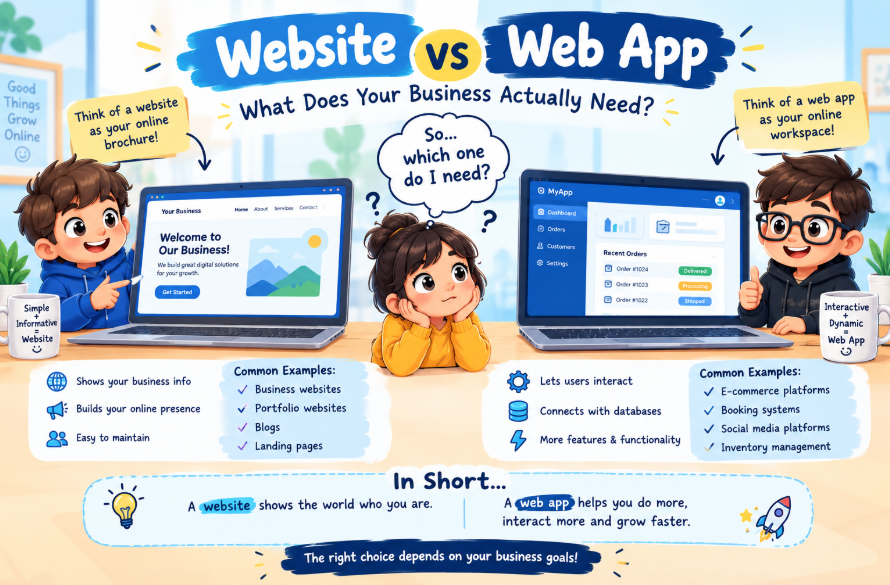
On the surface, the answer seems obvious. Frontend is what users see—buttons, layouts, colors, animations. Backend is what users don't see—servers, databases, business logic. Simple, right?
But it's not that simple. The line between frontend and backend has blurred dramatically over the past decade. Modern frontend frameworks handle routing, state management, and even data fetching. Backend services generate HTML and manage user sessions. Where does one end and the other begin?
More importantly, why does this distinction matter for your business? Whether you're hiring developers, building a product, or trying to understand your own tech stack, knowing the difference—and knowing why both matter—is essential.
The truth is, great products require excellence on both sides. A beautiful frontend with a broken backend is useless. A robust backend with a terrible frontend goes unused. The magic happens when both work together seamlessly.
So let's break it down properly. No jargon. No assumptions. Just a clear explanation of what frontend and backend actually are, why both matter, and what it costs to build them right.
At CodingNowAI, we've spent five years building both sides of the stack. Here's what we've learned.
Frontend vs Backend: The Real Difference
Let's start with clear definitions, then explore why the distinction matters.
What Is Frontend?
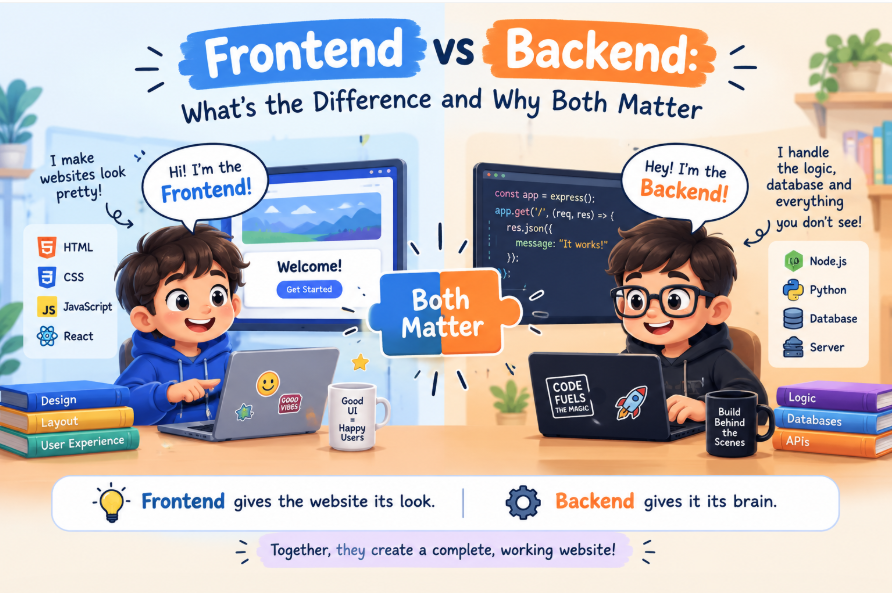
The frontend is everything users see and interact with directly. It's the visual layer—the buttons you click, the forms you fill, the images you scroll past, the animations that make an app feel responsive. When you open a website and it looks good, that's frontend work.
Frontend development involves:
-
HTML: The structure of content
-
CSS: The styling and layout
-
JavaScript: The interactivity and dynamic behavior
-
Frameworks: React, Vue, Angular, Svelte—tools that make building complex interfaces easier
-
Design systems: Consistent components, colors, and patterns
-
Accessibility: Making sure everyone can use what you build
-
Performance: Making pages load fast and feel smooth
Good frontend developers think about user experience. They care about how things feel, not just how they look. They understand that a button in the wrong place, a slow load time, or a confusing flow can lose a customer instantly.
What Is Backend?
The backend is everything that happens behind the scenes. It's the logic, the data, the infrastructure—the parts users never see but absolutely depend on. When you log in, place an order, or send a message, the backend is doing the work.
Backend development involves:
-
Server-side languages: Node.js, Python, Ruby, Java, Go, PHP
-
Databases: PostgreSQL, MySQL, MongoDB, Redis
-
APIs: REST, GraphQL—the interfaces that connect frontend to backend
-
Authentication: Managing users, sessions, and permissions
-
Business logic: The rules that govern how your application behaves
-
Infrastructure: Servers, cloud services, deployment, scaling
-
Security: Protecting data, preventing attacks, ensuring compliance
Good backend developers think about reliability, scalability, and correctness. They care about what happens when things go wrong. They understand that a single bug in the backend can affect every user simultaneously.
Why the Line Is Blurring
Modern development has complicated this clean separation. Frameworks like Next.js and Nuxt blur the boundary—they handle both frontend rendering and backend logic. Serverless functions let frontend developers write backend code. APIs are increasingly generated automatically.
This doesn't mean the distinction is meaningless. It means developers need to understand both sides, even if they specialize in one. The best developers think in terms of systems, not layers.
Why Both Matter Equally
Here's the uncomfortable truth: businesses often undervalue one side or the other. Design-focused companies build beautiful frontends with fragile backends. Engineering-focused companies build robust backends with unusable frontends. Both fail.
Your frontend is your brand. It's what customers judge you on. A confusing interface, slow load times, or broken interactions drive people away regardless of how good your backend is.
Your backend is your foundation. It's what makes your product reliable, secure, and scalable. No amount of beautiful design compensates for data loss, security breaches, or systems that crash under load.
The best products excel at both. That's not an accident—it's a choice. It's a commitment to understanding that user experience and technical excellence aren't opposites. They're partners.
Cost Based on Website Type
If you're building a website or application, here's what different levels of investment typically look like across frontend and backend work.
Basic Informational Website ($2,000 - $8,000): Simple sites with static content. Frontend work dominates—layout, styling, basic interactivity. Backend is minimal—maybe a contact form and a simple CMS. Most developers can handle both sides.
E-commerce Website ($15,000 - $80,000): This is where both sides get complex. Frontend involves product pages, cart flows, checkout experiences, and responsive design. Backend involves inventory management, payment processing, order handling, and integration with external systems. Specialized skills on both sides matter.
SaaS Platform ($50,000 - $250,000+): Complex applications with user accounts, dashboards, real-time features, and business logic. Frontend requires sophisticated state management and component architecture. Backend requires scalable APIs, database design, and infrastructure. You typically need dedicated specialists on both sides.
Enterprise Application ($300,000 - $1,500,000+): Full-scale systems with multiple user roles, complex workflows, and integration with existing enterprise systems. Frontend and backend teams work in parallel, often with dedicated architects on each side.
The honest truth: most businesses should start smaller than they think. A focused product with excellent execution on both sides beats a sprawling platform with mediocre everything.
Breakdown by Developer Type (2020 - 2026 Rates)
The cost of hiring frontend and backend developers has shifted significantly over the past six years.
2020-2022: The Specialization Era
During this period, frontend and backend were clearly separated career paths. Frontend developers focused on React, Vue, and CSS. Backend developers focused on Node, Python, and databases. Full-stack developers existed but were often generalists—good at both, masters of neither. Rates were high because talent was scarce.
2023-2024: The Full-Stack Shift
Frameworks like Next.js and Remix made full-stack development more practical. Developers could build entire applications with a single language and framework. The demand for pure specialists declined slightly, while demand for full-stack developers increased. Rates for full-stack skills commanded a premium.
2025-2026: The System Era
Today, the market values developers who understand systems, not just layers. The best developers think about how frontend and backend interact, how data flows, and how changes in one affect the other. Specialization still matters, but context matters more.
Current rates reflect this:
-
US-based frontend developers: $85+ per hour
-
US-based backend developers: $90+ per hour
-
US-based full-stack developers: $95+ per hour
-
Canada-based: $45-55 per hour
-
India-based: $30-40 per hour
-
Pakistan-based: $25-30 per hour (for comparison)
For a mid-complexity web application, a US team might quote $100,000-$200,000. An India-based team with equivalent skills quotes $30,000-$70,000 for the same scope.
At CodingNowAI, we've built our delivery model around this reality—combining India-based talent with global standards.
Why Prices Changed in 2026
Several forces converged to reshape development pricing this year.
AI Wrote the Easy Code
AI tools now handle boilerplate—CRUD operations, simple components, standard API endpoints. This has devalued developers who only knew how to write basic code. But AI struggles with the hard parts—complex state management, system design, performance optimization. The premium for human expertise has increased even as general coding has been commoditized.
The Full-Stack Expectation
Employers increasingly expect developers to understand both frontend and backend, even if they specialize. This has raised the baseline for what "good" looks like and shifted demand toward developers with broader skills.
The Talent Cost Correction
In 2020, development talent commanded a massive premium because it was scarce. In 2026, India alone produces 1.5 million engineers annually. The supply-demand imbalance that kept rates artificially high has corrected.
The Production Gap
The market has split between developers who can build demos and those who can ship production systems. The latter command premium rates because production experience is genuinely scarce—and genuinely valuable.
Pro Tips to Save Money in 2026
1. Start with a Clear Scope
The biggest money-waster in development is vague requirements. Know what you're building before you hire. A clear scope prevents expensive iterations and scope creep.
2. Hire for Systems Thinking
Developers who understand both frontend and backend—even if they specialize—make better decisions. They anticipate how changes in one layer affect the other. They catch problems earlier. They cost more per hour but save more overall.
3. Use Modern Frameworks Strategically
Frameworks like Next.js reduce the need for separate frontend and backend developers. One skilled developer can build both sides. This isn't right for every project, but it's often the most cost-effective approach for startups and small teams.
4. Leverage Global Talent Strategically
An India-based team can deliver equivalent quality at 60-65% less cost than US-based teams. For complex, novel problems requiring frontier research, specialists may justify their premium. For standard implementations, global talent is the smarter economic choice.
5. Invest in Code Quality Early
Technical debt compounds. A few shortcuts early on become expensive problems later. Insist on code reviews, testing, and documentation from day one.
6. Plan for Maintenance from Day One
Software decays. Dependencies update. Requirements change. Budget 20-30% of initial development cost annually for maintenance, updates, and improvements.
For more practical tips on building cost-effective development teams, check out the resources at CodingNowAI.
Questions to Ask Before Hiring
Before you commit budget to a development partner, ask these questions.
"Show me a live application you've shipped, not a demo."
Demos are easy. Production systems that handle real users, real data, and real edge cases are hard. If they can't show you something running, they haven't shipped.
"How do you handle the frontend-backend boundary?"
This reveals whether they think about systems or just layers. Good answers include API design, data contracts, and how changes propagate. Vague answers reveal inexperience.
"What happens when something breaks in production?"
Every system fails sometimes. The question is: how do you detect it, diagnose it, and fix it? Good answers include monitoring, logging, and incident response. Vendors who haven't thought about failure modes have never shipped production systems.
"Who actually writes the code?"
Many agencies subcontract development. You're paying agency rates for junior contractors. Ask directly who will be working on your project, and whether you'll have direct access to them.
"What's NOT included in this quote?"
The honest vendors answer this fast. Testing? Deployment? Ongoing support? Integration with your existing systems? Get the complete picture before signing.
"How will we measure success?"
Before any code is written, you should agree on specific metrics. Performance? User engagement? Revenue impact? Vague goals lead to vague outcomes.
Why Delhi is a Great Hub for AI Development
When OpenAI chose Delhi for its first India office in late 2025, it validated what many in the industry already knew: Delhi NCR has become a genuine center of tech gravity.
The reasons are both structural and specific:
Talent Density: Delhi NCR—encompassing Delhi, Gurugram, and Noida—hosts over 8,000 active startups. The region benefits from premier engineering institutions (IIT Delhi, IIIT Delhi) that feed a continuous pipeline of technical talent. With India producing 1.5 million engineers annually, the raw material for development is abundant.
Cost Advantage Without Quality Compromise: Building a development team in India costs approximately 10x less than in the US. For frontend and backend development specifically, an India-based team delivers comparable quality at 60-65% lower cost. The historical quality gap has narrowed dramatically.
Infrastructure Maturation: The infrastructure gap that once made India challenging has largely closed. Cloud services, high-speed connectivity, and modern development tooling are all accessible.
Policy Positioning: Delhi is India's policy center. For companies navigating regulatory landscapes and data localization requirements, proximity to the capital is strategic.
The Global Ambition Shift: Indian founders are increasingly building for global markets from day one, not just for India. This shift in mindset—combined with cost advantages and technical depth—makes Delhi an increasingly compelling base for development teams serving international clients.
CodingNowAI is proud to be part of this ecosystem, building world-class frontend and backend solutions from the heart of Delhi NCR.
What We Offer
At CodingNowAI, we've spent five years building both sides of the stack—frontend and backend—that actually ship. Not demos. Not prototypes. Solutions that handle real users and real scale.
Our Development Services Include:
-
Frontend Development: Modern, responsive, accessible interfaces built with React, Vue, Next.js, and other leading frameworks.
-
Backend Development: Scalable APIs, robust databases, and secure infrastructure built with Node.js, Python, and modern cloud services.
-
Full-Stack Development: End-to-end solutions from a single team that understands how frontend and backend work together.
-
API Design and Integration: Connecting systems, services, and third-party platforms seamlessly.
-
Performance Optimization: Making applications faster, more responsive, and more efficient.
-
Ongoing Support: Maintenance, updates, and improvements as your product evolves.
We build on the foundation of five years of production experience. We've seen what works and what doesn't. We know that clean code beats clever code. That a simple solution that ships beats an elegant solution that doesn't. That business value, not technical sophistication, is the only metric that matters.
Our team combines India-based engineering excellence with global delivery standards. We offer the cost advantages of Delhi NCR without the quality compromises that once defined offshore development. Learn more about our work at CodingNowAI.
Frequently Asked Questions
What's the difference between frontend and backend?
Frontend is everything users see and interact with directly—layouts, buttons, forms, animations. Backend is everything that happens behind the scenes—servers, databases, business logic, APIs. Both are essential for any functional application.
Which is more important, frontend or backend?
Neither. A beautiful frontend with a broken backend is useless. A robust backend with a terrible frontend goes unused. Great products require excellence on both sides.
Do I need separate developers for frontend and backend?
Not necessarily. Full-stack developers can handle both. For complex projects, specialists often deliver better results. For simpler projects, full-stack developers are often more cost-effective.
How long does it take to build a web application?
For a simple application: 4-8 weeks. For a mid-complexity application: 3-6 months. For complex platforms: 6-12+ months. The timeline depends primarily on scope and complexity.
What technologies should I use?
It depends on your project. React and Next.js are popular for frontend. Node.js and Python are popular for backend. PostgreSQL and MongoDB are popular databases. The best choice depends on your specific needs, team skills, and long-term plans.
How much does it cost to build a web application?
Costs vary dramatically based on complexity. Simple applications might cost $5,000-$15,000. Mid-complexity applications range from $20,000-$80,000. Complex platforms can exceed $200,000. We provide detailed quotes after understanding your requirements.
Will this integrate with our existing systems?
Yes. We build APIs and connectors that integrate with existing systems—CRM, ERP, payment processors, and custom applications. Integration is often a significant part of development work.
What happens after the application is deployed?
Applications need monitoring and maintenance. We offer ongoing support including bug fixes, security updates, performance improvements, and feature additions. Budget 20-30% of initial development cost annually for this.
Can you work with our existing team?
Absolutely. We often collaborate with internal teams, providing specialized expertise while they own business logic and ongoing operations. This hybrid approach is often the most cost-effective.
How do you handle security?
Security is built into everything we do—from architecture design to deployment practices. We follow industry best practices and can help you meet specific compliance requirements.
What makes your approach different from other development vendors?
We've been building production systems for five years. We've seen the failures—the over-engineered solutions that never ship, the applications that impress in demos but fail under real load, the projects that deliver technical elegance but no business value. We build differently because we've learned what doesn't work. We start with business outcomes, use the simplest tools that solve the problem, and measure success in your metrics, not ours.
Frequently Asked Questions
What industries do you work with?
We've built applications across e-commerce, SaaS, financial services, healthcare, and professional services. The common thread isn't industry—it's a need for reliable, scalable, user-friendly software.
Do you offer pilot projects?
Yes. For new clients, we often start with a scoped pilot focused on a specific feature or module. This proves value before larger commitments. Pilots typically run 4-6 weeks and cost $5,000-$15,000 depending on scope.
How is pricing structured?
We offer fixed-price proposals for well-defined projects and time-and-materials for exploratory work. Most development projects fall into the $15,000-$80,000 range depending on complexity, integration requirements, and ongoing support needs.
What if we already have some development in place?
We can augment existing systems rather than replacing them. Many clients have partial implementations that need completion, optimization, or extension. Building on what you have is often more efficient than starting over.
Can you help us figure out what to build first?
Yes. We offer discovery engagements where we analyze your requirements, identify high-impact features, and recommend a prioritized roadmap. This typically takes 2-3 weeks.
Where can I learn more about your work?
Visit us at CodingNowAI to explore our portfolio, read case studies, and get in touch. We're always happy to talk about what great development can do for your business.
Both Sides Matter. Let's Build Them Right.
Frontend and backend aren't competitors. They're partners. The best products—the ones users love and businesses depend on—excel at both. They look beautiful and work reliably. They feel fast and handle scale. They delight users and protect data.
The businesses that thrive in 2026 and beyond understand this. They don't settle for excellence on one side and mediocrity on the other. They invest in both because both matter.
The question is simple: Are you building something that works beautifully on both sides?
Let's make sure you are.