The Big Question
Here's a question that keeps smart business leaders up at night: We're collecting more data than ever. So why does decision-making still feel like guesswork?
It's a paradox of the modern business era. Companies have more information at their fingertips than at any point in history. Customer behavior, operational metrics, market signals—it's all being captured somewhere. Yet many businesses still struggle to translate that data into decisions that actually improve outcomes.
The problem isn't data availability. It's the gap between raw information and actionable intelligence. That gap is where data science operates—and it's the difference between companies that thrive on data and those that merely accumulate it.
Data science isn't magic. It's not a buzzword to slap on your LinkedIn profile. It's a systematic process for extracting meaning from data and turning that meaning into decisions. When done well, it transforms how businesses operate. When done poorly, it becomes an expensive exercise in collecting dashboards nobody uses.
So the real question isn't whether you have data. It's whether you know how to turn it into results. That's what we're going to explore.
At CodingNowAI, we've spent five years helping businesses bridge this gap. Here's what we've learned.
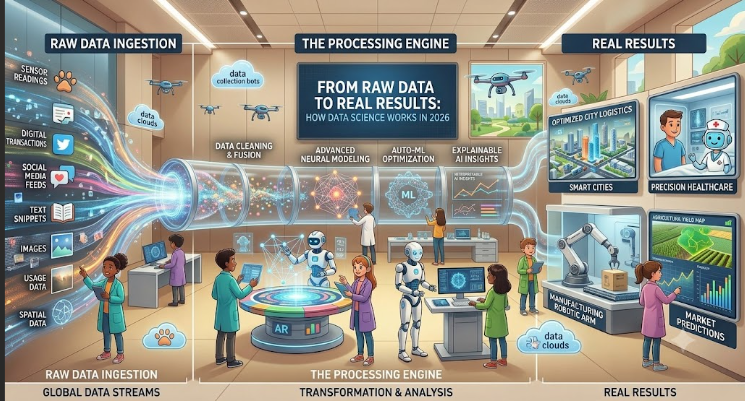
The Data Science Journey: From Raw to Real
Let's walk through how data science actually works—step by step, without the jargon.
Step 1: Problem Definition
Everything starts with a question. Not "what can we do with our data?" but "what decision are we trying to make better?" This distinction matters enormously. Data science without a clear business question is just expensive exploration.
Good problem definition means understanding what decision will change based on the analysis. Will you target different customers? Adjust pricing? Change inventory levels? Improve a process? The answer shapes everything that follows.
Step 2: Data Collection
Once you know what question you're answering, you need the right data. This often means pulling from multiple sources—transaction systems, CRM platforms, web analytics, external datasets. It's rarely as simple as "query the database."
The data you need might not exist yet. It might be trapped in silos. It might be incomplete, inconsistent, or just plain wrong. Data collection is where the real work begins.
Step 3: Data Cleaning and Preparation
Here's the dirty secret of data science: 70-80% of the work is cleaning and preparing data. Raw data is messy. It has missing values, duplicates, inconsistencies, and errors. It comes in different formats from different systems. It doesn't align neatly with the questions you're trying to answer.
This step is unglamorous but essential. A clean dataset is the foundation for everything else. Skip this step, and your analysis will be built on sand.
Step 4: Exploratory Analysis
Before building models, data scientists explore. They look for patterns, anomalies, and relationships. They visualize distributions. They test hypotheses. This phase is about understanding what the data is actually telling you—not what you hoped it would say.
Exploratory analysis often reveals surprises. A pattern you expected might not exist. A relationship you didn't anticipate might emerge. This is where genuine insights begin to surface.
Step 5: Modeling
This is what most people think of when they hear "data science"—building predictive models, training algorithms, tuning parameters. It's important, but it's only one part of the process.
The choice of model depends on the problem. Sometimes a simple regression is enough. Sometimes you need something more sophisticated. The goal isn't to use the fanciest algorithm—it's to answer the question reliably.
Step 6: Evaluation
How do you know if your model is any good? This is harder than it sounds. You need to test it on data it hasn't seen. You need metrics that reflect business value, not just statistical accuracy. You need to understand where it fails and how badly.
Evaluation isn't a one-time step. It's ongoing. Models drift as conditions change. What worked last quarter might not work next quarter.
Step 7: Deployment and Integration
A model that lives in a notebook is useless. Data science delivers value when models are deployed into production—when predictions flow into systems that people actually use. This means APIs, dashboards, alerts, integrations.
Deployment is often the hardest part. It requires engineering skills, not just analytical ones. It requires understanding how the model will be used, by whom, and what happens when it's wrong.
Step 8: Monitoring and Iteration
Data science isn't a project with an end date. It's a cycle. Models need monitoring. Data changes. Business conditions shift. What worked yesterday needs adjustment today. The best data science teams build feedback loops that continuously improve.
If you want to learn more about building effective data science systems, CodingNowAI has practical resources that go beyond the theory.
Cost Based on Website Type
If you're looking to add data science capabilities to your business, here's what different levels of investment typically look like.
Basic Informational Website ($1,000 - $4,000): Simple analytics setup, basic reporting dashboards, and perhaps light lead scoring. Most businesses can handle this with existing tools and minimal custom development.
E-commerce Website ($10,000 - $60,000): Customer segmentation, product recommendations, demand forecasting, and churn prediction. These require integration with existing systems and some custom modeling work.
SaaS Platform ($40,000 - $200,000+): User behavior analysis, predictive churn modeling, expansion revenue prediction, and feature adoption analysis. These require significant data infrastructure and ongoing iteration.
Enterprise Application ($200,000 - $1,200,000+): Full-scale data science platforms with custom models, complex integrations, and production reliability requirements. These are multi-team efforts with ongoing operational needs.
The honest truth: most businesses should start smaller than they think. A focused analysis that answers one important question often delivers more value than a sprawling data initiative that never ships.
Breakdown by Developer Type (2020 - 2026 Rates)
The cost of hiring data science talent has shifted dramatically over the past six years.
2020-2022: The Specialist Premium
During this period, data science skills were scarce and expensive. Data scientists commanded $150,000-$200,000 annually in the US. Projects took months because everything had to be built from scratch—data pipelines, feature engineering, model training infrastructure.
2023-2024: The Tooling Revolution
Libraries and platforms matured. Cloud data services (Snowflake, Databricks, BigQuery) made data infrastructure accessible. AutoML tools lowered the barrier to entry. The cost of building standard data science capabilities dropped by 40%. More importantly, the required skill set broadened—analysts with some coding skills could build functional models.
2025-2026: The Maturity Era
Today, the market has matured. Data science as a standalone discipline has fragmented into specializations—data engineering, analytics engineering, ML engineering, and domain-specific analytics. What commands premium rates is production experience, system design, and evaluation expertise.
Current rates reflect this:
-
US-based data scientists: $90+ per hour
-
Canada-based: $50 per hour
-
India-based: $35 per hour
-
Pakistan-based: $25-30 per hour (for comparison)
For a mid-complexity data science project (customer segmentation + predictive model + dashboard), a US team might quote $80,000-$150,000. An India-based team with equivalent skills quotes $25,000-$50,000 for the same scope.
At CodingNowAI, we've built our delivery model around this reality—combining India-based talent with global standards.
Why Prices Changed in 2026
Several forces converged to reshape data science pricing this year.
The Infrastructure Commoditization
Cloud data platforms have become commoditized. What once required significant infrastructure investment—data warehouses, processing pipelines, storage—is now available as managed services at predictable costs. This has lowered the barrier to entry significantly.
The AI Overlap
Data science and AI have converged. Many tasks that once required dedicated data scientists—prediction, classification, anomaly detection—can now be handled by AI systems with less specialized expertise. This has shifted demand toward professionals who understand both.
The Talent Cost Correction
In 2020, data science talent commanded a massive premium because it was scarce. In 2026, India alone produces 1.5 million engineers annually, and a growing percentage have data science expertise. The supply-demand imbalance that kept rates artificially high has corrected.
The Production Gap
The market has split between data scientists who can build models and those who can deploy and maintain them. The latter command premium rates because production experience is genuinely scarce—and genuinely valuable.
Pro Tips to Save Money in 2026
1. Start with a Question, Not a Platform
The biggest money-waster in data science is building infrastructure before proving value. Start with a single, high-impact question. Answer it with the simplest possible approach. Prove ROI. Then expand.
2. Use Managed Services Strategically
Managed data warehouses, managed ML platforms, managed dashboards—these services cost more per unit but save enormous amounts in engineering time. Use them where they provide the most leverage.
3. Invest in Data Quality, Not Model Complexity
The dirty secret of data science: a simple model on clean, well-prepared data often outperforms a sophisticated model on messy data. Spend your budget on data preparation before model architecture.
4. Leverage Global Talent Strategically
An India-based team can deliver equivalent quality for standard data science work at 60-65% less cost than US-based teams. For complex, novel problems requiring frontier research, specialists may justify their premium. For standard implementations, global talent is the smarter economic choice.
5. Consider Pre-Built Solutions First
Before commissioning custom development, evaluate whether existing tools solve your problem. Custom builds make sense when your use case is genuinely differentiated.
6. Plan for Maintenance from Day One
Data science models decay. Customer behavior changes. Market conditions shift. Budget 20-30% of initial development cost annually for monitoring, retraining, and adjustment.
For more practical tips on building cost-effective data science systems, check out the resources at CodingNowAI.
Questions to Ask Before Hiring
Before you commit budget to a data science partner, ask these questions.
"Show me a live data science system you've shipped, not a demo."
Demos are easy. Production systems that handle real data, real edge cases, and real failure modes are hard. If they can't show you something running, they haven't shipped.
"How do you handle messy data?"
This separates serious practitioners from theorists. Good answers include specific techniques for cleaning, validation, and quality assurance. Vague answers reveal inexperience.
"What happens when the model is wrong?"
Every model is wrong sometimes. The question is: does the system have guardrails? Does it flag low-confidence predictions? Is there a human review process? Vendors who haven't thought about failure modes have never shipped production systems.
"Who actually does the work?"
Many agencies subcontract development. You're paying agency rates for junior contractors. Ask directly who will be working on your project, and whether you'll have direct access to them.
"What's NOT included in this quote?"
The honest vendors answer this fast. Data cleaning? Ongoing support? Model updates? Integration with your existing systems? Get the complete picture before signing.
"How will we measure success?"
Before any work begins, you should agree on specific metrics. Prediction accuracy? Revenue impact? Cost savings? Time saved? Vague goals lead to vague outcomes.
Why Delhi is a Great Hub for AI Development
When OpenAI chose Delhi for its first India office in late 2025, it validated what many in the industry already knew: Delhi NCR has become a genuine center of data and AI gravity.
The reasons are both structural and specific:
Talent Density: Delhi NCR—encompassing Delhi, Gurugram, and Noida—hosts over 8,000 active startups. The region benefits from premier engineering institutions (IIT Delhi, IIIT Delhi) that feed a continuous pipeline of technical talent. With India producing 1.5 million engineers annually, the raw material for data science is abundant.
Cost Advantage Without Quality Compromise: Building a data science team in India costs approximately 10x less than in the US. For data science specifically, an India-based team delivers comparable quality at 60-65% lower cost. The historical quality gap has narrowed dramatically, particularly for applied work.
Infrastructure Maturation: The infrastructure gap that once made India challenging has largely closed. Cloud services, high-speed connectivity, and modern data tooling are all accessible.
Policy Positioning: Delhi is India's policy center. For companies navigating data regulations and localization requirements, proximity to the capital is strategic.
The Global Ambition Shift: Indian founders are increasingly building for global markets from day one, not just for India. This shift in mindset—combined with cost advantages and technical depth—makes Delhi an increasingly compelling base for data science teams serving international clients.
CodingNowAI is proud to be part of this ecosystem, building world-class data solutions from the heart of Delhi NCR.
What We Offer
At CodingNowAI, we've spent five years building data science solutions that actually ship. Not proofs of concept. Not dashboards nobody uses. Solutions that turn data into decisions.
Our Data Science Services Include:
-
Data Engineering: Building the pipelines, warehouses, and infrastructure that make analysis possible.
-
Exploratory Analysis: Understanding what your data is actually telling you before building models.
-
Predictive Modeling: Forecasting, classification, and scoring systems that answer real business questions.
-
Customer Analytics: Segmentation, lifetime value prediction, churn modeling, and behavioral analysis.
-
Operational Analytics: Process optimization, anomaly detection, and performance monitoring.
-
Dashboard and Reporting: Making insights accessible to decision-makers across your organization.
We build on the foundation of five years of production experience. We've seen what works and what doesn't. We know that clean data beats complex models. That a simple solution that ships beats an elegant solution that doesn't. That business value, not technical sophistication, is the only metric that matters.
Our team combines India-based engineering excellence with global delivery standards. We offer the cost advantages of Delhi NCR without the quality compromises that once defined offshore development. Learn more about our work at CodingNowAI.
Frequently Asked Questions
How long does it take to build a data science solution?
For a focused, single-question analysis: 2-4 weeks. For a predictive model with deployment: 6-12 weeks. For multi-component systems with integration complexity: 3-6 months. The timeline depends primarily on data readiness—clean, accessible data accelerates everything.
Do I need a data scientist on staff to use data science?
No. We build systems that generate insights your team can act on without understanding the underlying mathematics. The output is business intelligence, not academic research. We do recommend having someone who owns the system's business application.
What data do I need to get started?
More than you think, less than you fear. For customer analytics, you need transaction history, engagement data, and outcome labels. For operational analytics, you need process data and performance metrics. We can often work with existing data you haven't fully utilized.
How accurate are predictive models?
Accuracy varies by use case and data quality. Churn prediction typically achieves 75-85% accuracy. Demand forecasting can reach 90%+ for stable products. The honest answer: accuracy depends on how predictable your specific domain is, and how much signal exists in your data. We'll give you realistic expectations before you commit.
Will this integrate with our existing systems?
Yes. We build APIs and connectors that bring insights into your existing workflows—CRM, ERP, marketing platforms, or custom applications. The goal is actionable intelligence where decisions actually happen.
What happens after the model is deployed?
Models need monitoring and maintenance. We offer ongoing support including performance monitoring, retraining schedules, and model updates as your business evolves. Budget 20-30% of initial development cost annually for this.
Can you work with our existing data team?
Absolutely. We often collaborate with internal data teams, providing specialized expertise while they own data infrastructure and business integration. This hybrid approach is often the most cost-effective.
How do you handle data privacy and security?
We implement industry-standard encryption, access controls, and data handling procedures. For India-based clients, we ensure compliance with applicable data protection regulations. For international clients, we adhere to GDPR, CCPA, and other relevant frameworks as required.
What makes your approach different from other data science vendors?
We've been building production data systems for five years. We've seen the failures—the over-engineered solutions that never ship, the models that impress in demos but fail on real data, the projects that deliver technical elegance but no business value. We build differently because we've learned what doesn't work. We start with business outcomes, use the simplest tools that solve the problem, and measure success in your metrics, not ours.
Frequently Asked Questions
What industries do you work with?
We've built data science solutions across e-commerce, SaaS, financial services, healthcare, and professional services. The common thread isn't industry—it's data availability and a willingness to make decisions based on evidence rather than intuition.
Do you offer pilot projects?
Yes. For new clients, we often start with a scoped pilot focused on one specific question. This proves value before larger commitments. Pilots typically run 4-6 weeks and cost $5,000-$15,000 depending on scope.
How is pricing structured?
We offer fixed-price proposals for well-defined projects and time-and-materials for exploratory work. Most data science projects fall into the $15,000-$60,000 range depending on complexity, data integration requirements, and ongoing support needs.
What if we already have some analytics in place?
We can augment existing systems rather than replacing them. Many clients have dashboards and reporting but lack predictive capabilities. Adding data science layers to existing infrastructure is often the most efficient path.
Can you help us figure out which use case to start with?
Yes. We offer a discovery engagement where we analyze your data landscape, identify high-impact opportunities, and recommend a prioritized roadmap. This typically takes 2-3 weeks.
Where can I learn more about your work?
Visit us at CodingNowAI to explore our portfolio, read case studies, and get in touch. We're always happy to talk about what data science can do for your business.
Your Data Has a Story. Let's Read It Together.
Data isn't valuable because it exists. It's valuable because of what it can tell you—about your customers, your operations, your opportunities. The businesses that thrive in 2026 and beyond aren't the ones with the most data. They're the ones who know how to extract meaning from it.
Data science isn't a luxury or a research project. It's the discipline that turns raw information into real results. The question is simple: Are you ready to stop collecting data and start using it?