The Big Question
Let us ask you something directly.
You are a professional from a non-technical background. You work in marketing, finance, HR, operations, or consulting. You see AI everywhere. You want to be part of it. But you think: "I am not a coder. Can I still have a career in AI?"
We hear this question every week from professionals who visit our center near Pitampura Metro.
Here is the honest answer based on the latest employment data: AI is evolving from a specialised technical skill into a broader workplace capability . Companies are integrating AI into everyday operations, and professionals across all departments are increasingly seeking training to remain competitive .
The skills that built your current career are not irrelevant. They are actually part of what makes a career switcher effective once technical depth is added . If you have spent years in operations, you understand how systems fail. If you came from healthcare, you understand data quality in a way someone who has only worked in software often does not .
None of that disappears when you learn to work with AI. It compounds.
Let us explore the AI careers that do not require coding.
Step 3: The Big Picture – AI Careers Beyond Software Development
AI is no longer restricted to software development and engineering roles in India . Organisations are adopting AI across business functions, and the talent market is responding.
Key Trends:
| Metric | Number | Source |
|---|---|---|
| AI learners from non-technical fields | Nearly 25% | Scaler India AI Workforce Report 2026 |
| AI outcomes outside software development | More than 50% | Scaler India AI Workforce Report 2026 |
| Average salary increase after AI upskilling | 147% | Scaler India AI Workforce Report 2026 |
| Average salary of senior engineering leaders post-upskilling | ₹33 LPA | Scaler India AI Workforce Report 2026 |
Top AI Career Outcomes (All Professionals):
| Career Outcome | % of Learners |
|---|---|
| Software Engineering | 34.77% |
| Engineering Leadership | 17.51% |
| Consulting | ~5.65% |
| Other (HR, Marketing, Finance, Operations, Academia) | ~25% |
Women in AI:
Women are increasingly entering AI-enabled careers across sectors such as human resources, marketing, and academia . Female professionals transitioning into AI roles reported an average salary increase of 145%. Among them, women in quality assurance recorded the highest gains, with salary growth reaching 574% after moving into AI-enabled career pathways .
Step 4: AI Product Manager
What They Do:
An AI Product Manager is responsible for guiding the development and success of AI-powered products while leveraging artificial intelligence tools to improve productivity and decision-making . In 2026, AI product managers use AI systems to accelerate market research, analyse customer feedback, generate documentation, run experiments, and monitor product performance .
The role involves defining the AI product vision and strategy, managing the AI product roadmap, prioritizing AI features, collaborating with AI teams and stakeholders, and analysing AI model performance .
Key Skills:
| Skill Category | Specific Skills |
|---|---|
| Technical | ML fundamentals, data analysis, SQL basics, A/B testing |
| Strategic | Product roadmapping, user research, Agile/Scrum |
| Soft | Communication, strategic thinking |
What Makes This Role Non-Technical:
AI product managers do not need to code. They need to understand how machine learning works to make informed product decisions, but they are not expected to build models . Communication and strategic thinking are the most valued soft skills for bridging AI technology with business goals .
Salary:
Entry-level: $100-130K (US), Mid-level: $130-180K, Senior: $180-300K+ . In India, senior leaders with AI skills average ₹33 LPA .
How AI Is Changing the PM Role:
-
User research synthesis: AI cuts weeks-long cycles to minutes by auto-summarising transcripts and feedback
-
PRDs and specs: LLMs draft structured PRDs from briefs in minutes
-
Competitive intelligence: AI agents continuously track competitor releases and reviews
-
The PM's core work increasingly shifts to judgment over data
Step 5: AI Ethics and Governance
The Growing Importance of AI Ethics:
As AI systems become more powerful and ubiquitous, organisations need professionals who can ensure these systems are fair, transparent, and accountable. A Director of AI Ethics and Governance executes comprehensive AI governance frameworks aligned with organisational goals, ethical principles, and regulatory requirements .
What They Do:
| Responsibility | Description |
|---|---|
| AI Governance Framework | Translate high-level AI policies into actionable processes, guidelines, and operational workflows |
| Risk Assessment | Identify potential ethical, legal, and societal risks associated with AI applications |
| Bias Mitigation | Ensure fairness, transparency, and accountability in AI development and deployment |
| Training and Awareness | Develop AI training programs for employees on governance principles and ethical considerations |
| Compliance | Ensure compliance with regulations like the EU AI Act, NIST AI RMF, and DPDP Act |
Key Skills:
-
Deep understanding of AI governance frameworks and ethical principles
-
Ability to identify and assess risks associated with AI technologies
-
Knowledge of data governance frameworks and best practices
-
Experience with AI model development (preferred)
Who Is Hiring:
| Company | Role | Location |
|---|---|---|
| Centene Corporation | Director, AI Ethics and Governance | US |
| Deloitte | Deputy Manager, AI Security, Risk and Control Metrics | Delhi |
| Cognizant | Responsible AI Engineer | India |
Regulatory Demand:
Experts note that with regulatory pressure growing, roles like AI responsibility officers, AI governance analysts, and policy/compliance specialists are becoming more common . The EU AI Act and DPDP Act are creating demand for compliance professionals.
Step 6: Prompt Engineer
What They Do:
Prompt engineers design, test, and refine prompts for large language models (e.g., GPT, LLaMA, Claude, Gemini) to improve response accuracy, reliability, and efficiency . They optimise zero-shot, few-shot, and chain-of-thought prompting techniques for various business use cases .
This is a legitimate, high-skill role. It involves far more than simply interacting with an LLM like ChatGPT. Prompt engineers test workflows, document results, and refine prompts for real use cases .
Key Responsibilities:
| Responsibility | Description |
|---|---|
| Prompt Design | Design and refine prompts for LLMs |
| Performance Optimisation | Improve accuracy, reliability, and efficiency |
| Integration | Fine-tune LLM interactions and integrate APIs |
| Issue Mitigation | Analyse and mitigate issues like hallucination, bias, and token efficiency |
Key Skills:
-
Prompt engineering expertise and NLP/LLM knowledge
-
Python and AI libraries (LangChain, Hugging Face, OpenAI API)
-
Data science and ML experience
-
Familiarity with transformer models and vector embeddings
Who Is Hiring:
| Company | Role | Location |
|---|---|---|
| Appian | AI Prompt Engineer | US |
| Morgan McKinley | Prompt Engineer | Singapore |
Salary:
Average prompt engineer rates range from $30 to $60 or more per hour . The role is one of the most competitive in the AI space .
Career Path:
Prompt engineering is evolving from a standalone skill to becoming a baseline competency in many tech roles . It is particularly attractive for professionals from writing, analytical, and linguistic backgrounds.
Step 7: Responsible AI Engineer
What They Do:
A Responsible AI Engineer engineers the trust, safety, and governance layer for agentic AI systems deployed at enterprise scale . This role emerged as a direct response to the risks posed by autonomous AI systems.
Key Responsibilities:
| Responsibility | Description |
|---|---|
| Guardrails Engineering | Design and implement runtime guardrails and safety architectures for LLM systems |
| Red-Teaming | Lead adversarial testing initiatives to identify vulnerabilities like jailbreaks and prompt injections |
| Governance Frameworks | Build and operationalize AI governance and compliance frameworks |
| Evaluation Pipelines | Develop fairness, bias, and model evaluation pipelines |
| Observability | Establish structured logging, audit trails, and incident response processes |
Key Skills:
-
Experience in software engineering or ML engineering
-
Hands-on exposure to AI safety, governance, or trust engineering
-
Strong Python programming skills
-
Knowledge of AI regulatory frameworks such as EU AI Act, NIST AI RMF, ISO/IEC 42001
-
Excellent communication and executive-level presentation skills
Who Is Hiring:
Cognizant has roles for Responsible AI Engineers in Chennai, Bangalore, and Hyderabad . The role requires 5 days a week in office and collaboration with security, legal, and risk stakeholders .
Step 8: AI Consultant
The Growing Role of AI Consulting:
Consulting roles linked to AI nearly doubled, increasing from 3.1% of learner outcomes at the entry stage to 5.65% of overall professional outcomes . This reflects the growing demand for professionals who can guide organisations through AI adoption.
What They Do:
AI consultants advise organisations on AI strategy, implementation, governance, and change management. They bridge the gap between technical teams and business stakeholders.
Why This Role Exists:
Companies are adopting AI across business functions, but most organizations lack internal expertise. They need consultants to guide them through AI governance, risk, and compliance engagements .
Key Responsibilities:
-
Conduct AI risk assessments and maturity assessments against frameworks like ISO/IEC 42001, NIST AI RMF
-
Evaluate AI-related risks including model governance, data privacy, and bias
-
Assist clients in establishing Responsible AI governance programs
-
Support AI governance audits and compliance reviews
Who Is Hiring:
| Company | Role | Location |
|---|---|---|
| Deloitte | Deputy Manager, AI Security and Governance | Delhi |
Step 9: Entry-Level AI Careers for Beginners
AI is not just for experienced professionals. Many entry-level roles are open to beginners, including remote and freelance positions . While some require coding or data skills, many prioritize strong communication, attention to detail, and critical thinking .
Non-Technical Entry-Level Roles:
| Role | What It Involves | Best For |
|---|---|---|
| AI Data Annotator | Tagging images, text, video, or audio for model training | Detail-oriented beginners, remote freelancers |
| AI Trainer / RLHF Specialist | Evaluating model outputs and providing structured feedback | Expert professionals with domain expertise |
| AI Content Specialist | Reviewing AI-generated content for accuracy and tone | Writers, editors, QA professionals |
| Search Engine Evaluator | Assessing the relevance of AI-generated search results | Beginners looking for flexible remote work |
| Junior QA or Product Tester | Testing AI features and documenting issues | Problem-solvers with attention to detail |
| Customer Support for AI Services | Troubleshooting and guiding users of AI-powered platforms | Customer-facing professionals |
| UX Feedback on AI Tools | Testing usability and documenting user experience | UX-minded professionals |
| Freelance Research and Editing | Verifying facts and refining language for AI training | Researchers, editors, writers |
Semi-Technical Entry-Level Roles:
| Role | What It Involves | Best For |
|---|---|---|
| Prompt Engineer | Designing and refining prompts for LLMs | Writers, analytical thinkers |
| Junior NLP / Generative AI Analyst | Evaluating language models and testing generative AI | Candidates interested in language models |
Step 10: Skills You Need for Non-Technical AI Careers
The requirements for AI careers vary by role type, but common themes emerge.
Non-Technical Roles:
| Skill | Why It Matters |
|---|---|
| Judgment and Communication | Evaluating AI outputs and explaining them to others |
| Attention to Detail | Spotting errors and biases in AI outputs |
| Critical Thinking | Challenging AI outputs and drawing correct conclusions |
| Consistency | Reliable evaluation over time |
Semi-Technical Roles:
| Skill | Why It Matters |
|---|---|
| Prompt Design | Crafting effective inputs for AI systems |
| Spreadsheet Analysis | Basic data handling and analysis |
| Light Scripting | Basic automation and workflow optimisation |
The Common Pattern:
These roles are well-suited to professionals from marketing, writing, or operations backgrounds looking to transition into AI positions . Building a portfolio of practical AI projects often matters more than formal education . Nearly one in five AI learners now comes from Tier-II cities including Lucknow, Jaipur, Patna, Indore, Coimbatore, and Nagpur .
Step 11: How Coding Now Prepares You for AI Careers Beyond Coding
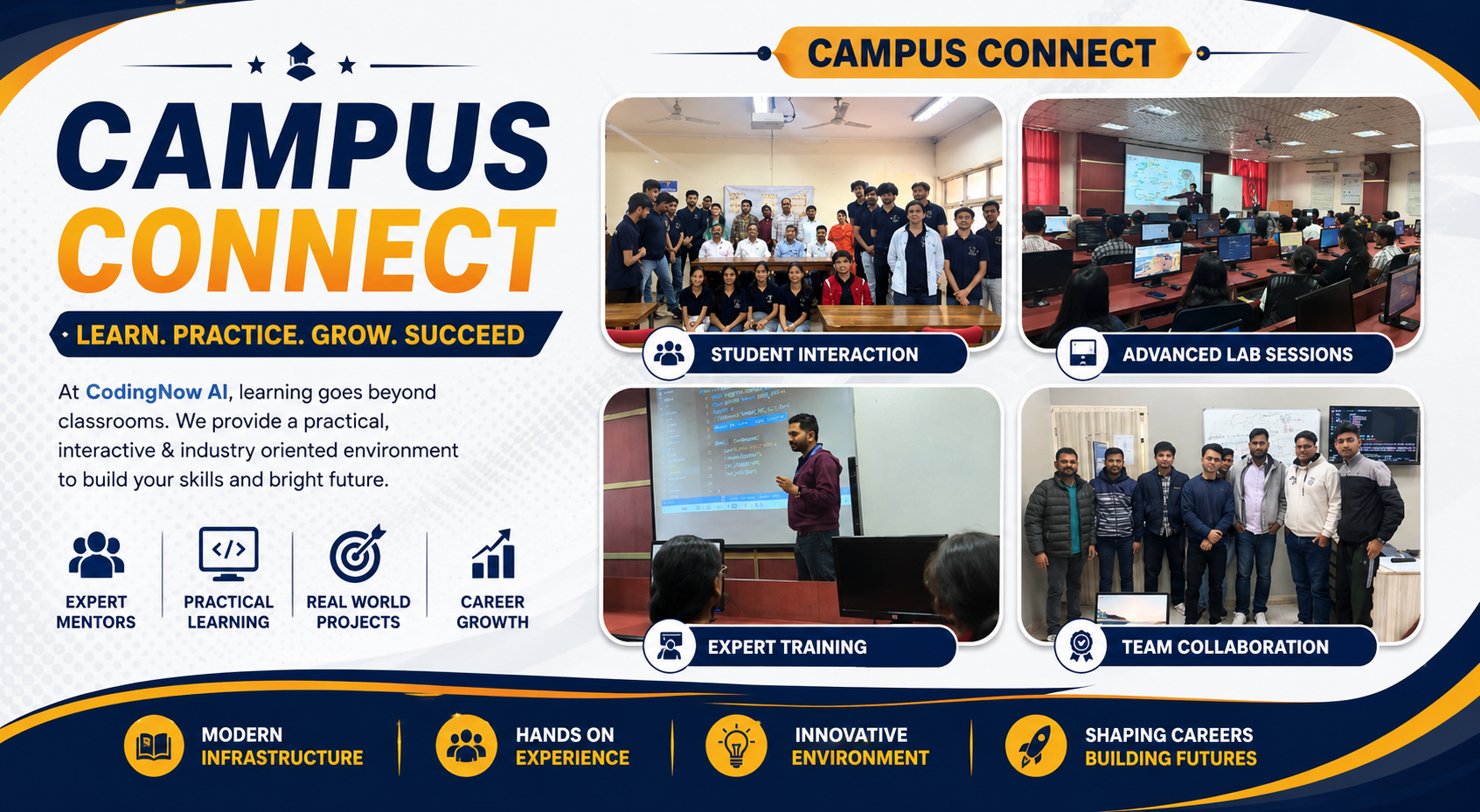
At Coding Now – Gurukul of AI, we understand that AI careers are no longer limited to software development. Our programs help professionals from all backgrounds build the skills they need.
Our Relevant Programs:
| Program | Duration | Skills Covered |
|---|---|---|
| AI Engineering Diploma | 6 months | Python, ML, LLMs, RAG, LangChain, AI agents, deployment |
| Data Science | 4 months | Python, Pandas, NumPy, Statistics, ML, SQL |
What We Teach That Matters for Non-Technical AI Careers:
| Career Path | Skills We Teach |
|---|---|
| AI Product Management | Understanding ML fundamentals, data analysis, AI capabilities |
| AI Consulting | Understanding AI workflows, governance, and deployment |
| Prompt Engineering | Working with LLMs, prompt design, workflow optimisation |
| AI Governance | Data handling, privacy, ethical AI principles |
Placement Support:
| Metric | Number |
|---|---|
| Students placed | 3,200+ |
| Hiring partners | 3,500+ |
| Average salary | ₹8-18 LPA |
| Highest package | ₹34 LPA |
Our Location: 2nd Floor, Kapil Vihar, opposite Metro Pillar No.354, Pitampura, New Delhi – 110034
Limited Offer: 50% OFF on select courses. Call +91 9667708830.
Step 12: Pro Tips for Starting an AI Career Without Coding
Tip 1: Leverage Your Existing Domain Expertise
The skills you built in your current career are not irrelevant. They are part of what makes a career switcher effective .
Tip 2: Build a Portfolio of AI Projects
Employers are looking for demonstrable capabilities rather than just degrees. A strong portfolio of practical AI projects is your best credential .
Tip 3: Learn AI Literacy
Understanding what AI can and cannot do is essential, even if you are not coding. This prevents overreliance and ensures ethical use of AI tools .
Tip 4: Consider Entry-Level Roles as a Starting Point
Non-technical entry-level roles like data annotator, content specialist, or prompt engineer offer a practical entry point into the AI world .
Step 13: Frequently Asked Questions
Q1: Do I need to code for a career in AI?
No. Many AI careers do not require coding. Roles like AI Product Manager, AI Ethics Specialist, Prompt Engineer, and AI Consultant require AI literacy, not programming skills .
Q2: What is the best non-technical AI career?
AI Product Manager is one of the most promising non-technical AI careers, with salaries ranging from $100-300K in the US . Prompt engineering is also growing rapidly .
Q3: Can I get an AI job without a degree?
Yes. For non-technical roles, a portfolio of practical AI projects often matters more than formal education . Nearly 25% of AI learners now come from non-technical fields .
Q4: What skills do I need for a non-technical AI career?
Judgment, communication, attention to detail, critical thinking, and AI literacy. For roles like prompt engineer, domain expertise and analytical thinking are also valuable .
Q5: How much can I earn in a non-technical AI role?
Prompt engineers earn $30-60+ per hour . AI Product Managers earn $100-300K+ in the US . In India, senior leaders with AI skills average ₹33 LPA .
Q6: Does Coding Now help with non-technical AI careers?
Yes. Our programs teach AI literacy and practical skills that apply to product management, consulting, governance, and prompt engineering.
Q7: What is the free trial class?
Attend free trial classes. If you do not see value, we refund 100% of the fee.
Q8: How do I enroll?
Call +91 9667708830 or visit our center at 2nd Floor, Kapil Vihar (Opp. Metro Pillar No.354), Pitampura, New Delhi – 110034.
Step 14: Final Tagline
"AI is Not Just for Coders. New Careers Are Being Created Every Day."
Hashtags:
#AICareers #NonTechnicalAI #AIProductManager #PromptEngineer #AIEthics #AIGovernance #CodingNow #GurukulOfAI
Step 15: A Note on the Future of AI Careers
AI is evolving from a specialised technical skill into a broader workplace capability . The skills that make us human, judgment, communication, and strategic thinking, are becoming the defining capabilities of the AI era.
As the data shows, nearly 25% of AI learners now come from non-technical fields . More than half of AI career outcomes now emerge outside software development . The opportunities are real, and the entry points are more accessible than ever.
At Coding Now, we are committed to helping professionals from all backgrounds build the skills they need for the AI era. Come visit us. Take a free demo class. See what is possible.
Your AI career starts now, coding or not.
Contact Us
Phone: +91 9667708830
Email: info@codingnow.in
Website: https://codingnowai.in/
Address:
2nd Floor, Kapil Vihar (Opp. Metro Pillar No.354)
Pitampura, New Delhi – 110034
Backlink to main website: Explore AI Engineering Diploma and other courses at Coding Now – Gurukul of AI