The Big Question
Here's a question that's dividing the tech industry: If AI can write code, what exactly are companies hiring for?
The answer is changing faster than anyone expected. In 2023, AI was a productivity tool—a fancy autocomplete. Developers used it, but they were still fundamentally hired for their ability to write code. By 2026, the equation has flipped. AI writes a significant portion of the code, and developers are increasingly hired for their ability to direct, evaluate, and improve what the AI produces.
This shift has created a paradox. Companies say they want "AI-fluent" developers. They've added the phrase to job descriptions. But most hiring processes haven't changed at all. Candidates still solve algorithm puzzles from scratch. They still write code on whiteboards. The interview measures skills that matter less and less in actual work .
The result is a widening gap between what companies say they want and what they actually test for. And that gap has real consequences—for companies struggling to identify genuine talent, and for developers unsure what skills to build.
At CodingNowAI, we've spent five years building AI systems and watching this transformation unfold. Here's what we've learned about how AI-native development is reshaping hiring.
What "AI-Native Development" Actually Means
Before diving into hiring implications, let's define the shift.
Traditional Development
A developer writes code. They use tools—IDEs, debuggers, version control—but the code comes from their fingers. Their primary skill is translation: taking requirements and converting them into functioning software.
AI-Assisted Development
A developer uses AI to write code faster. They prompt, review, and refine. Their primary skill is still coding, but augmented by AI efficiency.
AI-Native Development
A developer directs AI agents to build software. The agents write most of the code. The human's role shifts to planning, specification, supervision, and verification. Their primary skill is judgment—knowing what to build, how to structure it, and whether the AI got it right .
The distinction matters because it changes what companies should hire for. In an AI-native world, the ability to write code from scratch matters less than the ability to evaluate and improve code written by someone—or something—else.
How Hiring Is Actually Changing
The shift is real, but uneven. Here's what's happening across the industry.
The Rise of AI-Native Job Titles
Companies are creating explicit AI-native roles. A LinkedIn job posting for an "AI-Native Python Developer" requires "expertise in vibe coding" and "proficiency with generative AI tools (GitHub Copilot, Cursor, Claude, ChatGPT)" . Accenture is hiring "AI-Native Full Stack Developers" who can "distinguish between using AI effectively to build applications and building production-grade agentic applications" .
These aren't just rebranded traditional roles. They represent a genuine shift in expectations. The job isn't "write code with AI help." It's "direct AI agents to produce production-grade software while maintaining accountability for quality and security."
The "AI Fluency" Problem
Almost every technical job description now mentions "AI fluency." Almost nobody agrees on what it means . Some teams mean "comfortable using AI tools." Others mean "can write good prompts." Others treat it as a gut-feel judgment with no consistent definition .
This ambiguity creates a hiring problem. When the criteria are vague, evaluations become inconsistent. A candidate who impresses one interviewer might fail with another. And companies end up hiring people who talk well about AI but can't actually use it to produce reliable work.
The Junior Developer Squeeze
The impact is uneven across experience levels. Stanford's 2026 AI Index reports that employment for early-career software developers (ages 22-25) dropped by 20% since generative AI took hold . Senior roles grew—71% of new software job growth came from senior positions .
The reason is straightforward: AI handles the routine tasks that used to be junior developers' training ground. Writing boilerplate, fixing simple bugs, implementing standard patterns—work that taught juniors how systems fit together. When AI does that work, juniors lose both the tasks and the learning opportunities.
TeamLease Digital's CEO put it bluntly: "Every entrant into the labour workforce, into the IT sector, has to become an AI-first person." Otherwise, "the roles will be few and far between" .
Why Traditional Hiring Is Failing
The mismatch between what companies need and what they test for has become glaring.
The Coding Test Paradox
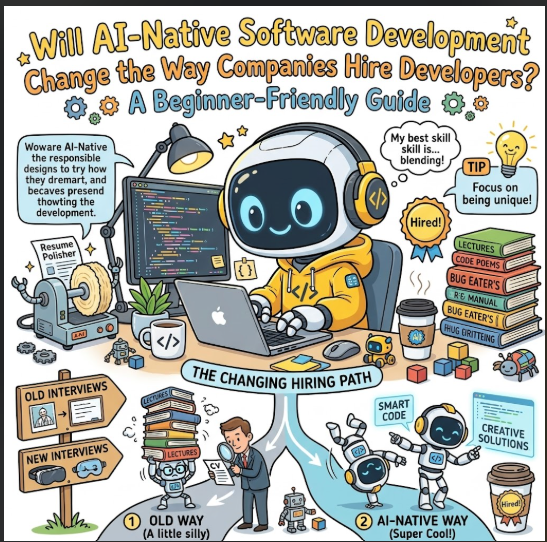
Traditional technical interviews ask candidates to solve algorithm problems from scratch. This made sense when the job was writing code from scratch. It makes less sense when the job is directing AI to write code.
A candidate who can implement a binary search tree manually may have no ability to evaluate whether an AI-generated implementation is correct, efficient, and maintainable. Conversely, a candidate who excels at directing AI might struggle with puzzles designed for a different era .
The industry is split on how to respond. CoderPad's 2026 survey found that 34% of companies still ban AI in technical assessments, 46% allow it (with or without constraints), and 20% decide case by case . There's no consensus.
The Signal Problem
When candidates use AI during interviews, the results become ambiguous. Two candidates might both submit working solutions and score 90%. One is a strong engineer who used AI to move faster and verified everything. The other prompted their way into code they don't understand and couldn't debug if it broke .
From the outside, they look identical. The test can't tell you who did the work—or who could do it again without AI.
This is the core challenge of AI-era hiring: measuring what the candidate can actually do when AI is in the room.
How Some Companies Are Adapting
A few organizations are redesigning their processes for the AI-native era. Their approaches offer a roadmap.
The Plan/Build/Review Framework
HackerRank's agentic interview structure separates evaluation into three phases that mirror AI-native work :
-
Plan: Can the candidate break down the problem, identify edge cases, and set constraints before any code is written?
-
Build: Can the candidate supervise AI output, catch drift, and redirect when needed?
-
Review: Can the candidate evaluate what was generated, spot bugs the AI missed, and explain why decisions were made?
The insight: Plan and Review carry more signal than Build. An engineer who plans clearly and reviews rigorously demonstrates the judgment that matters most.
The Split-Assessment Approach
TestDome advocates measuring two things separately :
-
Unaided skill: What can the candidate do without AI? This establishes a baseline.
-
AI direction: How well does the candidate direct and correct AI? This measures the new skill set.
If you only measure one blended score, you can't tell whether you're hiring a skilled engineer or a lucky prompter.
Spec-First Development
Some organizations are shifting from "prompt-first" to "spec-first" development . Instead of prompting AI and hoping for the best, teams write structured specifications that define API contracts, data schemas, acceptance criteria, and security requirements. The AI generates code against the spec. Humans verify compliance.
This approach creates a consistent benchmark for evaluating AI output—and for evaluating candidates' ability to write good specs.
What This Means for Developers
If you're building a career in software, the skills that matter are shifting.
What's declining in importance: Writing code from scratch. Memorizing syntax. Implementing standard algorithms manually.
What's increasing in importance: Systems design. Debugging and fine-tuning. Understanding tradeoffs. Critical evaluation of AI output. Domain knowledge .
Microsoft's CVP of CoreAI Engineering observed that in effective AI-native teams, "plan and validate now consume the majority of time, because create and operate are compressing" . Those are the stages where "understanding of craft matters most."
The developers who thrive won't be those who resist AI or those who blindly accept it. They'll be those who use it effectively—directing it, questioning it, and knowing when to override it .
Cost Based on Website Type
If you're building or hiring for AI-native development, here's what different levels typically cost.
Basic Informational Website ($500 - $3,000): AI-assisted development for simple sites. Limited complexity, standard patterns. AI handles most boilerplate.
E-commerce Website ($5,000 - $40,000): AI-native development with human oversight for critical systems. Payment flows, security, and data integrity require human verification.
SaaS Platform ($40,000 - $200,000+): Full AI-native lifecycle with spec-driven development, agent orchestration, and human-in-the-loop verification. Requires developers who can direct AI effectively.
Enterprise Application ($200,000 - $1,000,000+): Comprehensive AI-native engineering organization with governance, model routing, security review, and continuous evaluation. At this scale, AI fluency becomes a core competency.
Breakdown by Developer Type (2020 - 2026 Rates)
The cost of hiring AI-fluent developers has shifted.
2020-2022: Traditional developers. AI skills were a bonus. Rates reflected standard software engineering.
2023-2024: AI-assisted development became common. Developers who adapted commanded slight premiums.
2025-2026: AI-native development is emerging. Developers who can direct agents, write specs, and verify output command significant premiums—especially senior developers with strong fundamentals .
Current rates reflect this:
-
US-based AI-native developers: $110+ per hour
-
Canada-based: $60 per hour
-
India-based: $40 per hour
-
Pakistan-based: $28-32 per hour
At CodingNowAI, we've built teams across these levels.
Why Prices Changed in 2026
Several forces have reshaped developer economics.
Junior Roles Declined
AI handles routine tasks. Entry-level hiring dropped 20% for early-career developers . Companies hire fewer juniors, and those they hire must be AI-ready from day one .
Senior Roles Premium Increased
Experienced developers who can architect, debug, and evaluate AI output are scarce and valuable. 71% of job growth came from senior positions .
AI Skills Became Table Stakes
"AI fluency" moved from differentiator to requirement. Companies expect developers to work with AI tools effectively .
The Talent Pool Globalized
AI-native development expertise exists globally. India-based developers deliver quality work at 60-65% less than US equivalents.
Pro Tips to Save Money in 2026
1. Hire for Judgment, Not Just Coding
AI can write code. Humans need to evaluate it. Hire developers who can direct, supervise, and verify .
2. Test AI Fluency Separately
Measure unaided skill and AI direction separately. Blended scores hide who actually did the work .
3. Use Realistic Assessments
Let candidates use AI the way they would on the job. Then evaluate how they use it—not just the final output .
4. Invest in Senior Talent
Seniors who can architect and review AI output are the bottleneck. Prioritize hiring them.
5. Train Your Juniors
If you hire juniors, invest in their AI skills. TeamLease reports training programs compressed from months to weeks .
6. Consider Global Talent
AI-native development expertise exists globally. India-based developers deliver quality work at 60-65% less than US equivalents.
For more guidance, explore CodingNowAI.
Questions to Ask Before Hiring
Before hiring AI-native developers, ask these questions.
"Walk me through how you'd approach a new feature using AI."
Listen for planning, constraints, and verification. Good candidates describe a process, not just a tool.
"How do you know when AI output is wrong?"
This tests critical evaluation. They should describe specific techniques—testing, edge case analysis, understanding the domain.
"Tell me about a time AI gave you bad code. What did you do?"
Reveals whether they blindly accept AI output or verify it.
"What's your approach to spec-driven development?"
Specs are the control layer for AI agents. They should understand this.
"How do you balance speed and quality with AI?"
AI makes speed easy. Quality requires judgment. Their answer reveals maturity.
"What would you do if AI wrote code you don't understand?"
This is the key question. Good answers involve investigation, not shipping code they can't explain.
Why Delhi is a Great Hub for AI Development
Delhi NCR has become a center for AI-native development.
Talent Density: Thousands of startups and premier institutions create a dense ecosystem.
Cost Advantage: Building in India costs significantly less than in the US, creating opportunities for local talent.
AI-First Hiring: Indian IT firms are prioritizing AI skills for freshers, with 20-25% of entry-level requirements focused on AI roles .
Global Standards: Indian engineering teams build for global markets, adopting international best practices.
Policy Support: Government initiatives like the "AI+Software" action plan are driving adoption .
CodingNowAI is proud to be part of this ecosystem.
What We Offer
At CodingNowAI, we've spent five years building AI systems and helping companies hire for the AI-native era.
For Employers:
-
AI-Native Hiring Assessment: Evaluating candidates for AI direction, supervision, and verification skills.
-
Team Building: Access to AI-fluent developers at all levels.
-
Training Programs: Upskilling existing teams for AI-native development.
For Developers:
-
Career Guidance: Building AI fluency that employers actually value.
-
Portfolio Review: Feedback on showcasing AI-native skills.
-
Opportunities: Connecting with companies hiring for AI-native roles.
We believe in proof of work. We help companies identify developers who can think, not just code. And we help developers build the skills that matter.
Learn more at CodingNowAI.
Frequently Asked Questions
Will AI-native development eliminate developer jobs?
No. It changes what developers do. AI handles routine coding; humans focus on architecture, judgment, and verification. Demand for senior developers is growing .
What is AI fluency in hiring?
AI fluency is the ability to direct, supervise, and verify AI agents toward correct, shippable work. It's not tool familiarity—it's judgment .
Should companies allow AI in technical interviews?
Increasingly, yes. If the job involves AI, the interview should too. But measure unaided skill and AI direction separately .
How do I assess AI fluency in candidates?
Use realistic tasks. Watch how they plan, supervise, and review. Ask them to explain decisions. Look for critical evaluation, not blind acceptance .
What skills matter most for AI-native developers?
Systems design, debugging, critical evaluation, and domain knowledge. Writing code from scratch matters less .
How is hiring for juniors changing?
Entry-level hiring dropped 20%. Juniors must be AI-ready from day one. Training programs have compressed from months to weeks .
What's spec-driven development?
Writing structured specifications that AI generates code against. Specs become the control layer for AI agents .
How do I get started?
Visit CodingNowAI to explore our hiring and training services. The first conversation is free.
Frequently Asked Questions
What is an AI-native developer?
A developer who uses AI agents as a core part of the development lifecycle, while remaining accountable for architecture, quality, security, and production outcomes .
Is "vibe coding" a real skill?
Yes. It's the ability to use AI tools effectively—prompting with intent, critically reviewing output, and knowing when not to use AI .
Will AI replace junior developers?
AI handles tasks that used to train juniors. Companies need to invest in training or hire AI-ready juniors. Otherwise, the talent pipeline breaks .
How do I measure AI fluency?
Measure direction (planning), supervision (build), and verification (review). Score each separately .
What's the biggest hiring mistake in the AI era?
Using traditional coding tests that don't measure AI skills. You end up hiring for yesterday's job.
How do I attract AI-native talent?
Offer meaningful work with AI tools. Let developers use AI effectively. Invest in their growth .
What's the future of developer hiring?
More focus on judgment, less on coding from scratch. AI fluency as a baseline. Senior roles growing, junior roles requiring AI skills from day one.
How do I get started?
Visit CodingNowAI to explore our services. Assess your hiring process, train your team, and find the right talent. The first conversation is free.
The Shift Is Real. The Question Is Whether You're Ready.
AI-native development isn't coming. It's here. One-third of pull requests involve AI agents . Companies are hiring "vibe coding experts" . The skills that matter are changing.
The companies that adapt their hiring will find developers who can direct AI effectively, evaluate its output critically, and ship reliable software. The ones that don't will keep running coding tests that measure skills from yesterday.
The question isn't whether AI will change hiring. It's whether your hiring will change with it.