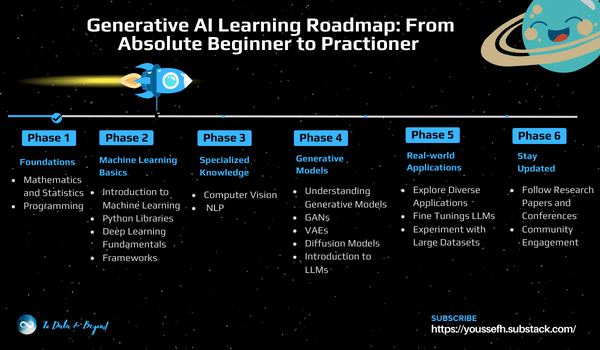
The Ultimate Generative AI Engineer Roadmap: From Zero to Hired in 2026
Generative AI is the fastest-growing field in technology. Companies are racing to integrate LLMs, RAG systems, and AI agents into their products. But here is the challenge: the field moves so fast that most learning resources are already outdated by the time you find them.
This roadmap cuts through the noise. It gives you a structured, project-driven path to become a job-ready Generative AI Engineer in 2026—whether you are starting from scratch or transitioning from software engineering.
What Is a Generative AI Engineer? (And What It Is Not)
Before diving in, understand the role clearly. A generative AI engineer is a software engineer who builds production systems on top of foundation models (LLMs, diffusion models, multimodal models) using techniques like RAG, fine-tuning, embeddings, evaluation harnesses, and guardrails to turn a probabilistic model into a reliable product feature .
What this role is not :
-
Not a data scientist – Data scientists build models from scratch; GenAI engineers compose and productionize existing foundation models.
-
Not just a prompt engineer – Prompt design is one skill inside the role, not the whole job.
-
Not an ML research scientist – Researchers advance the underlying models; GenAI engineers apply them under latency, cost, and reliability constraints.
Getting this distinction right is crucial. Most failed hires in this space trace back to a title-to-work mismatch .
How Long Will This Take?
| Your Background | 10-15 hrs/week | 20+ hrs/week |
|---|---|---|
| Software Engineer | 3-4 months | 2-3 months |
| Data Scientist / ML Engineer | 2-3 months | 1-2 months |
| No programming experience | 6-8 months | 4-5 months |
The roadmap below is structured as a project-driven learning path with 10 phases and over 30 hands-on projects . The philosophy is simple: build first, learn second .
Phase 1: Foundations (Software Baseline)
Before touching GenAI, ensure you have solid software engineering fundamentals.
Skills You Need
-
Strong Python – This is non-negotiable. You will work with APIs, process text, and build web applications daily .
-
Git and version control – You will version prompts, models, and code.
-
Basic HTTP and REST APIs – You will consume and build APIs constantly.
-
Async programming in Python – Important for building responsive applications that call multiple AI services .
Project: Set up your development environment with FastAPI, a virtual environment, and a basic API endpoint .
Phase 2: Generative AI Fundamentals
What Makes Generative AI Different
Traditional machine learning excels at classification and prediction. Generative AI creates new content: text, images, code. Instead of collecting labeled datasets and training models from scratch, you work with pre-trained foundation models that already understand language, images, or code .
Large Language Models (LLMs)
Most current GenAI applications are powered by LLMs built on transformer architecture. Understand:
-
How transformers work (attention mechanisms, context windows)
-
Major models and their strengths: GPT-4, Claude, Gemini, Llama
-
Model capabilities, pricing, and token management
Diffusion Models and Image Generation
For applications involving images, learn:
-
How diffusion models work (forward/reverse diffusion, noise prediction)
-
Tools like DALL-E, Stable Diffusion, Midjourney
-
Multi-modal systems that process both text and images
Projects: Build a prompt playground that compares different models and strategies .
Phase 3: Prompt Engineering Excellence
Prompt engineering transforms GenAI from impressive demo to practical tool. Well-designed prompts consistently produce useful outputs; poor prompts lead to inconsistent, irrelevant, or harmful results .
Core Skills
-
System prompts – Set the model's role, tone, and constraints
-
Few-shot learning – Provide examples that guide the model toward desired outputs
-
Chain-of-thought prompting – Encourage step-by-step reasoning
-
Prompt versioning and testing – Treat prompts like code; track changes and evaluate results
Best Practices
-
Start with clear objectives—what specific output do you need?
-
Define success criteria—how will you know when the prompt works?
-
Test variations systematically
Projects: Build a summarization service, a tone/style rewriter, and a structured data extractor .
Phase 4: Retrieval-Augmented Generation (RAG) Systems
RAG addresses one of the biggest limitations of foundation models: their knowledge cutoff and lack of domain-specific information. By combining pre-trained models with external knowledge bases, RAG systems provide accurate, up-to-date information while maintaining natural language capabilities .
Architecture Patterns
-
Simple RAG – Retrieve relevant documents and include them in prompts
-
Advanced RAG – Multiple retrieval steps, reranking, follow-up queries
-
HyDE – Generate hypothetical documents to improve retrieval
Vector Databases and Embeddings
-
Choose the right embedding models for your use case
-
Understand chunking strategies (semantic coherence, chunk size)
-
Work with vector databases: Pinecone, Weaviate, Chroma, pgvector, FAISS
Document Processing
The quality of your RAG system depends heavily on how you process documents:
-
Clean formatting and extract metadata
-
Create document summaries for better retrieval
-
Consider document structure when chunking
Projects: Build a document Q&A system, a resume vs. JD analyzer, and an internal knowledge base chatbot .
Phase 5: Tool Calling, Workflows, and AI Agents
Modern GenAI systems don't just generate text—they take actions.
Tool Calling and Function Calling
-
Understand how LLMs can call external functions and APIs
-
Build tools that let the model search, calculate, or perform actions
-
Design safe tool-calling patterns with proper validation
Orchestration Frameworks
-
LangChain – Simplifies common patterns like prompt templates and chain composition
-
LangGraph – Supports complex workflows with branching and conditional logic
-
MCP (Model Context Protocol) – For tool-use and agentic systems
-
CrewAI and AutoGen – For multi-agent systems
Agentic Systems
AI agents can:
-
Plan and execute multi-step tasks
-
Use tools and memory
-
Adapt based on feedback
Projects: Build a CLI chatbot with personas, a workflow automation agent, and a multi-agent orchestration system .
Phase 6: Evals, Observability, and Production
Unlike traditional ML models with clear accuracy metrics, evaluating generative AI requires more sophisticated approaches .
Evaluation (Evals)
-
Automated metrics: BLEU, ROUGE for baseline text quality
-
Human evaluation: Assess creativity, relevance, safety
-
Custom evals: Build test sets for your specific use case
-
Regression testing: Ensure prompt changes don't break quality
LLMOps / Observability
-
Logging and tracing model calls
-
Monitoring drift, performance, and cost
-
Guardrails: input/output validation, PII handling, content safety
Cost and Latency Engineering
-
Cache common responses
-
Route to smaller models for simpler tasks
-
Optimize prompt length
Projects: Build an evaluations harness, implement monitoring dashboards, and add guardrails to your applications .
Phase 7: Fine-Tuning and Optimization
Not every problem can be solved with prompt engineering alone. Sometimes you need to adapt the model weights.
Techniques
-
LoRA and QLoRA – Parameter-efficient fine-tuning
-
DPO (Direct Preference Optimization) – Align models with human preferences
-
RLHF – Reinforcement learning from human feedback
When to Fine-Tune vs. RAG
-
Fine-tuning: When you have a large dataset of examples and need consistent formatting
-
RAG: When you need to reference specific documents and keep knowledge current
Optimization
-
Quantization – Reduce model size (GGUF, vLLM)
-
Distillation – Train smaller models to mimic larger ones
-
SLMs (Small Language Models) – For edge deployment
Phase 8: Multimodal and Real-Time Systems
Multimodal AI
-
Process text and images together
-
Generate text descriptions of images
-
Create or modify images based on text input
-
Work with vision-language models
Real-Time Systems
-
Streaming responses for better user experience
-
WebSocket support for chat applications
-
Async processing for variable generation times
Phase 9: MLOps and Deployment
A model that only runs locally doesn't prove you can ship.
Skills
-
Docker and Kubernetes – Containerization and orchestration
-
CI/CD pipelines – Automate testing and deployment
-
Cloud platforms: AWS, GCP, Azure AI services
Azure AI Engineer Track (Recommended)
-
Microsoft Certified: Azure AI Engineer Associate
-
Focus on: Azure AI services, Azure AI Search, Azure OpenAI
-
Applied Skills: Develop generative AI apps with Azure OpenAI and Semantic Kernel
Projects: Deploy your applications with Docker, set up CI/CD, and monitor production systems .
Phase 10: Portfolio and Capstone
Your portfolio is your proof of work. Build at least 3 complete projects that demonstrate:
Capstone Project Ideas
-
Enterprise Knowledge Assistant: RAG system that answers questions from internal documentation with citations
-
Content Generation Pipeline: Multi-step system that researches, outlines, writes, and refines content
-
Multimodal AI Assistant: Processes both text and images, generating responses with descriptions or modifications
Portfolio Best Practices
-
Write a detailed README for each project
-
Explain the problem, your approach, key decisions, and what you learned
-
Include architecture diagrams and evaluation results
-
Deploy at least one project to the cloud
Quick Reference: Full Roadmap Summary
| Phase | Focus | Key Tools/Skills |
|---|---|---|
| 1. Foundations | Python, APIs, async | FastAPI, Git, virtual environments |
| 2. GenAI Fundamentals | LLMs, diffusion models | OpenAI API, Hugging Face, transformers |
| 3. Prompt Engineering | Prompt design, system prompts | Few-shot, chain-of-thought |
| 4. RAG Systems | Vector DBs, embeddings | Pinecone, Chroma, pgvector |
| 5. Tool Calling & Agents | Orchestration, workflows | LangChain, LangGraph, MCP |
| 6. Evals & Production | Testing, observability, guardrails | Evals harnesses, LLMOps |
| 7. Fine-Tuning | LoRA, QLoRA, DPO | PyTorch, Hugging Face |
| 8. Multimodal Systems | Vision, real-time | Vision models, WebSockets |
| 9. MLOps/Deployment | Docker, Kubernetes, cloud | AWS/GCP/Azure, CI/CD |
| 10. Portfolio | Capstone projects | GitHub, README, deployment |
Total estimated time: ~165 hours of structured learning with 37 hands-on projects .
Key Tools and Frameworks Summary
Must-Have Skills
-
Python (non-negotiable)
-
RAG end-to-end: chunking, embeddings, vector DB, retrieval, reranking
-
Prompt engineering as a disciplined practice
-
Evaluation: building eval harnesses, measuring groundedness and hallucination rate
-
Orchestration: LangChain, LlamaIndex
-
LLMOps/observability: logging, tracing, monitoring, cost control
-
Guardrails and safety: input/output validation, PII handling
Nice-to-Have Skills
-
Fine-tuning (LoRA, QLoRA)
-
Distillation and quantization
-
MLOps tools (Docker, Kubernetes, MLflow)
Recommended Learning Resources
Curated Platforms
-
DeepLearning.AI – Short courses on cutting-edge topics (mostly free)
-
Pluralsight – Structured video courses
-
Microsoft Learn – Free Azure AI learning paths and certification prep
-
LangChain Academy – Free LangChain/LangGraph courses
Local Development
-
LM Studio – GUI for running local LLMs (Llama, Mistral, Phi)
-
Ollama – CLI-driven local model server
-
Recommended models: Gemma 4 (chat/generation/vision), Nomic Embed Text (embeddings)
Certifications (Optional)
-
Microsoft Certified: Azure AI Engineer Associate
-
Google AI Certification
-
IBM AI Engineering
-
HCL GUVI AI/ML Career Program
Common Mistakes to Avoid
-
Skipping software engineering fundamentals – You are an engineer first, AI specialist second. Strong Python and system design matter .
-
Ignoring evaluation – Without evals, you cannot improve. Treat prompts like code; test them .
-
Never deploying – A project that only runs locally proves nothing. Ship it .
-
Relying only on prompt engineering – Some problems need fine-tuning or different architectures .
-
Not understanding cost – Production GenAI costs real money. Learn token management and caching .
The Bottom Line
Generative AI engineering is one of the highest-demand roles in tech. Companies are hiring—and they are paying top dollar for engineers who can build production-grade systems. The path is clear but requires hands-on practice, not just theory.
Your immediate action plan:
-
Today: Set up Python, create a virtual environment, and get started with LangChain and FastAPI.
-
This week: Build your first prompt engineering application (a summarizer or rewriter).
-
This month: Build a RAG system with a vector database.
-
Within 3 months: Add eval harness, tool calling, and deploy with Docker.
-
Within 6 months: Build 2-3 capstone projects, write detailed READMEs, and start applying.
GenAI engineering rewards builders. Build consistently, ship projects, and you will be job-ready faster than you think.
Contact Us
Phone: +91 9667708830
Email: info@codingnow.in
Website: https://codingnowai.in/
Address:
2nd Floor, Kapil Vihar (Opp. Metro Pillar No.354)
Pitampura, New Delhi – 110034
Backlink to main website: Explore Python and AI courses at Coding Now – Gurukul of Ai