The Definitive Coding Interview Roadmap for 2026
Let's be honest—the coding interview has changed. If you're preparing like it's 2023, you're preparing for an interview that's quietly stopped existing at many companies .
Here's why: AI broke "does the code run" as a signal. When a candidate produces suspiciously clean, suspiciously fast code, that used to mean skill. Now it might just mean they had a second tab open. So interviewers adjusted the whole rubric around that problem .
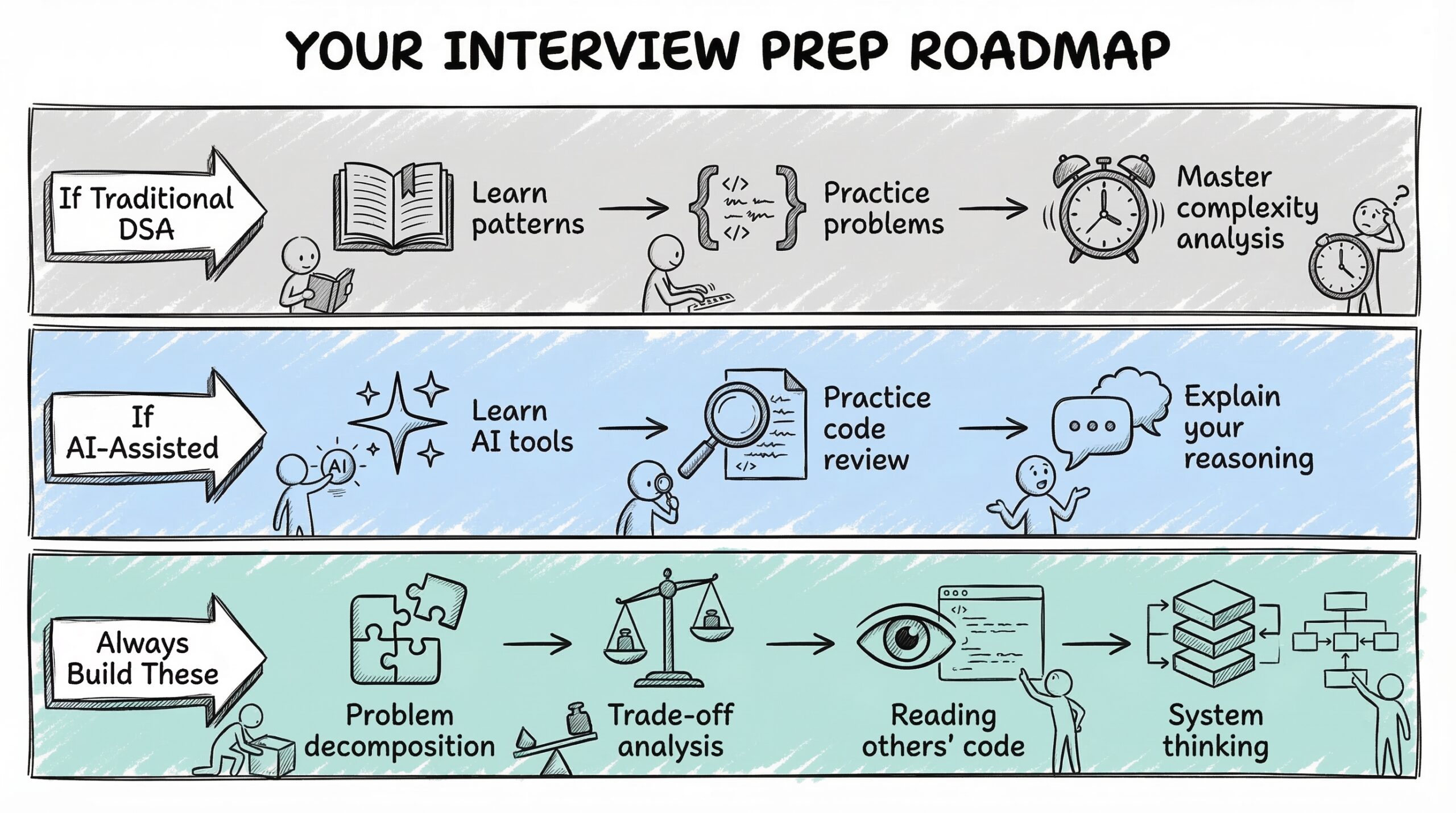
This roadmap covers everything you need to know—from the fundamentals that still matter to the AI-era skills that now make the difference.
The New Reality: What's Changed in 2026
AI Is Reshaping Every Round
Software engineer interviews are no longer just about writing code—they evaluate your ability to reason, verify, debug, and improve AI-generated code .
| Dimension | Before AI Era | In the AI Era |
|---|---|---|
| Primary focus | Write correct code from scratch | Reason, verify, debug AI-generated code |
| Coding round | Manual implementation under pressure | Reviewing buggy AI code, optimizing performance |
| Use of AI tools | Restricted or disallowed | Allowed or expected, with emphasis on responsible use |
| System design | CRUD services, queues, caches | AI-native systems: LLM pipelines, RAG architectures |
The Live Coding Shift
Live pair programming has gained ground specifically because it's hard to fake in real time . The coding round no longer just tests "does it work"—it tests what happens after it works. Expect questions like "why this data structure over a hashmap," "what if this input is null," and "walk me through line 14" .
What You Actually Need to Master
1. Core Data Structures & Algorithms (Still Non-Negotiable)
Even if AI can write the code, you must understand the logic . Focus on :
Data Structures:
-
Arrays, Strings, Linked Lists
-
Stacks, Queues, Hash Maps
-
Trees (Binary, BST, Trie)
-
Graphs (Adjacency List/Matrix)
-
Heaps & Priority Queues
Algorithms:
-
Sorting & Searching (Binary Search, Merge/Quick Sort)
-
Recursion & Backtracking
-
Sliding Window, Two Pointers
-
Greedy & Divide and Conquer
-
Dynamic Programming (0/1 Knapsack, LIS)
-
Graph Algorithms (DFS, BFS, Dijkstra, Topological Sort)
Common Patterns to Know:
-
Two pointers (sorted arrays, target sum problems)
-
Sliding window (substring/subarray problems)
-
Binary search (any sorted structure)
-
Backtracking (permutations, combinations)
-
Union-Find (connected components in graphs)
2. AI Fluency: The New Core Requirement
AI fluency has become a core requirement, shifting the focus from manual coding to verifying, debugging, and optimizing AI-generated solutions .
What you need to know:
-
LangChain & LangGraph: For chaining multiple AI calls and building stateful agents
-
LlamaIndex: The go-to framework for connecting custom data to LLMs
-
Vector Database Proficiency: When to use Pinecone, Weaviate, Milvus versus pgvector, and understanding indexing algorithms like HNSW and IVF
-
RAG Engineering: Chunking strategies, embedding models, reranking
-
Model Serving & Optimization: Quantization (GGUF, AWQ, GPTQ), local inference with Ollama, vLLM
3. System Design (Mid-Level and Above)
For mid-level and senior roles, system design interviews carry as much weight as coding challenges—sometimes more . In 2026, expect AI components to appear right next to the usual "design a rate limiter" prompt .
Key areas:
-
Designing from requirements: turning vague requests into clear system requirements
-
Scalability and trade-offs: partitioning, caching, load balancing, database sharding
-
AI-native systems: recommendation engines, RAG pipelines, LLM-serving layers
Common design problems:
-
URL shortener (bit.ly style)
-
Ride-sharing service
-
Messaging platform
-
Intelligent search/QA system with RAG architecture
Framework to use every time:
-
Clarify requirements (functional and non-functional)
-
Estimate scale (QPS, storage, bandwidth)
-
Define API / data model
-
Sketch high-level components
-
Drill into bottlenecks
-
Discuss trade-offs
4. Behavioral Interviews (Now Heavier Weight)
Behavioral questions carry more weight than many candidates expect—search data shows "behavioral interview questions" gets 911 AI searches/month in the US, outpacing coding-specific queries .
Use the STAR method (Situation, Task, Action, Result) to structure your stories .
Prepare for questions about:
-
Conflict resolution and mentorship
-
Learning from failure
-
How you improved a system (with metrics)
-
Disagreements with technical decisions
-
Ownership and judgment
Pro tip: Behavioral rounds stopped accepting vague answers. "I led a project and it went well" doesn't land anymore. They want the number, the timeline, the thing that actually moved .
5. Behavioral Skills for the AI Era
Technical ability alone is no longer enough. Interviewers evaluate :
| Skill | What It Means |
|---|---|
| Radical Accountability | Reviewing AI-generated code carefully, not blindly trusting it |
| Ethical Intelligence | Knowing AI risks (hallucinations, bias), responsible tool adoption |
| Hype Management | Setting realistic stakeholder expectations about AI capabilities |
| Adaptability | Rapidly learning new AI tools and frameworks |
| Collaborative Stewardship | Code review and mentorship in AI-assisted codebases |
Your 4-Week Study Plan
Week 1: Build Your Foundation
Master core data structures (arrays, strings, hash maps, linked lists). Solve 2-3 beginner-level problems daily. Review alternative approaches and understand why they work .
Focus: Arrays, Strings, Hash Maps, Linked Lists
Week 2: Learn and Apply Patterns
Work with intermediate problems introducing DFS, BFS, sliding window, two pointers. Instead of memorizing solutions, focus on recognizing when a particular approach applies .
Focus: DFS, BFS, Sliding Window, Two Pointers
Week 3: Advanced Problem Solving
Tackle complex problems involving heaps, trees, DP, graph algorithms. Solve at least one problem daily under time constraints. Revisit earlier problems and improve solutions .
Focus: Heaps, Trees, DP, Graph Algorithms
Week 4: Mock Interviews and Refinement
Shift from learning to performing. Do mock interviews with peers or platforms (Pramp, Interviewing.io). Practice explaining your thought process clearly, not just reaching the answer .
Focus: Communication, timing, identifying weak areas
Language-Specific Prep
Python
Most commonly tested in data engineering, ML, backend, and full-stack roles .
Key concepts:
-
List vs. tuple (mutable vs. immutable)
-
Decorators and generators
-
*argsand**kwargs -
GIL and multiprocessing vs. threading
-
deepcopyvs.copy -
Method Resolution Order (MRO)
JavaScript
Covers language mechanics (closures, event loop, prototype chain) and modern ES6+ patterns .
Key concepts:
-
Closures and lexical scoping
-
Event loop (call stack, task queue, microtask queue)
-
==vs.=== -
var,let,const(scope and hoisting) -
Prototypal inheritance
-
Promise.all,Promise.allSettled,Promise.race -
Memory leaks (event listeners, closures, detached DOM nodes)
The New Interview Format: Plan, Build, Review
One emerging format represents how work actually happens now :
Phase 1: Plan (Half the time)
The candidate doesn't start coding. They build a plan, ask clarifying questions, pressure-test assumptions. The interviewer watches how they think before code is written.
What's evaluated: Can they hold a plan in their head, interrogate assumptions, make deliberate decisions?
Phase 2: Build
The candidate supervises AI agents writing code. They don't write everything manually—they keep agents honest to the plan.
What's evaluated: Can they spot when AI drifts from the agreed approach? Can they redirect it?
Phase 3: Review
The candidate reviews the AI-generated diff, runs tests, catches edge cases, and decides if it's safe to ship.
What's evaluated: Judgment—the ability to direct, supervise, and verify AI output that's actually ready for production .
Smart Preparation Tips
1. Focus on Patterns, Not Memorization
The best way to succeed is not to memorize 1500+ LeetCode problems. Understanding patterns is the key . Learn reusable problem-solving patterns so you can adapt to unfamiliar questions on the spot .
2. Practice Explaining Out Loud
If you've never once explained your own solution out loud while writing it, you've only been training for half the round .
3. Build a Feedback Loop
Track your mistakes in a prep log. Revisit weak areas with spaced repetition. Re-solve problems after a few days to reinforce understanding .
4. Practice in Real Environments
Many companies now rely on online coding environments with limited debugging tools. Practice writing code in a simple editor without relying heavily on IDE features .
5. Set Realistic Timelines
Give yourself up to three months of focused prep (or 4-6 weeks if you're already comfortable with core concepts) .
6. Don't Skip Mock Interviews
Mock interviews are a great way to practice demonstrating soft skills and talking through problem-solving under pressure .
Quick Reference: The Complete Checklist
| Category | Must-Know Topics |
|---|---|
| DSA | Arrays, Strings, Hash Maps, Linked Lists, Trees, Graphs, Heaps, DP, DFS/BFS, Sliding Window, Two Pointers |
| AI Fluency | LangChain, LlamaIndex, Vector Databases, RAG Engineering, Model Serving |
| System Design | URL Shortener, Ride-sharing, Chat App, RAG Architecture, Scalability Trade-offs |
| Behavioral | STAR Method, Quantifiable Impact Stories, Conflict Resolution |
| Debugging | Reading others' code, interpreting stack traces, edge-case thinking |
| Programming | Python or JavaScript with deep understanding of core concepts |
Final Thought: Prepare for the Interview That Actually Exists
The coding interview isn't what it was five years ago—or even two years ago. AI changed what interviewers are looking for. Correct code that runs on the first try is no longer the headline signal. Judgment is .
That means:
-
Can you review code critically?
-
Can you supervise AI output?
-
Can you explain your decisions?
-
Can you defend your choices under scrutiny?
-
Can you quantify your impact?
None of this means DSA stopped mattering. It means solving silently in a tab isn't the whole prep anymore . The best-prepared candidates understand the fundamentals and can reason, communicate, and collaborate in the new AI-powered workflow.
Contact Us
Phone: +91 9667708830
Email: info@codingnow.in
Website: https://codingnowai.in/
Address:
2nd Floor, Kapil Vihar (Opp. Metro Pillar No.354)
Pitampura, New Delhi – 110034
Backlink to main website: Explore Python and AI courses at Coding Now – Gurukul of Ai