Roadmap to Master in Docker – From Beginner to Production-Ready in 2026
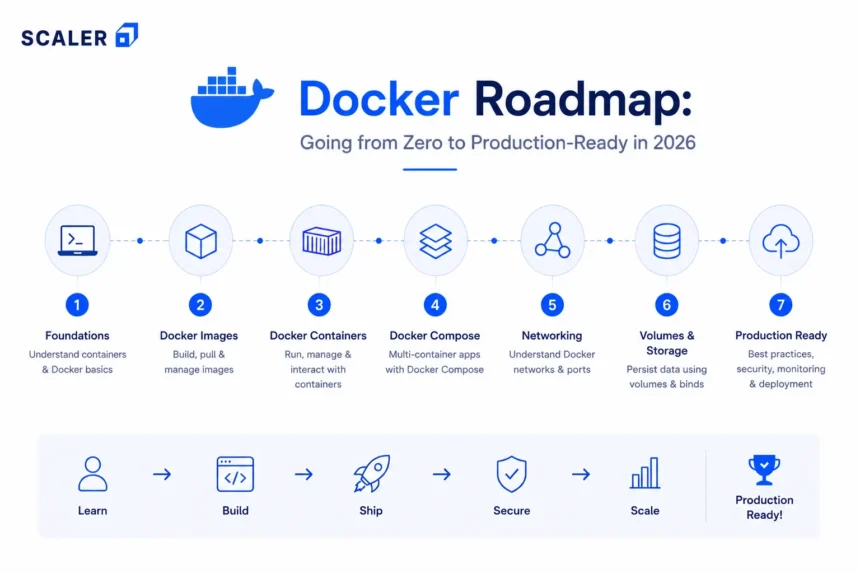
Docker is the undisputed foundation of modern DevOps and cloud-native development. Mastering it isn't just about memorizing commands—it's about understanding how to build, ship, and run applications reliably in any environment. The journey from beginner to proficiency typically takes 3-6 weeks with daily practice, followed by deeper production and orchestration skills over 1-2 additional months . Here's your comprehensive step-by-step roadmap.
Phase 1: Foundation Understanding the Core (Week 1)
Before you type a single command, it's essential to understand what containers are and why they're so important. A container is a lightweight, portable unit that packages an application with all its dependencies, ensuring it runs consistently in any environment.
What to Learn:
-
What containerization is and Docker's role in the software delivery lifecycle
-
Docker vs. Virtual Machines: understand the efficiency difference
-
Docker Architecture: Client, Daemon, Registry, Images, and Containers
-
Key use cases: running databases, proxy servers, and message queues in containers
Hands-on Practice:
-
Install Docker and run your first container:
docker run hello-world -
Pull and run an Nginx container, map a host port, and view it in your browser
Phase 2: Essential Skills – Working with Images and Containers (Weeks 2-3)
This phase focuses on the hands-on skills that form the bulk of daily Docker work. A realistic timeline for this is about 1-2 weeks with regular practice .
What to Learn:
-
Images: Pulling, listing, and removing images (
docker pull,docker images,docker rmi) -
Containers: Full lifecycle management (
docker run,ps,stop,start,rm) -
Writing Dockerfiles: Core instructions like
FROM,RUN,COPY,WORKDIR,EXPOSE,CMD, andENTRYPOINT -
Image Layers and Caching: How Docker builds images layer by layer, why the order of instructions matters, and how to maximize the build cache
Hands-on Practice:
-
Create a
Dockerfilefor a simple Python Flask or Node.js application -
Use
docker buildto create your own custom image and run a container from it -
Understand and implement a
.dockerignorefile to prevent bloated builds
Phase 3: Intermediate – Data Persistence and Networking (Weeks 3-5)
This is where containers become genuinely useful for real applications. Understanding how to manage data and networking is the transition point from a beginner to an intermediate user.
What to Learn:
-
Volumes: How to persist data (
-vflag, named volumes) so database data doesn't disappear when a container restarts -
Networking: Basic container-to-container communication, port mapping, and bridge networks. Connecting to
localhostinside a container will not work -
Docker Compose: Defining and running multi-container applications in a
docker-compose.ymlfile
Hands-on Practice:
-
Run a PostgreSQL container with a named volume to persist data
-
Use Docker Compose to spin up a full-stack app (frontend + backend + database)
Phase 4: Advanced – Production-Ready Practices (Weeks 5-8+)
This phase separates a developer who tinkers with Docker from one who can be trusted in production .
What to Learn:
-
Image Optimization: Multi-stage builds to create smaller, leaner production images
-
CI/CD Pipelines: Using GitHub Actions to automate image builds and pushes to a registry
-
Security: Understand that credentials in a Dockerfile are a major security risk, as they end up in the image history . Use secrets management instead.
-
Modern Docker (2026):
-
Gordon (AI Assistant): Docker's AI agent that can debug containers using your actual environment
-
Docker Model Runner: For running AI models alongside your applications as first-class OCI artifacts
-
Docker Scout: Continuous security analysis for images, vulnerability scanning, and SBOM generation
-
Projects to Build Your Portfolio
A certificate shows you sat through a course. A project on GitHub proves you can build . Here are three key projects for your resume:
| Project | What It Practices | Skill Level |
|---|---|---|
| Dockerized Python Web App | Dockerfile best practices, port mapping |
Beginner |
| Full-Stack App with Compose | Multi-service networking, volumes, environment variables | Intermediate |
| CI/CD Pipeline | Automated builds, image registry push | Advanced |
Common Mistakes and How to Avoid Them
| Mistake | Why It Hurts | The Fix |
|---|---|---|
| Jumping to Kubernetes too early | Kubernetes is a separate, complex system. Docker Compose is a prerequisite | Master Compose first |
Using latest tag everywhere |
You lose the ability to track exactly which version is running in production | Use explicit tags |
| Putting secrets in Dockerfiles | Credentials become visible to anyone with access to the image history | Use Docker secrets or environment variables |
| Not understanding volumes | Surprise! Database data disappears when the container restarts | Practice with named volumes |
Career Outlook and Certifications
Salary Expectations in India: A DevOps engineer with Docker skills commands an average salary of ₹8.5 LPA in India .
The Certification Question: The dedicated Docker certification is the Docker Certified Associate (DCA), administered by Mirantis (formerly the official Docker-run program). It's a 55-question, 80-minute exam costing $195 . While it validates real skills, its orchestration focus on Docker Swarm (not Kubernetes) means it may be less relevant for many DevOps roles today. For most professionals, building rock-solid Docker skills for free and then pursuing a Kubernetes certification is a more strategic path .
Contact Us
Phone: +91 9667708830
Email: info@codingnow.in
Website: https://codingnowai.in/
Address:
2nd Floor, Kapil Vihar (Opp. Metro Pillar No.354)
Pitampura, New Delhi – 110034
Backlink to main website: Explore Python and AI courses at Coding Now – Gurukul of AI