Roadmap to Become a Full Stack Developer in 2026
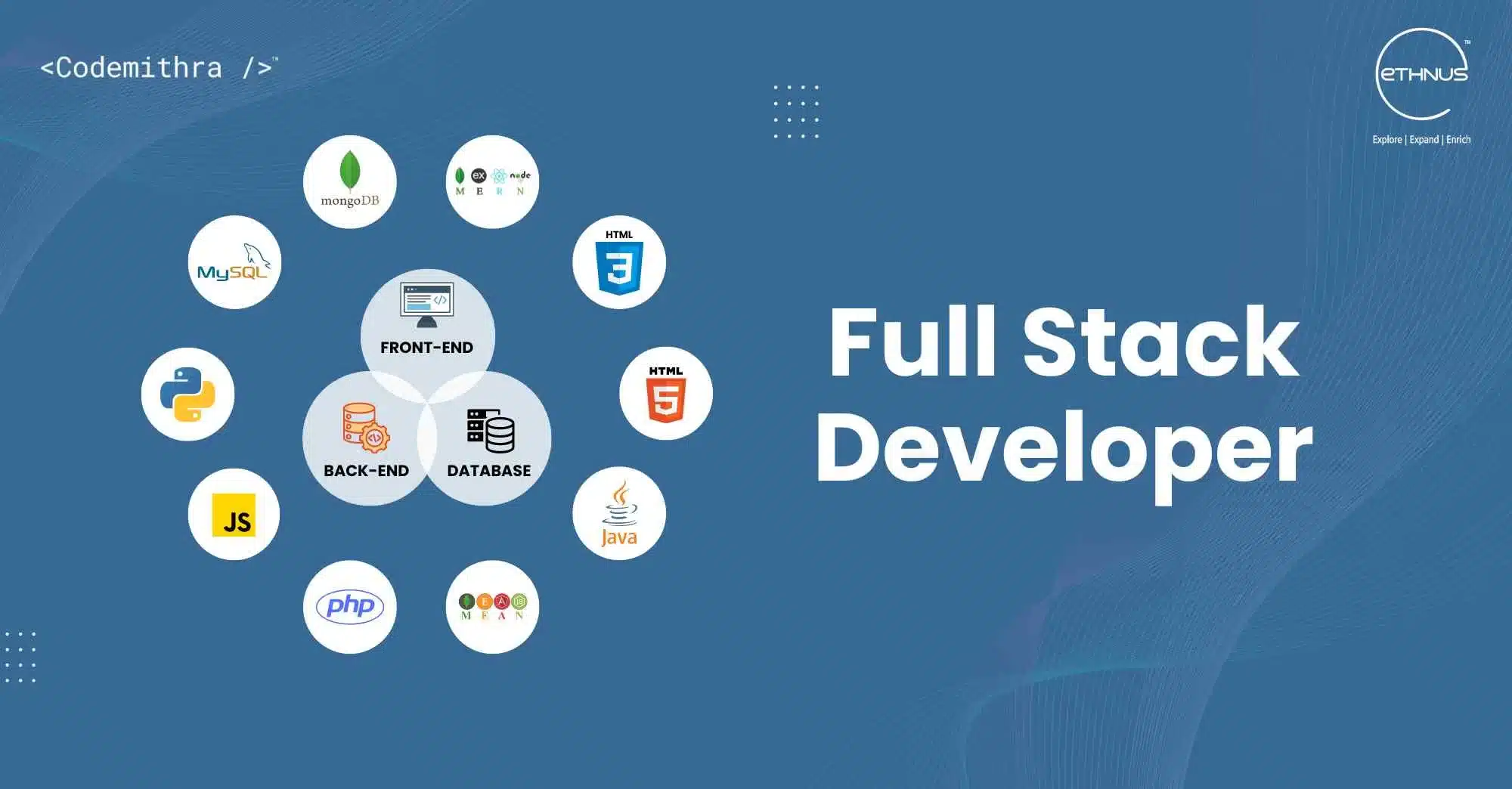
Full Stack Developers are the Swiss Army knives of the tech world they can build a complete application from the user interface users see, all the way down to the server logic and databases that power it. In 2026, companies across India are increasingly seeking developers who can connect design, development, and deployment, making this one of the most versatile and future-proof career paths in tech . Here is your clear, step-by-step roadmap to go from beginner to job-ready.
Step 1: Master the Frontend Foundation (Months 1-3)
Your first few months should be entirely focused on the core building blocks of the web. Do not skip this step a shaky foundation will make everything harder later.
| Technology | What to Learn | Why It Matters |
|---|---|---|
| HTML | Semantic structure, forms, and accessibility tags | Builds the skeleton and meaning of every webpage |
| CSS | Flexbox, Grid, responsive design, and animations | Creates layouts that work on any device, from phones to desktops |
| JavaScript | ES6+ features, DOM manipulation, promises, and the event loop | The logic behind interactivity and the foundation for all modern frameworks |
Goal: Build a clean, responsive, static portfolio website from scratch. This is your first step to understanding how the web works.
Step 2: Choose Your First Framework & Go Deep (Months 4-6)
Once you are comfortable with vanilla JavaScript, it is time to pick a modern frontend framework. This is where you will spend most of your time as a professional. In 2026, React remains the most popular and safest bet for job opportunities, with Next.js offering a powerful framework built on top of it .
What to learn:
-
React: Components, state management (
useState,useReducer), side effects (useEffect), and routing. -
State Management: Understand when to use local state vs. a global state library like Redux or Context API.
-
TypeScript: This has become an industry standard. Most companies expect you to build and maintain large, scalable applications with static typing .
Project: Build a dynamic single-page application (SPA), like a weather app that fetches data from a public API or a task manager that saves to a local database.
Step 3: Tackle the Backend & Logic (Months 7-9)
Now it's time to make your applications do real work. This is the "brain" of the application—handling user authentication, business logic, and data processing. Since you already know JavaScript, Node.js with the Express framework is the most natural and popular next step for a full stack developer .
What to learn:
-
Node.js & Express: Build RESTful APIs that handle
GET,POST,PUT, andDELETErequests. -
Authentication: Implement JSON Web Tokens (JWT) and session-based authentication to secure your applications.
-
Server Logic: Understand middleware, routing, and how to handle requests and responses.
Project: Build a simple blog or a user dashboard backend. It doesn't need a frontend yet—just test it with tools like Postman.
Step 4: Master Databases (Months 9-10)
Your server needs a place to store all the data. You should be comfortable with both SQL and NoSQL solutions.
| Database Type | Technologies to Learn | When to Use |
|---|---|---|
| Relational (SQL) | PostgreSQL or MySQL | For structured data with clear relationships, like an e-commerce site's users, orders, and products. |
| Non-Relational (NoSQL) | MongoDB | For unstructured or rapidly changing data, like user profiles or content in a blog. |
What to learn:
-
SQL: Master joins, window functions, and complex queries to retrieve and manipulate data efficiently.
-
Database Design: Learn about indexing and how to structure data for performance and scalability .
Step 5: Learn Professional Production Tools (Months 10-12)
Being a full stack developer isn't just about writing code—it's about getting that code into the hands of users safely and efficiently. These skills are what separate junior developers from mid-level and senior engineers.
What to learn:
-
Version Control: Master Git and GitHub for collaboration. Your GitHub profile will become your public portfolio .
-
The Cloud & DevOps: Learn the basics of Docker for containerization and deploy your applications on a cloud platform like AWS or Azure.
-
CI/CD: Set up automated testing and deployment pipelines (Continuous Integration / Continuous Deployment) using tools like GitHub Actions .
Project: Containerize your full stack application and deploy it to the cloud with a public URL. This is a huge step that proves you can take an app to production.
The 2026 Full Stack Mindset
Portfolio > Certificate
The era of a degree guaranteeing a job is over; in fact, an Hindustan Times report noted that 84% of engineering graduates remained unemployed or without an internship . Skills, experience, and a demonstrable ability to solve real problems are what get you hired. Your portfolio of 3-4 well-built, deployed projects is your most powerful asset .
The Challenge of Being a Generalist
The biggest challenge you will face is the "jack of all trades, master of none" feeling. However, the broad perspective you gain as a full stack developer is excellent preparation for leadership roles, as you will understand the entire product lifecycle . To stand out, combine your full stack skills with a niche skill, such as AI integration, cloud expertise, or cybersecurity .
Career Progression & Salary (India)
Full stack developer salaries in India vary widely based on experience, location, and the company's size.
| Experience Level | Common Roles | Approx. Salary Range (India) |
|---|---|---|
| Fresher (0-1 year) | Junior Full Stack Developer | ₹4 LPA – ₹7 LPA |
| Early Career (1-3 years) | Full Stack Developer | ₹8 LPA – ₹15 LPA |
| Mid-Level (5-7 years) | Senior Full Stack Developer | ₹15 LPA – ₹28 LPA |
| Senior (8+ years) | Tech Lead / Architect | ₹28 LPA – ₹50 LPA+ |
A note on growth: According to the Instahyre Product-Tech PayCheck 2025 report, backend salaries tend to climb faster than frontend or full stack salaries over a longer tenure . However, this is offset by the immense versatility and leadership opportunities full stack development offers.
Your 12-Month Action Plan
| Month | Focus | Key Deliverable |
|---|---|---|
| 1-3 | Foundation: HTML, CSS, JavaScript | A responsive personal portfolio website. |
| 4-6 | Frontend Expertise: React, TypeScript | A dynamic single-page application (e.g., weather app). |
| 7-9 | Backend Logic: Node.js, Express, REST APIs | A working blog or user dashboard API. |
| 10-12 | Database & Production: MongoDB/PostgreSQL, Docker, Deployment | A deployed, full-stack application with a database connection. |
Contact Us
Phone: +91 9667708830
Email: info@codingnow.in
Website: https://codingnowai.in/
Address:
2nd Floor, Kapil Vihar (Opp. Metro Pillar No.354)
Pitampura, New Delhi – 110034
Backlink to main website: Explore Python and AI courses at Coding Now – Gurukul of AI