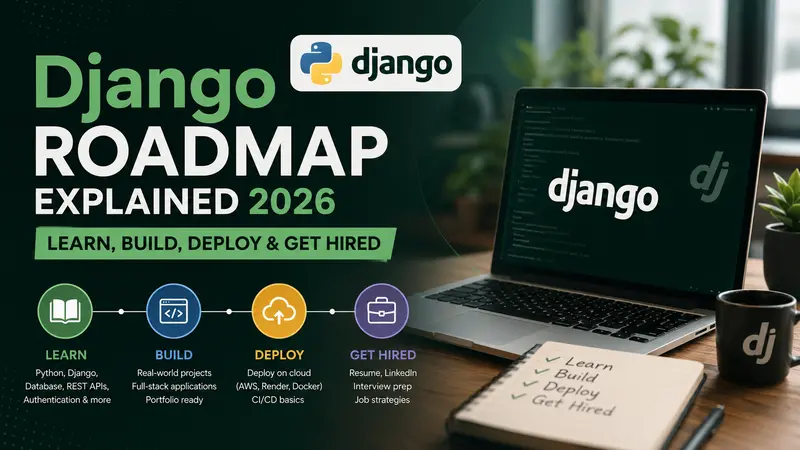
Django Learning Roadmap 2026: From Beginner to Job-Ready
Django remains one of the most trusted web frameworks in 2026. It's not the shiny new thing—it's the mature, reliable workhorse that powers large content platforms, SaaS backends, and admin-heavy internal tools . This roadmap is designed to take you from complete beginner to a confident Django developer.
Phase 1: Python Prerequisites
You don't need to be a Python expert, but you need solid fundamentals. Before touching Django:
Must-know Python concepts:
-
Basic syntax and data types (lists, dictionaries, tuples)
-
Functions and control flow
-
Classes and Object-Oriented Programming (OOP)
-
Import system and modules
-
Virtual environments (
venv)
Goal: You should be comfortable writing basic Python scripts and understanding error messages.
Phase 2: Django Core Fundamentals
This is where your Django journey begins. Don't rush—depth matters more than speed.
Week 1-2: Project Setup and MVT Architecture
What to learn:
-
What Django is and how it compares to other frameworks
-
MVT pattern (Model-View-Template)—Django's take on MVC
-
Starting a new project:
django-admin startproject -
Projects vs. apps—the core organizational concept
-
The development server:
python manage.py runserver
Hands-on task: Create your first project, run the server, and understand each generated file (settings.py, urls.py, manage.py).
Week 3-4: Views, URLs, and Templates
What to learn:
-
Writing your first view and mapping it to a URL
-
URL routing with
path()andinclude() -
Basic templates: HTML with Django Template Language
-
Template inheritance (DRY for frontend)
Hands-on task: Build a simple "Hello World" with a personalized greeting page that accepts URL parameters .
Week 5-6: Models and Databases
What to learn:
-
Defining models as Python classes
-
Migrations: creating and applying database changes
-
Django ORM basics: CRUD operations
-
The Django admin interface—your instant CMS
Hands-on task: Create a blog model, register it with admin, and display posts on the frontend.
Checkpoint: By now, you should be able to build a basic CRUD app .
Phase 3: ORM Mastery (Critical for Production)
This is where most Django developers fall behind. Go deep here .
Deep-dive topics:
-
select_relatedvsprefetch_related—prevent N+1 queries -
Annotations and aggregations (
Count,Avg,Sum) -
Query optimization and indexing strategies
-
Database design for scale, not just correctness
Hands-on task: Profile your blog app queries. Identify and fix N+1 issues.
Key mindset shift: "Why is this page slow and how do I fix it?"—learn from problems, not features .
Phase 4: Advanced Django Topics
Forms and Authentication
-
Django forms and
ModelForm -
CSRF protection
-
Built-in authentication (
User, login/logout, registration) -
Permissions and authorization (
@login_required)
Class-Based Views (CBVs)
-
Function-based views vs. class-based views
-
When to use
ListView,DetailView,CreateView, etc.
Caching
-
Django's cache framework
-
Per-view and template fragment caching
-
Redis integration
Admin Customization
-
Admin is a product, not just a tool
-
Custom list displays, filters, search, and actions
-
Creating internal tools with custom admin
Phase 5: APIs with Django REST Framework (DRF)
Modern Django almost always lives alongside an API .
Must-learn:
-
DRF installation and basics
-
Serializers: converting models to JSON
-
ViewSet vs APIView
-
Authentication and permissions for APIs
-
Nested relationships and dynamic fields
Hands-on task: Create a REST API for your blog with full CRUD and authentication.
Phase 6: Production-Ready Skills
Deployment
-
Preparing for production (
DEBUG=False, static files) -
Environment variables for sensitive settings
-
Deployment options: Render, Railway, AWS, or Docker
Asynchronous Tasks
-
Celery for background tasks (email, data processing)
-
Task retries, error handling, and periodic tasks
Testing
-
Django's test framework
-
Test-driven development basics
-
Using factories and fixtures
Version Control
-
Git basics (commits, branches, merges)
-
GitHub for collaboration
Hands-on task: Deploy your project to a live server with a CI/CD pipeline.
Recommended Learning Resources
Best Websites
-
Official Django Documentation—most reliable reference
-
Real Python—clear, practical tutorials
-
TestDriven.io—testing, APIs, Docker, production setups
-
SimpleIsBetterThanComplex—deep dives on core concepts
YouTube Channels
-
CodingEntrepreneurs—SaaS-style projects
-
Corey Schafer—clear fundamentals
-
Dennis Ivy—practical Django structure
-
Very Academy—modern Django with frontend integration
Books Worth Reading
-
Two Scoops of Django—best practices and project structure
-
Django for Professionals—authentication, security, deployment
-
Designing Data-Intensive Applications—system design thinking (not Django-specific, but essential)
Sample Projects to Build
-
Personal Blog—user registration, CRUD, auth
-
E-commerce Store—product listings, cart, session management
-
Task Manager with REST API—DRF, serialization, permissions
-
Community Forum—discussion threads, moderation tools
-
Portfolio Website + Email Sending—real-world, interview-ready
What to Skip (For Now)
-
Async Django—wait until you're comfortable with sync Django
-
Complex DevOps—stick to simple deployment first
-
Every third-party package—learn Django's built-in tools before replacing them
Contact Us
Phone: +91 9667708830
Email: info@codingnow.in
Website: https://codingnowai.in/
Address:
2nd Floor, Kapil Vihar (Opp. Metro Pillar No.354)
Pitampura, New Delhi – 110034
Backlink to main website: Explore Python and AI courses at Coding Now – Gurukul of Ai