The Big Question
Every business leader I meet has the same fantasy: hire a data analyst, unlock insights, make smarter decisions, watch revenue climb.
Then they actually hire one—and discover something baffling. The analyst spends weeks "preparing" data before producing a single chart. Reports get delayed. Questions go unanswered. The leadership team starts wondering what they're paying for.
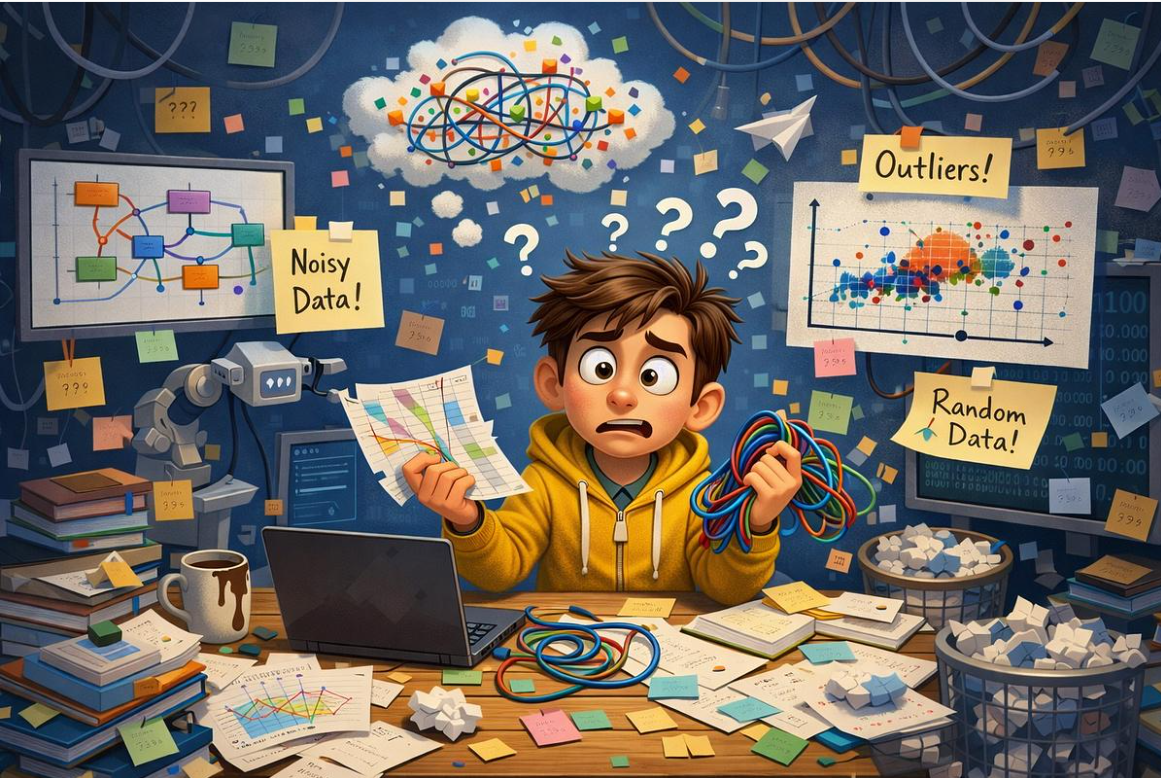
Here's the uncomfortable truth: data analysts spend 60–80% of their time cleaning data, not analyzing it. That's not laziness or poor time management. That's the reality of working with real-world data—data that's messy, incomplete, inconsistent, and scattered across a dozen systems that were never designed to talk to each other.
At CodingNowAI, we've spent five years building AI solutions, and we've worked with dozens of organizations drowning in dirty data. We've seen analysts burn out. We've seen insights arrive too late to matter. And we've seen what happens when you finally fix the underlying problem.
So why does data cleaning consume so much time? And more importantly—what can be done about it?
Why Data Analysts Spend So Much Time Cleaning Data
The reasons are layered, and they compound on each other. Let's break them down.
1. Real-World Data Is Fundamentally Messy
Textbook datasets are pristine. Real datasets are chaos. Customer names spelled five different ways. Dates formatted inconsistently—some as MM/DD/YYYY, others as DD-MM-YY. Phone numbers with and without country codes. Addresses with missing postal codes or duplicated entries. Every one of these inconsistencies must be found, standardized, and corrected before analysis can begin.
2. Data Comes From Everywhere—and Nothing Talks to Anything
A typical company's data lives in CRM systems, spreadsheets, email threads, legacy databases, cloud applications, and paper records. Each source has its own format, its own quirks, its own definition of "customer." Merging these sources into a single coherent dataset is an engineering project in itself—and it falls on the analyst's plate.
3. Duplicates Multiply Like Rabbits
The same customer appears three times with slightly different spellings. The same transaction gets recorded in two systems. Without systematic deduplication, analysts waste hours identifying and merging records that should have been unified at the source.
4. Missing Values Are Everywhere
Surveys with blank fields. Forms where users skipped questions. Systems that failed to capture certain data points. Every missing value requires a decision: ignore it, fill it with a default, impute it statistically, or track down the original source. Each decision takes time—and each wrong decision corrupts the analysis downstream.
5. Formats Resist Standardization
One department uses kilograms, another uses pounds. One system stores currency in USD, another in local currency. One team records dates in UTC, another in local time. Standardizing these formats isn't glamorous work—but skipping it produces garbage insights.
6. Business Rules Are Inconsistent or Undocumented
What counts as an "active customer"? A purchase in the last 30 days? 90 days? Does a refunded order count? Different teams have different answers, and nobody documented them. The analyst must interview stakeholders, reconcile definitions, and rebuild the dataset—often discovering mid-analysis that a critical rule was never written down.
7. Legacy Systems Refuse to Cooperate
Old databases with cryptic column names. Exports that truncate long fields. Files that only open in software nobody has licenses for anymore. Legacy systems are the archaeological ruins of business data—and analysts are the archaeologists.
8. The Data Keeps Changing
Cleaning isn't a one-time job. New data arrives daily, with new errors, new inconsistencies, new edge cases. A pipeline that worked last month breaks this month when a vendor changes their export format. Maintaining clean data is an ongoing battle, not a finished project.
9. Nobody Owns Data Quality
In many organizations, data quality is everyone's problem and no one's responsibility. The sales team enters data carelessly because it doesn't affect them. The engineering team doesn't validate inputs because it's not in their sprint. The analyst inherits the mess and bears the cost.
10. Manual Cleaning Doesn't Scale
Excel formulas, manual copy-paste, one-off scripts—these work for small datasets. But as data volumes grow, manual cleaning becomes exponentially slower. Analysts spend nights running the same cleanup scripts that should have been automated years ago.
The Hidden Costs of Dirty Data
The time analysts spend cleaning data isn't just an inconvenience. It has real business consequences.
Delayed Insights
When cleaning takes 80% of the time, analysis takes 20%. Decisions get delayed. Opportunities get missed. By the time a report is ready, the market has moved on.
Burnout and Turnover
Data analysts didn't spend years learning statistics and machine learning to spend their days fixing typos. The best analysts leave for roles where they actually get to analyze. Replacing them costs time and money.
Costly Errors
Dirty data produces wrong insights. A duplicated customer record inflates revenue numbers. A missing value skews a forecast. A formatting error breaks a model. Each error cascades into bad decisions—sometimes with regulatory or financial consequences.
Lost Competitive Advantage
While your analysts are cleaning spreadsheets, your competitors' analysts are generating insights. Speed matters, and dirty data is a brake pedal.
According to industry research, poor data quality costs organizations an average of 10–20% of revenue. For a mid-sized company, that's not a rounding error—it's a strategic threat.
Why This Problem Persists in 2026
You'd think by 2026, with all our AI and automation, data cleaning would be solved. It isn't—for three reasons.
First, data volumes keep growing faster than cleaning tools improve. Every new application, every new integration, every new customer touchpoint generates more data. The mess grows faster than the mops.
Second, AI models are only as good as the data they're trained on. Ironically, the rise of AI has made data quality more important, not less. A machine learning model trained on dirty data produces confident nonsense. Analysts must clean before they can train.
Third, organizational silos persist. Departments still hoard data, use different tools, and follow different standards. Technology can't fix culture—and culture is often the root cause of dirty data.
What's Changing: AI-Powered Data Cleaning
The good news? The tools are finally catching up.
Automated Data Profiling
AI systems now scan datasets automatically, identifying anomalies, missing values, and inconsistencies without human intervention. What took hours now takes minutes.
Intelligent Deduplication
Machine learning models match records based on fuzzy logic—catching duplicates that exact matching misses. "John Smith" and "Jon Smith" get flagged as potential duplicates, even with different formatting.
Smart Imputation
Instead of filling missing values with crude averages, AI models predict missing values based on patterns in the rest of the data—producing more accurate, context-aware imputations.
Continuous Monitoring
Instead of cleaning once and hoping, modern systems monitor data pipelines continuously, flagging quality issues the moment they appear. Problems get caught before they contaminate analysis.
Natural Language Data Preparation
New tools let analysts describe what they want in plain English—"remove duplicate customers, standardize phone numbers, fill missing countries based on city"—and the system executes the cleanup automatically.
At CodingNowAI, we've built AI-powered data cleaning solutions that cut manual cleaning time by 60–70%. We've seen analysts reclaim entire days of their week for actual analysis—and we've seen what happens to business outcomes when they do.
How to Reduce Data Cleaning Time in Your Organization
Technology helps, but it's not the whole answer. Here's what actually works:
Fix Data at the Source
The most effective data cleaning is the cleaning that never happens. Validate data at the point of entry. Add dropdowns instead of free-text fields. Enforce formats at input. Every error prevented upstream is an hour saved downstream.
Document Business Rules
Write down what "active customer" means. Define your date formats. Document how currency conversion works. When rules are documented, cleaning becomes mechanical—and automatable.
Assign Data Ownership
Every data source needs an owner responsible for quality. When nobody owns it, everybody suffers. When someone owns it, quality improves dramatically.
Invest in Automated Pipelines
Manual cleaning doesn't scale. Automated pipelines—with validation, deduplication, and standardization built in—do. The initial investment pays for itself within months.
Use AI Where It Matters
AI isn't magic, but it's remarkably good at pattern detection, anomaly flagging, and intelligent imputation. Deploy it where manual effort is highest.
Measure and Track Data Quality
You can't improve what you don't measure. Track data quality metrics—completeness, accuracy, consistency—and make them visible to the whole organization.
Why Delhi NCR Is Leading the Data Revolution
Delhi NCR has become a hub for AI-powered data solutions—and for good reason.
Talent Density: The region produces thousands of engineers and analysts annually, and the concentration of funded startups means those professionals gain real production experience quickly. Data cleaning at scale requires engineers who understand both data pipelines and machine learning—a combination Delhi's ecosystem develops well.
Funding Momentum: Delhi NCR startups raised $1.7 billion in Q1 2026 alone, with enterprise infrastructure and AI applications leading the charge. This capital fuels experimentation with cutting-edge data tooling.
Cost Efficiency: A senior data engineer in Delhi costs 60–70% less than their counterpart in San Francisco—without compromising skill. For companies burning through data infrastructure budgets, this difference is transformative.
Infrastructure: Gurugram and Noida have become data center hubs, with significant investments signaling long-term commitment to AI and data infrastructure.
At CodingNowAI, we've built our entire operation around this reality. We don't just study data cleaning—we deploy AI-powered solutions for clients across industries.
What We Offer
At CodingNowAI, we specialize in AI-powered data solutions that actually work in production.
AI Data Cleaning Solutions: We build automated systems that profile, clean, deduplicate, and standardize your data—cutting manual cleaning time by 60–70%.
Data Pipeline Architecture: We design pipelines that validate data at the source, catch errors early, and keep data clean continuously—not just once.
Data Quality Monitoring: We implement systems that track data quality metrics in real time, flagging issues before they contaminate your analysis.
AI Workload Deployment: From Docker and Kubernetes to GPU scheduling, we handle the infrastructure that makes data processing run reliably at scale.
Custom Analytics Solutions: Once your data is clean, we help you extract real insights—with dashboards, models, and reports that drive decisions.
Ongoing Support: Flexible retainers for teams that need expert guidance without a full-time hire.
Explore our services at https://codingnowai.in/ and see how we've helped organizations move from data chaos to data clarity.
Frequently Asked Questions
Why do data analysts spend so much time cleaning data?
Because real-world data is messy—inconsistent formats, duplicates, missing values, and scattered sources. Cleaning is the unglamorous prerequisite to any meaningful analysis, and it consumes 60–80% of an analyst's time in most organizations.
Is data cleaning really necessary, or can analysts skip it?
Skipping it guarantees wrong results. Dirty data produces garbage insights—inflated revenue numbers, skewed forecasts, broken models. Cleaning isn't optional; it's the foundation of trustworthy analysis.
How can organizations reduce data cleaning time?
Fix data at the source with validation and standardized input. Automate cleaning pipelines with AI-powered tools. Document business rules. Assign data ownership. And invest in systems that monitor data quality continuously.
What role does AI play in data cleaning?
AI automates anomaly detection, intelligent deduplication, smart imputation, and continuous monitoring. It cuts manual cleaning time dramatically—and produces more accurate results than manual effort alone.
Will AI eventually eliminate data cleaning entirely?
No—but it will make cleaning dramatically faster and less painful. Some judgment calls still require human oversight, but the bulk of routine cleaning can be automated. Analysts will shift from cleaning to supervising and refining automated systems.
How do I know if my organization has a data quality problem?
Symptoms include: analysts complaining about spending most of their time on cleanup, reports that don't match across departments, decisions based on inconsistent numbers, and constant requests for "the real data." If any of these sound familiar, you have a problem.
What industries benefit most from AI-powered data cleaning?
E-commerce, finance, healthcare, marketing, and any industry with large volumes of customer data. The more data you have, the more cleaning you need—and the more AI-powered cleaning pays off.