The Big Question
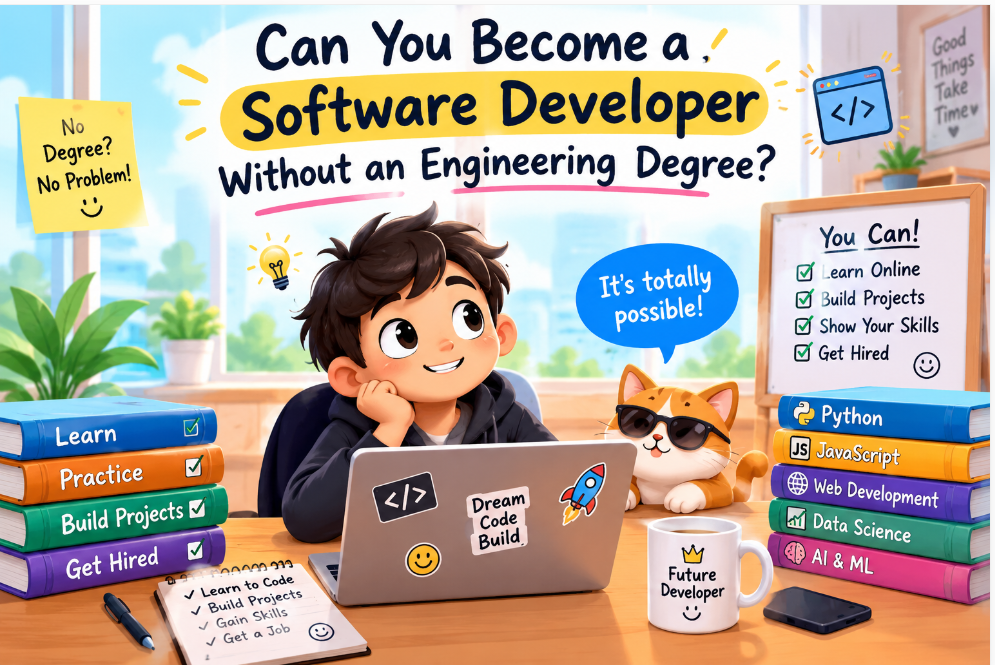
Here's the uncomfortable truth every no-degree aspirant needs to hear: Can you become a software developer without an engineering degree? Yes. But it's not the same path.
In India, a degree is not a legal requirement to work as a programmer . No law says you can't write code for a living. But the absence of a degree changes two concrete things.
First, you lose campus placements. Those structured pipelines where companies come to colleges and hire in batches? They don't exist for you. Second, many large service companies apply degree filters at the resume-screening stage—before a human even looks at your GitHub or your projects .
That's the bad news. The good news is that the industry is moving in your direction. Skills-based hiring is spreading. Startups and product companies care more about what you can demonstrate than what you studied. And the proof is everywhere—if you know where to look.
At CodingNowAI, we've spent five years building software and watching how hiring actually works in India. Here's the honest guide to the no-degree path.
What You Lose Without a Degree (Let's Be Honest)
Before talking about what's possible, let's talk about what's harder.
Campus Placements Are Gone
The biggest advantage of an engineering degree isn't the education—it's the placement pipeline. Companies visit campuses, conduct drives, and hire freshers in bulk. Without a degree, you're outside this system entirely . You'll apply off-campus, where competition is fiercer and response rates are lower.
Some Resume Filters Will Reject You
Large IT services companies often use degree as a blunt screening tool. Your resume might never reach a human . This is frustrating, but it's not universal. Product companies, startups, and a growing number of GCCs (Global Capability Centers) are moving away from degree filters .
You Pay in Uncertainty
Self-taught developers "pay in uncertainty what they save in tuition." No placements, no fixed pipeline, a lot of doubt and zig-zag progress . You'll face rejection that degree-holders avoid simply by being in the right room.
Peer Network Is Harder to Build
The best thing about college isn't the curriculum—it's the peers who push you. Finding five people who'll stay up till 2 AM arguing about code is much harder outside a campus environment .
These are real disadvantages. Don't let anyone tell you otherwise. But they're not the whole story.
What You Gain (And Why It's Worth It)
The no-degree path has its own advantages.
You Compete on Proof, Not Pedigree
When you don't have a degree, nobody hires you for your college name. They hire you because your GitHub shows working projects, your code is clean, and you can explain your decisions. This is actually a purer meritocracy—if you can build, you get hired .
Skills-Based Hiring Is Growing
The shift is real. A Bangalore-based financial services GCC hired 12 self-taught Python developers and found their code quality scores were on par with CS grads within six months . A Hyderabad GCC saw bootcamp hires ramp up 40% faster than fresh engineering graduates . Companies are noticing.
Startups Don't Care About Your Degree
Zerodha, the discount broker, hires based on curiosity and motivation, not certifications . Smallest.ai, an AI startup, hired self-taught developers for full-stack roles at ₹40 lakh per annum—no degree required . Zoho hired Abdul Alim, a security guard who taught himself to code, after telling him: "At Zoho, you don't need a college degree. What matters here is you and your skills" .
You Can Start Earning Sooner
No four years of college means no four years of tuition and delayed income. You can start building, freelancing, and applying while your peers are still in classrooms.
The Path That Actually Works
If you're serious about the no-degree route, here's the roadmap.
Step 1: Learn One Language to Working Depth
Don't collect languages. Pick one—Python or JavaScript are the most practical—and learn it well enough to build something real . "Working level" means you can build a small application from scratch without following a tutorial.
Step 2: Build Three Types of Projects
Recruiters want proof. Three projects cover your bases :
-
Foundational: A simple app that proves you know the basics (to-do app, calculator)
-
API/Data: A project that interacts with external data (weather app, scraper)
-
Original: A project that solves a real problem you personally have
Deploy them. Write READMEs. Explain your decisions.
Step 3: Create a GitHub That Speaks for You
Your GitHub is your substitute for a degree. Clean repositories with good READMEs, meaningful commit messages, and deployed demos . For a deeper guide, see our post on GitHub Portfolio for Freshers.
Step 4: Apply Where Degrees Don't Matter
Target these categories:
-
Startups: They hire based on skills and portfolio
-
Product companies: They care more about what you can build than what you studied
-
GCCs with skills-based hiring: Some are actively moving away from degree filters
-
Companies with non-degree pathways: TCS has B.Sc Ignite (for BCA/B.Sc graduates), Cognizant has GenC Analyst Trainee, Wipro has WILP
Step 5: Consider a Training Program (If It Helps)
Some internships and training programs accept non-degree candidates. Allerin Technologies doesn't require a particular degree and isn't filtering on college . Uncodemy explicitly states "Graduation is NOT mandatory" for their web developer intern role . These are entry points.
Step 6: Contribute to Open Source
Look for "good first issue" tags on GitHub. Start with documentation or small bug fixes. This proves you can collaborate with a real team—something recruiters value .
Cost Based on Website Type
If you're building a portfolio to compensate for the missing degree, here's what hosting and tools typically cost.
Personal Projects ($0/month): GitHub free tier, Vercel/Netlify free tier. Everything you need to showcase projects is free.
Portfolio Website ($0 - $20/month): Custom domain ($10-15/year), hosting free tier. A personal site adds professionalism.
Full-Stack Projects ($0 - $25/month): Free tiers for most services. Database hosting (Supabase, PlanetScale free tiers) and API services may have costs at scale.
AI/ML Projects ($0 - $50/month): Google Colab free tier for training, Hugging Face Spaces free for demos. Costs scale with usage but start at zero.
The reality: you can build an impressive portfolio for $0. The investment is time, not money.
Breakdown by Developer Type (2020 - 2026 Rates)
This section applies if you're evaluating job offers or hiring, but understanding market rates helps you know what's fair.
2020-2022: Degree filters were strict. Non-degree candidates faced steep barriers. Off-campus hiring was rare.
2023-2024: Skills-based hiring began spreading. Startups and product companies opened paths for self-taught developers.
2025-2026: The shift accelerated. TCS announced skill-based recruitment prioritization . GCCs reported bootcamp hires outperforming CS grads . Non-degree pathways became legitimate.
For freshers without degrees, entry-level salaries range from ₹3-6 LPA at startups, with product companies and GCCs paying higher for proven skills. After 1-2 years, experience matters far more than your degree .
Why Prices Changed in 2026
Several forces have reshaped the no-degree path.
Skills-Based Hiring Went Mainstream
TCS, India's largest IT employer, shifted toward skill-based recruitment, reducing campus hiring and focusing on project-ready professionals . When the biggest player changes, the industry follows.
AI Made Self-Learning Easier
AI tools help self-taught developers learn faster, debug code, and build projects without formal instruction. The gap between "learned in college" and "learned online" has narrowed.
GCCs Embraced Non-Traditional Talent
Global Capability Centers in India are actively hiring bootcamp and self-taught developers, with data showing they perform comparably to CS grads .
The Talent Shortage Is Real
Companies need developers who can build. If degree filters exclude capable candidates, companies lose. The market is correcting.
Pro Tips to Save Money in 2026
1. Start Free
Everything you need—GitHub, Colab, Vercel, learning resources—has a free tier. Don't pay for courses until you've exhausted free options.
2. Build, Don't Collect Certificates
"Course collecting" has low value. Project-based learning is what impresses recruiters .
3. Use AI as a Tutor
AI tools can explain concepts, review code, and help you debug. Use them to accelerate learning.
4. Target Startups First
Startups are more open to non-degree candidates. Get your first role, build experience, then move to larger companies if you want.
5. Freelance to Build Real Experience
Offer to build a website for a local business. Freelance work is real work—it counts .
6. Document Your Journey Publicly
Write about what you're learning. A LinkedIn series or blog establishes you as a consistent learner and attracts recruiters .
Questions to Ask Before Hiring (For Employers)
If you're evaluating non-degree candidates, ask these questions.
"Walk me through a project on your GitHub."
This reveals whether they understand their own code or just copied tutorials.
"What was the hardest bug you fixed?"
Tests problem-solving and persistence.
"Why did you choose this technology?"
Shows decision-making, not just tool usage.
"How do you learn something you don't know?"
Tests learning ability—critical for self-taught developers.
"Show me something you're proud of."
Passion matters. Self-taught developers who love building will grow fast.
Why Delhi is a Great Hub for AI Development
Delhi NCR has become a center for tech talent—and that matters for non-degree developers.
Talent Density: Thousands of startups and premier institutions create a dense ecosystem of opportunities.
Startup Culture: Delhi NCR has a high concentration of startups that hire based on skills, not degrees.
Cost Advantage: Building in India costs significantly less than in the US, creating more opportunities for local talent.
Global Standards: Indian engineering teams build for global markets, adopting international best practices.
Open Source Community: India has a growing open-source contributor base, with many beginner-friendly projects.
CodingNowAI is proud to be part of this ecosystem.
What We Offer
At CodingNowAI, we've spent five years building software and helping developers grow—regardless of their educational background.
For Aspiring Developers:
-
Internship Opportunities: Hands-on experience with real projects
-
Mentorship: Guidance from experienced engineers
-
Portfolio Review: Feedback on your GitHub profile and projects
For Employers:
-
Talent Pipeline: Access to vetted developers with strong portfolios
-
Skills-Based Assessment: Evaluate candidates on real work, not resumes
-
Training Programs: Upskilling for junior developers
We believe in proof of work. We know that a strong portfolio can open doors that degrees can't. We help developers build that portfolio—and help companies find them.
Learn more at CodingNowAI.
Frequently Asked Questions
Can I really become a software developer without an engineering degree in India?
Yes. No law requires a degree to work as a programmer . The path is harder—no campus placements, some resume filters—but startups, product companies, and a growing number of GCCs hire based on skills .
What skills do I need?
One programming language at working depth, basic data structures and algorithms, three deployed projects, and the ability to explain your thinking .
Will companies reject me because of my degree?
Some will. Large service companies often apply degree filters. But startups and product companies care more about your portfolio. Target the right companies .
What companies hire non-degree developers?
Startups like Zoho, Zerodha, and Smallest.ai hire based on skills . Some GCCs are actively hiring bootcamp and self-taught talent . TCS has non-degree pathways like B.Sc Ignite .
How long does it take?
Roughly a year of consistent, project-driven effort to become job-ready . Some learn faster, some slower. Consistency matters more than speed.
Do I need a portfolio?
Yes. Without a degree, your portfolio is your proof. GitHub with 3-5 complete, documented, deployed projects is essential .
What if I have no experience and no degree?
Start with projects. Build something. Deploy it. Freelance for a local business. Contribute to open source. Experience compounds—you just have to start.
How do I get started?
Visit CodingNowAI to explore resources and opportunities. Build one project. Create a GitHub profile. Start applying to startups. The first conversation is free.
Frequently Asked Questions
Is a degree completely useless?
No. A degree opens campus placements and clears some HR filters. It provides structure and a peer network. But it's not the only path .
What's the biggest challenge without a degree?
Uncertainty. No placements, no fixed pipeline, more rejection. You need resilience and consistency .
Can I get into big tech without a degree?
It's harder but possible. People without CS degrees work at Amazon and top startups . The path usually goes through startups or open source first.
What about AI and machine learning roles?
Possible, but harder. AI roles often require stronger math foundations. Start with software development, then specialize.
Should I lie about having a degree?
Never. Background checks are standard. Get hired on your skills, not deception.
What if I'm from a non-CS background but have a degree?
Many companies accept non-CS graduates. TCS, Cognizant, and Wipro have pathways for BCA, B.Sc, and other degrees . Your degree isn't CS, but it's still a degree.
How do I compete with CS graduates?
Build better projects. Document them well. Learn to explain your decisions. Skills-based hiring means your work speaks for itself .
How do I get started?
Visit CodingNowAI to explore resources. Build one project. Create a GitHub profile. Start applying to startups. The first conversation is free.
The Door Is Open—You Have to Walk Through It
You don't need an engineering degree to become a software developer. You need proof that you can build, learn, and contribute.
The path without a degree is harder in some ways—no campus placements, more rejection, more uncertainty. But it's also purer. Nobody hires you for your college name. They hire you because you can do the work.
The industry is shifting. Skills-based hiring is growing. Startups and GCCs are hiring self-taught developers. The door is open.
Your first project is waiting. What's stopping you?