
Learn Machine Learning from fundamentals to advanced algorithms, model evaluation, feature engineering, deployment and real-world projects.
What machine learning actually is, how it differs from AI/DL/Data Science, and the ML project lifecycle.
NumPy, Pandas, Matplotlib and scikit-learn — only the parts you actually need for ML.
Linear algebra, calculus and probability — explained with intuition first, formulas second.
Descriptive stats, distributions, correlation and hypothesis testing with practical ML examples.
Cleaning, encoding and scaling data correctly — and avoiding data leakage.
Understanding a dataset before modeling it — univariate to multivariate analysis.
Creating, transforming and selecting the features that make models work.
The foundational regression algorithm — equation, cost function and gradient descent.
The baseline classification algorithm, built on the sigmoid function.
A simple, instance-based algorithm for classification and regression.
Gini, entropy, information gain and pruning — how trees split and overfit.
Bagged decision trees — why an ensemble usually beats a single tree.
Margins, support vectors and the kernel trick for linear and non-linear boundaries.
Bayes' theorem applied to classification — fast, simple, surprisingly effective.
K-Means, hierarchical clustering and DBSCAN — finding structure without labels.
PCA, t-SNE and UMAP — compressing features while keeping signal.
Bagging, boosting and stacking — XGBoost, LightGBM and CatBoost compared.
Confusion matrix, precision/recall/F1, ROC-AUC and regression error metrics.
Bias-variance tradeoff, L1/L2 regularization and early stopping.
Grid search, random search and Bayesian optimization for model selection.
Why accuracy lies on imbalanced datasets, and how to fix it.
scikit-learn Pipeline and ColumnTransformer — reproducible, leak-free workflows.
SHAP, LIME and permutation importance — interpretability vs explainability.
Saving models and serving predictions with Flask, FastAPI, Streamlit and Docker.
Versioning, experiment tracking, monitoring, drift and retraining.
Feature stores, online vs offline inference, and scaling ML systems.
End-to-end builds — EDA through deployment — on realistic datasets.
Topic-wise ML interview questions with detailed, explained answers.
Implementation-oriented exercises across preprocessing, modeling and evaluation.
Concise reference pages for algorithms, metrics and scikit-learn syntax.
No notes found. Try a different search term, or browse all Machine Learning notes.
A practical definition of ML, how it differs from traditional programming, and a working code example.
The represent-predict-measure-improve loop behind every ML algorithm, with a worked example.
Supervised, unsupervised, semi-supervised, self-supervised and reinforcement learning compared.
Regression vs classification, a full scikit-learn example, and when supervised learning applies.
Clustering and dimensionality reduction explained, with a K-Means customer segmentation example.
How self-training works, and when it beats collecting more labeled data.
How models generate their own training labels from raw data, and why it powers modern LLMs.
The agent-environment-reward loop, and why reward design is the hardest part of RL.
Why ML is a subset of AI, not a synonym for it, with a clear containment diagram.
Feature engineering vs automatic feature learning, and when to choose each approach.
Why data science is the broader discipline, and ML is one tool within it.
The 10-step technical workflow from problem definition to monitoring, with a full code example.
The 5-stage business-facing lifecycle that wraps around the technical ML workflow.
The recurring problem types — regression, classification, clustering, ranking and more — mapped to algorithms.
The core ML Python stack, and which Python concepts you need before starting ML.
Vectorization, broadcasting and axis operations — the NumPy concepts ML code relies on.
Loading, inspecting, filtering and preparing tabular data for scikit-learn.
The diagnostic plots ML practitioners actually use — distributions, predicted vs actual, loss curves.
Correlation heatmaps, boxplots and pairplots for fast, effective EDA.
The fit/predict/transform API pattern that runs through every scikit-learn model.
Creating, indexing, slicing and reshaping the ndarray — the structure behind every ML feature matrix.
DataFrame structure, the index, and .loc vs .iloc explained clearly.
Loading CSV, Excel, JSON and SQL data correctly — and avoiding silent dtype and missing-value bugs.
The scikit-learn train_test_split function, stratify, random_state, and common leakage mistakes.
The building blocks of linear algebra for ML — vectors, matrices, dot products — tied together.
The formula, a worked example, and why matrix multiplication order matters.
The formula, characteristic equation, and a worked example solving for eigenvalues.
Solving for eigenvectors given an eigenvalue, and why PCA components are always orthogonal.
Basis, dimension and span — and how they explain feature space and redundant features.
Why calculus underlies model training, and how derivatives, gradients and the chain rule connect.
The formal definition, power rule, and a tangent-line diagram with a worked example.
Differentiating multivariable functions one variable at a time, with a worked example.
The formula, a worked example, and why it powers backpropagation.
Discrete vs continuous random variables, notation, and a coin-flip example.
Bernoulli, Binomial and Normal distributions, with formulas and a bell curve diagram.
The formula, a Venn diagram, and a worked spam-email example.
The expected value formula, linearity of expectation, and a dice-roll example.
Descriptive vs inferential statistics, and why skipping stats causes real ML mistakes.
The mean as a balance point, population vs sample formulas, and why it can mislead on skewed data.
The median as a rank-based, outlier-resistant summary, with odd/even-count worked examples.
The only central tendency measure for categorical data, with unimodal/bimodal intuition.
Why deviations are squared, population vs sample formulas, and Bessel's correction explained.
Why we take the square root of variance, the 68-95-99.7 rule, and Python implementation.
The standard preprocessing sequence — cleaning, encoding, scaling — and why order matters.
Fixing dtype, text and structural issues before deeper preprocessing.
MCAR, MAR and MNAR — why the type of missingness determines whether imputation is safe.
Mean, median, mode and KNN imputation compared, with a worked skewed-data example.
Detecting and removing exact and near-duplicate rows correctly.
IQR and Z-score outlier detection formulas, a boxplot diagram, and how to treat outliers.
Nominal vs ordinal categories, and why cardinality decides your encoding strategy.
How LabelEncoder works, and why using it on nominal features implies a false order.
How one-hot encoding works, the dummy variable trap, and handling unseen categories in production.
Encoding genuinely ordered categories while preserving their real-world rank.
Why scale matters for distance- and gradient-based models, with a before/after diagram.
The Z-score formula, a worked example, and why it's the default scaling choice.
The Min-Max formula, a worked example, and normalization vs standardization.
Median/IQR-based scaling that resists outliers, with a worked numerical example.
Preprocessing, target and temporal leakage — how each happens and how to prevent it.
Chaining imputation, encoding and scaling into a single reproducible scikit-learn pipeline.
The full EDA workflow — shape/quality checks through univariate, bivariate and multivariate analysis.
Analyzing one variable at a time — distribution shapes, skew, and turning findings into preprocessing decisions.
Numeric-numeric, numeric-categorical and categorical-categorical relationship analysis.
Analyzing 3+ variables together — pairplots, correlation heatmaps, and feature interactions.
The Pearson correlation formula, a hand-worked example, and correlation vs causation.
Fully annotated boxplot anatomy, and boxplot vs histogram — when to use each.
A direct decision table mapping common EDA findings to concrete preprocessing and modeling actions.
Creating, transforming and selecting features — and why it often matters more than algorithm choice.
Binning, ratios and other numeric feature engineering techniques beyond basic scaling.
Frequency encoding, target encoding, and handling rare/high-cardinality categories.
Extracting calendar features and cyclical sine/cosine encoding for time-based data.
Bag-of-Words, the TF-IDF formula, and simple statistical text features.
How polynomial expansion lets linear models fit curves, with a full worked example.
Capturing combined feature effects a linear model can't discover on its own.
Deriving new, compact features from raw or complex data — PCA, aggregation and text vectors.
Log, square root and Box-Cox transforms for fixing skewed numeric features.
Three ways to measure feature importance, and why they can disagree.
The filter, wrapper and embedded families of feature selection compared.
Variance threshold and correlation-based feature selection, with formulas and code.
Recursive Feature Elimination (RFE) explained step by step, with scikit-learn code.
Lasso regularization and tree-based importance as automatic feature selection.
A practical checklist and before/after example for disciplined feature engineering.
The equation, geometric intuition, simple vs multiple, and how the model is trained.
The full coefficient formula, hand-worked example, and residual calculation.
Fitting a plane through multiple features, and why coefficients mean something different here.
The MSE formula, why squared error, and why the cost surface is a convex bowl.
Deriving the exact gradient formulas and a from-scratch training loop.
The five assumptions, how to check each with a diagram, and what to do when one is violated.
A complete scikit-learn workflow plus a from-scratch Normal Equation implementation.
A full apartment-rent case study focused on interpreting coefficients for a business audience.
Eight commonly asked linear regression interview questions with detailed answers and tips.
The equation, decision boundary diagram, and full overview of the standard classification baseline.
Why linear regression fails at classification, and the log-odds interpretation of the coefficients.
The formula, S-curve diagram, derivative, and a worked numerical example.
The log-loss formula, why it stays convex, and a worked example comparing good vs bad predictions.
A complete scikit-learn workflow, threshold tuning, and multi-class classification.
A full loan default risk case study, from EDA to a business decision layer.
A direct side-by-side comparison, what they share, and how to choose between them.
The core idea, lazy learning, and a full overview of the KNN algorithm.
A complete hand-worked example — every distance computed, sorted, and voted on.
Euclidean, Manhattan and Minkowski distance formulas, with a diagram and worked example.
The bias-variance tradeoff of k, with a U-shaped error diagram and cross-validation code.
Majority voting, jagged decision boundaries, and distance-weighted voting.
Predicting continuous values by averaging neighbors, with a full worked example.
A complete pipeline with scaling and cross-validated k-tuning for classification and regression.
A focused pros/cons breakdown, including the curse of dimensionality explained with code.
Tree structure, terminology, and how a tree decides where to split.
A full worked example of choosing the first split using Gini and entropy.
Variance-reduction splitting and leaf-mean prediction, with a worked example.
The formula, an impurity curve diagram, and a worked calculation.
The information-theoretic formula, a curve comparison with Gini, and a worked example.
The formula and a complete worked calculation showing how a tree picks its best split.
Pre-pruning vs post-pruning (cost-complexity), with a full-tree vs pruned-tree diagram.
A complete workflow with tree visualization, feature importance, and rule extraction.
Why trees overfit so readily, a train-vs-validation diagram, and the fixes in order.
The ensemble idea, bagging and random feature subsets, and a voting diagram.
Bootstrap sampling, random feature subsets, and out-of-bag samples explained with the math.
Majority voting, the probability formula, and why the ensemble boundary is more stable.
Averaging tree predictions, with a worked example and Python implementation.
The Mean Decrease in Impurity formula, and its known bias toward high-cardinality features.
A complete workflow with OOB scoring, hyperparameter tuning, and parallelized training.
A direct comparison table and the bias-variance story behind why forests usually win.
The maximum-margin idea, the decision boundary formula, and a worked example.
The hard and soft margin optimization problems, and the role of the C hyperparameter.
The margin formula, why minimizing ||w|| maximizes it, and a full worked example.
Which points become support vectors, and why only they determine the boundary.
How SVM handles non-linear data without explicit feature transformation.
The simplest kernel, and when it beats non-linear alternatives (like for text data).
The Gaussian kernel formula, the gamma hyperparameter, and a worked numerical example.
A complete workflow with joint kernel/C/gamma tuning and SVR for regression.
A focused pros/cons breakdown and a direct comparison with logistic regression and Random Forest.
Bayes' theorem applied to classification, the independence assumption, and a full worked example.
The normal-distribution likelihood formula, with a full worked pass/fail example.
The word-count formula, Laplace smoothing, and a full worked text example.
The binary presence/absence formula, and how it differs from Multinomial NB.
A full spam-filter workflow from raw text to a trained, inspectable model.
All three NB variants compared side by side, with a decision table and tuning workflow.
The idea of grouping data with no labels, and the three main clustering approaches.
The WCSS objective formula, the algorithm steps, and a full hand-worked example.
Choosing k by finding the point of diminishing WCSS returns, with a diagram.
A complete workflow with scaling, elbow + silhouette for choosing k, and visualization.
Agglomerative vs divisive, dendrograms, and a full worked merging example.
The bottom-up merging algorithm in code, with linkage criteria compared.
Core, border and noise points, the algorithm steps, and why it handles irregular shapes.
A complete workflow comparing DBSCAN vs K-Means on non-convex cluster shapes.
Internal vs external metrics, and why numeric scores alone aren't enough.
The formula, a full hand-worked example, and how to use it to choose k.
Why fewer dimensions can mean more signal, and the two main families of techniques.
The eigenvalue formula, geometric intuition, and a full hand-worked example.
The complete 5-step algorithm, hand-computed from covariance matrix to projection.
A complete workflow with scree plots, 2D visualization, and reconstruction.
The interpretability tradeoff between new combined features and original features.
Non-linear, neighborhood-preserving visualization, and its critical interpretation limits.
How UMAP compares to t-SNE, and why it supports transforming new data.
Six concrete use cases, and a decision guide for whether you need it at all.
The four main ensemble families, and why bagging vs boosting reduce different types of error.
Bootstrap Aggregating's variance-reduction formula, generalized beyond Random Forest.
The general sequential error-correction pattern behind AdaBoost and Gradient Boosting.
Training a meta-model to learn the best combination of diverse base models.
Hard vs soft voting, with worked examples and weighted voting.
The full weight-update formula, computed by hand across one complete round.
Fitting residuals round by round, with a full worked numerical example.
What XGBoost adds beyond plain gradient boosting, with regularization and early stopping.
Leaf-wise vs level-wise tree growth, and why it's built for speed on large data.
Native categorical feature handling and ordered boosting explained.
A direct comparison and practical decision framework for choosing between them.
The full evaluation workflow, and why classification and regression need different metrics.
Why one split isn't always reliable, and the three-way train/validation/test setup.
Averaging performance across multiple splits, with the mean and std formulas.
The rotating-fold algorithm, with a diagram and full Python implementation.
Preserving class proportions per fold, essential for imbalanced classification.
TP/TN/FP/FN defined, with a full worked example and diagram.
The formula, a worked example, and why it's dangerously misleading on imbalanced data.
The formula, a worked example, and when false positives are the costly error.
The formula, a worked example, and the trap of trivially maximizing it.
The harmonic mean formula, a worked example, and why it beats a plain average.
TPR/FPR, the ROC curve diagram, and a worked threshold-by-threshold example.
Why it beats ROC-AUC on imbalanced data, with threshold-selection code.
Evaluating probability calibration, not just correctness, with a worked comparison.
The MSE formula, a worked example, and why squaring creates a units problem.
The MAE formula, a worked example, and a direct outlier-sensitivity comparison to MSE.
The square-root-of-MSE formula, a worked example, and why it's the most-reported metric.
The variance-explained formula, a worked example, and why R² can go negative.
A decision table for choosing between accuracy, precision, recall, F1 and ROC-AUC.
A decision table for choosing between MSE, MAE, RMSE and R².
The train/validation gap signal, common causes, and the full list of fixes.
The opposite failure mode — poor scores on both training and validation data.
The formal definition of model bias, and why more data can't fix it.
The full decomposition formula, a U-shaped diagram, and a 3-model worked comparison.
The general penalty formula, and why penalizing large coefficients prevents overfitting.
The soft-thresholding formula, worked example, and the geometric reason it zeroes coefficients.
The shrinkage formula, worked example, and why it handles correlated features better than L1.
Combining L1 and L2, and why it fixes Lasso's instability with correlated features.
The algorithm, a diagram, and implementations for XGBoost and neural networks.
The three main search strategies compared, and why tuning matters.
The exhaustive search formula, a worked example, and why it explodes with dimensions.
Why random sampling often beats grid search, with a coverage diagram.
Using past trials to intelligently search, with an Optuna implementation.
A clear table distinguishing the two, with examples across every major algorithm.
Comparing algorithms fairly, by tuning each one before comparing.
Nested cross-validation, and why GridSearchCV's best_score_ can be optimistic.
Why accuracy lies on skewed datasets, and the three families of fixes.
Duplicating minority examples, with the overfitting-to-duplicates risk explained.
Reducing majority examples, with Tomek Links as a smarter alternative to random removal.
The synthetic interpolation formula, a full worked example, and a diagram.
The balanced-weighting formula, a worked example, and custom cost-based weights.
Balanced Accuracy and MCC formulas, both worked from the same confusion matrix.
The end-to-end pipeline concept, its stages, and the three concrete benefits.
The Pipeline class mechanics — named steps, indexing, and grid search integration.
Applying different preprocessing to different columns, and the remainder trap.
Custom transformers with FunctionTransformer and BaseEstimator/TransformerMixin.
The full orchestration from split to tuning to saving one deployable pipeline.
How Pipeline mechanically prevents leakage during cross-validation, step by step.
Why explainability matters, the interpretability-accuracy tension, and the technique toolbox.
The precise distinction between interpretability and explainability, with examples.
The shuffle-and-measure algorithm, a worked example, and why it fixes MDI's bias.
The Shapley value formula, a full hand-worked 2-feature example, and Python code.
Local surrogate models explained, with a direct comparison to SHAP.
A clear table of which techniques serve which scope, and how to choose.
The deployment landscape, and batch vs real-time inference.
joblib vs pickle, what to save beyond the model, and the security warning.
Why joblib beats pickle for NumPy-heavy models, with compression and bundling.
The full security explanation of arbitrary code execution via untrusted pickle files.
Request/response design, versioning, and input validation for serving predictions.
A complete Flask implementation serving a model, with input validation.
A complete FastAPI implementation with automatic Pydantic validation.
Building an interactive model demo app, with caching and visualization.
A complete Dockerfile, version pinning, and multi-stage builds.
Train-serve skew, loading models once, and efficient batch prediction.
What MLOps is, why it exists, and four key comparisons that define it.
The full 14-stage pipeline diagram, and how it differs from the ML workflow and project lifecycle.
What to version, semantic versioning for models, and MLflow implementation.
Why Git alone doesn't work for data, and DVC implementation.
Logging every training run's parameters and metrics with MLflow.
Staging, production and archived model stages, with MLflow Model Registry.
What to monitor beyond uptime, and the delayed-label problem.
The umbrella term for degradation, the PSI formula, and a full worked example.
Detecting input distribution shift with the KS test and chi-squared test.
The three retraining triggers, and a full retraining pipeline with a quality gate.
The three C's of ML CI/CD, and a complete GitHub Actions workflow.
Join Coding Hubs School of AI's Data Science / AI course — live mentorship, hands-on projects, and 100% placement support in Delhi NCR.
Enroll Now — Free Demo Available

Insights on AI, Data Science, Full Stack & Career

Growth feels great—until your systems start to groan under the weight of it. New customers, bigger…
Read More →
Every business today collects data. Very few actually use it. The difference between having data and…
Read More →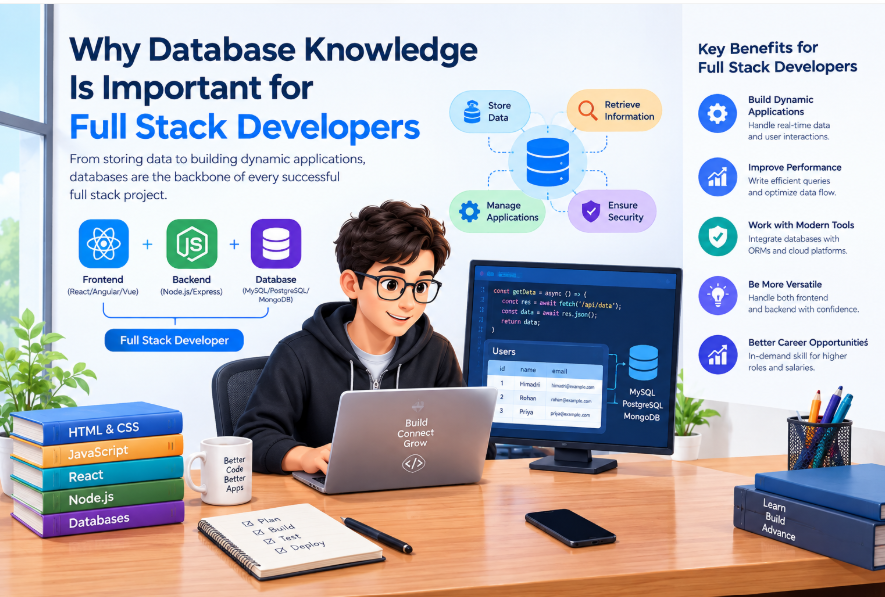
Every full stack developer knows how to build a beautiful frontend and a functional backend. But the…
Read More →