Roadmap to TCS: Your Step-by-Step Guide to Cracking the 2026 Hiring Process
Landing a job at Tata Consultancy Services (TCS) is a goal for countless graduates. As one of the world's largest IT services firms, TCS offers stability, clear career paths, and exposure to massive global projects. But with high hiring volumes come high expectations. This roadmap lays out a clear, step-by-step path to help you navigate the TCS recruitment process, from choosing the right entry path to acing the interview.
Step 1: Find Your Entry Point
TCS doesn't have a single hiring process; it has multiple tracks designed for different qualifications and career aspirations. Your first step is to identify which one is right for you.
For Engineering & Technology Graduates (BTech, BE, MTech, MCA, MSc):
Your primary route is the TCS National Qualifier Test (NQT) . This is a national-level online assessment that opens the door to the most prominent tech roles. You can also apply if you are from the 2024, 2025, or 2026 batches with up to two years of work experience.
For Science & Non-Engineering Graduates (BCA, BSc, BVoc):
The TCS Ignite & Smart Hiring 2026 program is specifically designed for you. It's a "Science to Software" initiative that offers training and a career path on par with engineering graduates. The application deadlines for this program are typically mid-year (e.g., the test is often in August), so timing is critical.
For Arts & Commerce Graduates (BCom, BA, BAF, BBA, etc.):
You are a perfect fit for TCS BPS (Business Process Services) Hiring. This track offers entry-level opportunities in TCS's rapidly growing business process units. It involves a separate test and application process, tailored for Arts and Commerce backgrounds.
For Experienced Professionals (2-4 years):
TCS has a dedicated skill-first hiring initiative for professionals with experience in technologies like Java, Python, SQL, and ReactJS. If you have 2 to 4 years of full-time IT experience, this fast-track program could be your path to a senior role, with salaries starting from ₹9 LPA.
Step 2: Ace the Online Test (NQT or BPS)
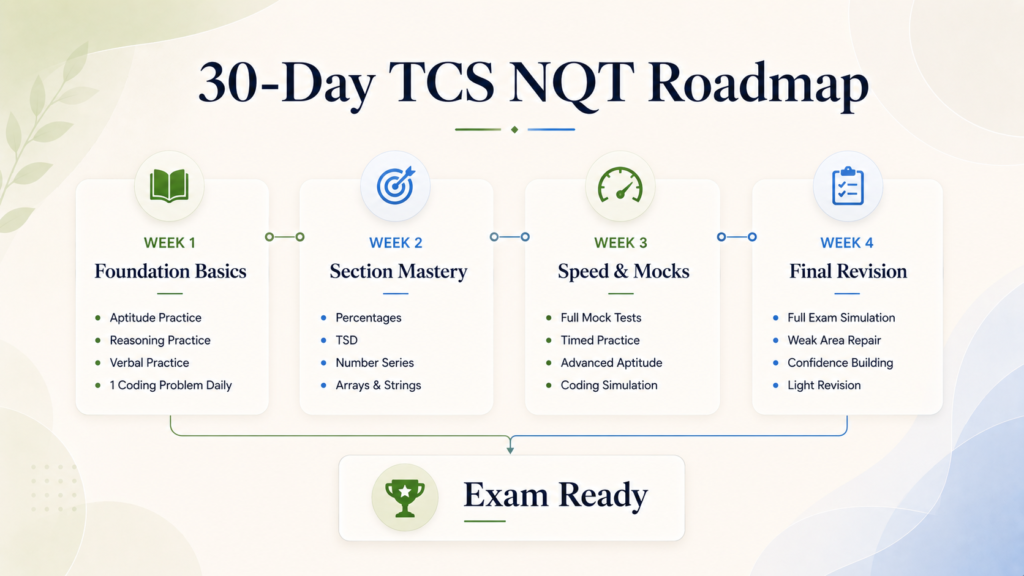
The online test is the first major hurdle. For the TCS NQT, there are two sections:
-
Foundation Section (75 mins): Tests aptitude (Verbal, Numerical, Reasoning).
-
Advanced Section (115 mins): Covers advanced quantitative ability and advanced coding. This section is mandatory if you are aiming for the high-paying Digital or Prime roles.
Preparation is key: Focus on clarity of concepts. As one candidate noted, "The coding questions test logic building rather than complex algorithms," but you must write complete programs from scratch, handling input, logic, and output formatting yourself. Practice writing code without relying on an IDE.
For the TCS BPS test, the exam is typically 50 minutes long and focuses exclusively on Verbal, Numerical, and Logical Reasoning.
Step 3: Understand the Role Levels (NQT Track)
Your performance in the NQT determines your role and salary package.
| Role | Approx. Salary (LPA) |
|---|---|
| Ninja | ₹3.36 LPA |
| Digital | ₹7.09 - ₹7.30 LPA |
| Prime | ₹9.09 - ₹12.26 LPA |
For the Digital and Prime roles, you will need to do particularly well in the NQT's Advanced section, as these are higher-paying and more competitive positions.
Step 4: Master the Interview Rounds
After clearing the online test, you will face a series of in-person interviews. The entire process from NQT to interview calls usually takes 1-2 weeks.
1. Technical Interview (30-45 mins)
This round focuses on your core Computer Science fundamentals and projects. Expect questions on:
-
Data Structures & Algorithms (DSA): Linked lists, trees, arrays, sorting, searching.
-
Database Management Systems (DBMS): SQL queries (e.g., nth highest salary), normalization, ACID properties.
-
Operating Systems (OS): Processes vs. threads, deadlocks, memory management.
-
Programming Languages: Be ready to explain your logic and write short code snippets. If you list a language on your resume, you must know its basics. For instance, in C, you might be asked to explain
mallocvscalloc, pointers, and storage classes. -
Your Projects: This is a major point of discussion. Be prepared to explain the problem you solved, the technologies you used, and the challenges you faced. "Interviewers dig deep into projects, so be honest about what you built versus what you learned from tutorials".
2. Managerial Round (10-15 mins)
This round assesses your attitude, team fit, and ability to handle pressure. You may be asked situational questions or have your technical answers challenged to see your reaction. The focus is often on teamwork, leadership, and communication.
3. HR Interview (10-15 mins)
This final round covers standard questions like:
-
Why TCS?
-
Are you willing to relocate or work in rotational shifts?
-
Do you have other offers?
-
Where do you see yourself in 5 years?
Pro-Tip: "For Prime roles, you need both strong DSA and development skills. They place you directly into projects, so practical framework knowledge matters," according to one candidate's experience.
Final Thought: Preparation is the Key
TCS interviews are not designed to trick you. They aim to see if you can communicate what you know clearly, think on your feet, and will fit into a large, structured organization. A correct answer delivered nervously often scores lower than a slightly incomplete answer explained with confidence. Focus on clarity, honesty, and a firm grasp of the fundamentals.
Contact Us
Phone: +91 9667708830
Email: info@codingnow.in
Website: https://codingnowai.in/
Address:
2nd Floor, Kapil Vihar (Opp. Metro Pillar No.354)
Pitampura, New Delhi – 110034
Backlink to main website: Explore Python and AI courses at Coding Now – Gurukul of Ai