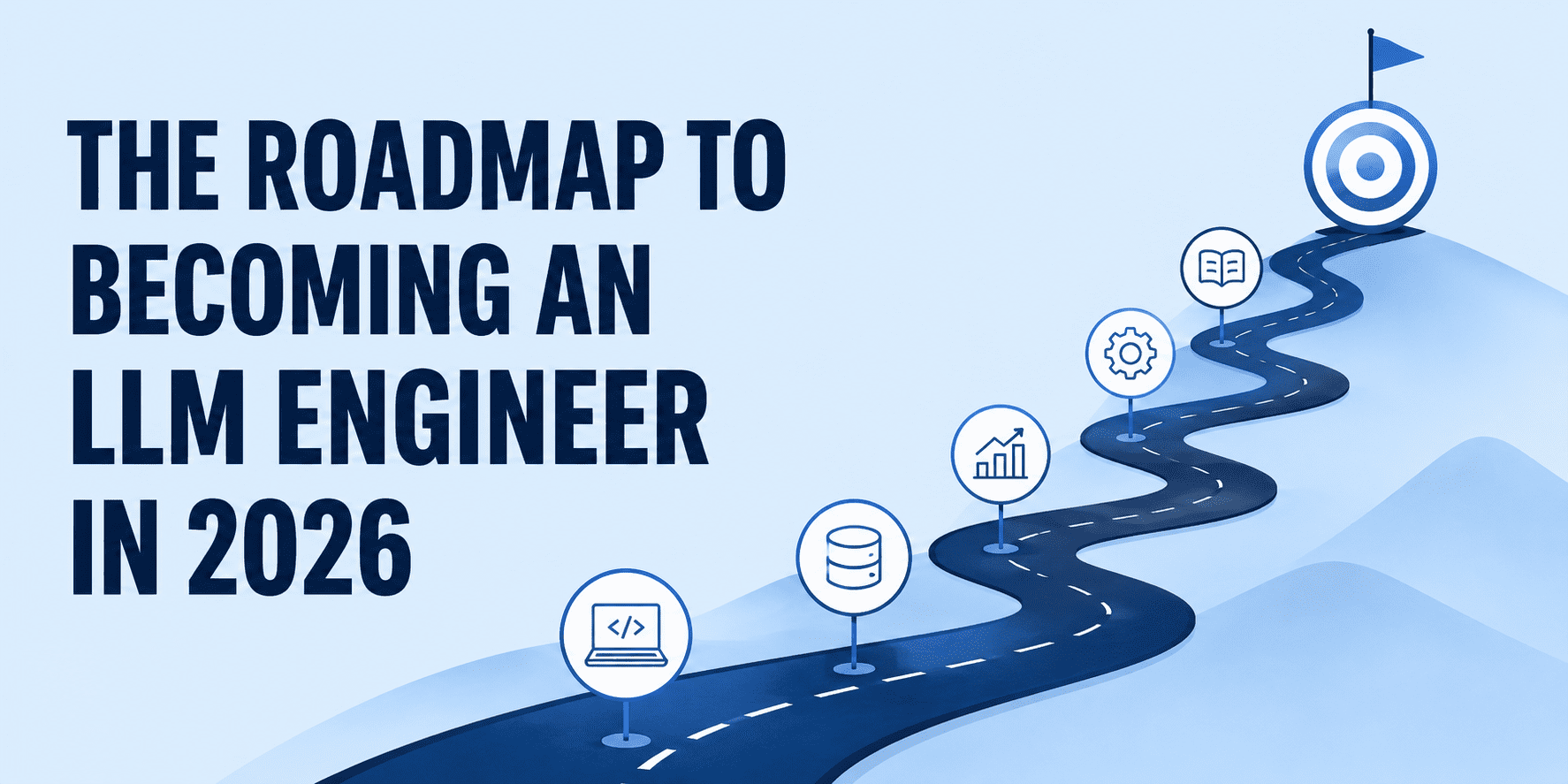
Roadmap to Become an LLM Specialist in 2026
Large Language Model (LLM) Specialists are the architects behind the AI systems that are transforming how businesses operate. They don't just use AI tools; they build and deploy them to solve complex business problems. This roadmap provides a structured, step-by-step plan to go from a solid foundation to a job-ready professional in this high-demand field .
First, Let's Bust a Few Myths
-
Myth 1: "I need a PhD or a $10,000 GPU." This is simply not true. Many LLM specialists start with just a strong grasp of Python and logic. You can begin using free LLM APIs from providers like OpenAI and Anthropic or even run smaller open-source models like Llama on a standard laptop .
-
Myth 2: "LLMs are just better search engines." They are far more powerful. LLMs can reason, write code, translate languages, and act as autonomous agents that complete multi-step tasks .
Phase 1: Build Your Strong Foundation (Months 1-2)
Before diving into LLMs, you need a firm grasp of the fundamentals. Trying to skip this step is a common mistake that makes debugging problems later nearly impossible .
1. Programming & Software Engineering
-
Python is Non-Negotiable: Python is the language of AI and is a core requirement for the vast majority of jobs in this field . Master the language, including:
-
Clean code, type hints, and dependency management.
-
Core software engineering habits: version control (Git), building APIs (FastAPI is a standard), and systematic testing .
-
-
Web Development: You should be familiar with the basics of web development to integrate your AI backend with a user interface. Learn backend and frontend fundamentals like FastAPI and React .
2. Machine Learning & NLP Fundamentals
-
Machine Learning Basics: Understand the core concepts: supervised vs. unsupervised learning, how neural networks learn, and the role of gradient descent .
-
NLP & The Transformer: Before working with an LLM, you should understand:
-
Tokenization: How raw text becomes numbers that a model can process .
-
Transformers: The architecture that powers nearly every modern LLM. Pay special attention to the self-attention mechanism, embeddings, and positional encoding .
-
Phase 2: Master Core LLM Skills & Tools (Months 3-4)
This is where you start building the specific skills that define an LLM Specialist.
1. Prompt Engineering & Context Management
-
Production-Grade Prompting: Learning to write good prompts is a key skill. You'll need to master different techniques like:
-
Zero-shot, Few-shot, and Chain-of-Thought (CoT) prompting to get the model to "think step-by-step" .
-
Requesting structured outputs (like JSON) and writing "system prompts" to set the model's role and constraints .
-
-
Context Engineering: Treat the context window as a resource. Learn how to manage, compress, and prioritize information fed into the model to get the best results .
2. Retrieval-Augmented Generation (RAG) & Vector Databases
This is the backbone of most production LLM applications. RAG allows an LLM to access your company's internal data, drastically reducing hallucinations .
-
Embeddings: Learn how to turn text into vectors (numerical representations of meaning) using models like
sentence-transformers. -
Vector Databases: You need a way to store and search these embeddings efficiently. Start with local options like Chroma or FAISS, then move on to production-grade tools like Pinecone, Weaviate, or Amazon OpenSearch with its vector engine .
-
Building RAG Pipelines: Learn how to build and debug a complete RAG pipeline. This includes chunking documents, designing retrieval strategies, and implementing hybrid search. A Document Q&A system is the classic project for this .
3. Orchestration Frameworks & APIs
-
Frameworks: You'll use tools like LangChain and LlamaIndex to connect your LLM to data, tools, and memory. This is where you go from a simple script to building a real system .
-
Working with APIs: Get hands-on experience with the core APIs of major providers like OpenAI, Anthropic (Claude), Google (Gemini), and AWS Bedrock. Master how to handle token limits, implement retries and error handling, and manage costs .
Phase 3: Advanced & Production Skills (Months 5-6)
This phase is critical to ensure your systems are reliable, safe, and ready for the real world. It's what separates a prototype from a product .
1. Agents & Tool Use
This is the fastest-growing area of the field . Agents can plan, reason, and use tools (like a search API or calculator) to achieve a goal autonomously .
-
Agent Architectures: Learn the core patterns like ReAct (Reasoning + Acting). Build agents that can call functions, manage state, and handle failures .
-
AI Agent Frameworks: Build multi-agent systems where specialized agents (e.g., a researcher and a writer) collaborate to solve complex problems .
2. Evaluation & Observability
-
Rigorous Evaluation: An AI system's output is probabilistic; you can't just write unit tests. You need to build an evaluation framework to measure output quality . This involves creating "golden datasets" and using metrics like faithfulness, answer_relevancy, and context_recall. The RAGAS framework is a standard for this .
-
Observability: You can't improve what you can't see. Set up monitoring for cost, latency, and drift. Tools like LangSmith, LangFuse, and OpenTelemetry are essential for tracing agent steps and debugging issues .
3. Fine-Tuning & Infrastructure
-
Fine-Tuning (Optional but Valuable): Learn to adapt a base model to your company's specific data or style. Techniques like LoRA (Low-Rank Adaptation) allow for faster and cheaper training .
-
Cloud & MLOps: Understand how to take a model to production. This includes working with cloud platforms (AWS, Azure, or GCP), using tools like Docker and Kubernetes for deployment, and setting up MLOps pipelines .
Your Career Path & Portfolio
The Role of an LLM Specialist
Your day-to-day work would likely involve:
-
Designing and fine-tuning LLM-based applications .
-
Building RAG pipelines so models can answer questions using proprietary company data .
-
Integrating LLM APIs into real-world applications .
-
Optimizing for cost, latency, and accuracy after the application is live .
-
Collaborating closely with data scientists, product managers, and software engineers .
Portfolio Projects That Get You Hired
Your portfolio is far more important than a pile of certificates . Build projects that demonstrate your skills:
-
A Document Q&A System: A robust RAG pipeline on a set of technical documents. This proves you understand vector databases, chunking, and retrieval quality .
-
An AI Agent with Tool Use: An agent that can make a plan and call external tools (like an API) to complete a multi-step task .
-
A Fine-Tuned Model: Even a small fine-tuning project on a specific niche task demonstrates you understand the training pipeline and model behavior .
Contact Us
Phone: +91 9667708830
Email: info@codingnow.in
Website: https://codingnowai.in/
Address:
2nd Floor, Kapil Vihar (Opp. Metro Pillar No.354)
Pitampura, New Delhi – 110034
Backlink to main website: Explore Python and AI courses at Coding Now – Gurukul of AI