Roadmap to Become an AI Expert in 2026
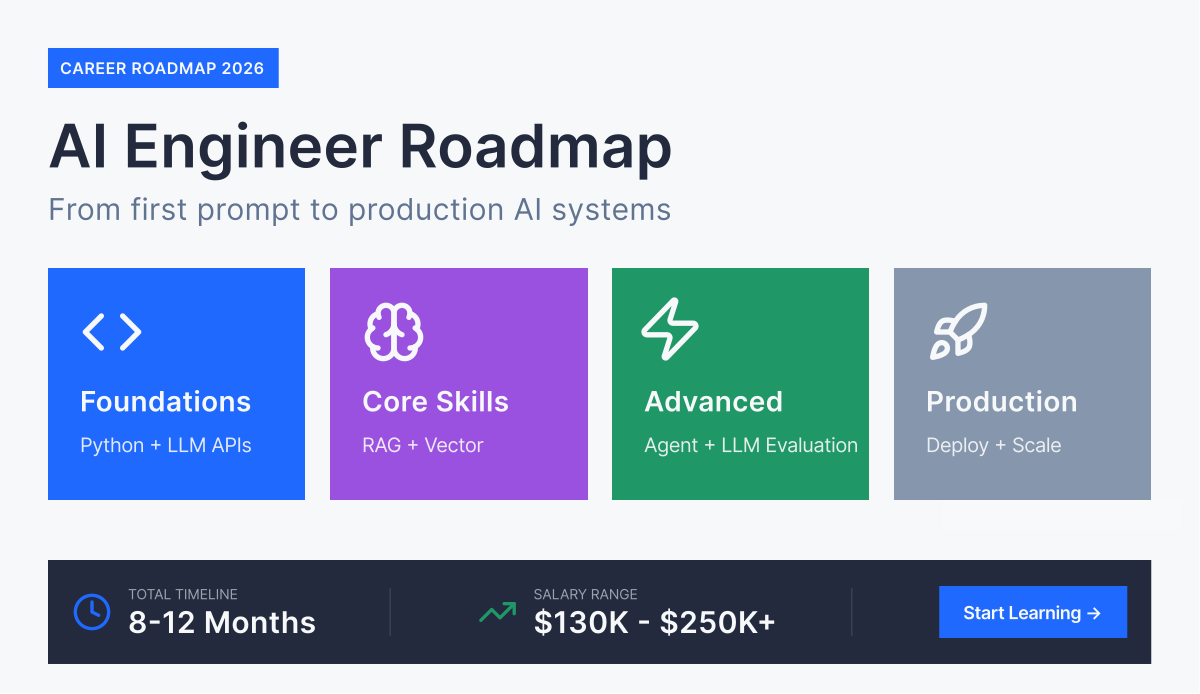
Becoming a true AI expert is not about chasing trends or completing a few short courses it's about deep technical understanding, production engineering, and building systems that solve real problems. This roadmap takes you from foundational skills to advanced AI expertise, with realistic timelines and a focus on hands-on project building.
What Does It Mean to Be an "AI Expert"?
A genuine AI expert moves beyond just using AI tools to engineering AI solutions. This involves:
-
System design and understanding model limitations
-
Production scalability, cost efficiency, and security
-
Evaluation systems to measure and improve performance
-
Integration thinking connecting AI with UX and business needs
Many who call themselves "AI Specialists" today lack this depth. Real expertise comes from building real things consistently, not just consuming content.
Step 1: Choose Your Path – Generalist vs. Expert Focus
AI roles fall into two broad categories, and your career path depends on which you pursue:
| Role Type | Focus | Best For |
|---|---|---|
| AI Generalist | Rapid prototyping, cross-functional integration, MVPs | Speed, flexibility, early-stage projects |
| AI Expert/Specialist | Advanced architectures, optimization, regulated industries, proprietary IP | Deep technical depth, research, mission-critical systems |
Key insight: Companies often start with generalists for flexibility and layer in experts as technical demands increase.
Step 2: Build Your Foundation (Months 1-2)
Python – Non-Negotiable
84% of AI engineering job postings require Python. Master:
-
Clean code, type hints, dependency management (
uv,poetry) -
Virtual environments and testing (
pytest) -
Libraries: NumPy, Pandas, Scikit-learn
Mathematics & Statistics
-
Linear algebra (foundation of neural networks)
-
Calculus (gradient descent)
-
Probability and statistics (model evaluation, distributions)
Resources: Khan Academy, 3Blue1Brown, YouTube tutorials.
Version Control & Software Engineering Basics
-
Git and GitHub
-
Basic software engineering practices (code review, documentation)
Goal: Write production-quality Python code and understand core math concepts. Commit 4 hours daily to build this foundation.
Step 3: Master Machine Learning Fundamentals (Months 2-3)
Core ML Concepts
-
Supervised vs unsupervised learning
-
Regression, classification, clustering
-
Model evaluation (overfitting, bias/variance, cross-validation)
-
Ensemble methods (Random Forest, XGBoost)
Project: Build a Predictive Model
Start with a classic dataset Titanic survival prediction is a great entry point.
Goal: Train and evaluate ML models confidently. Complete Andrew Ng's ML Course (free on Coursera).
Step 4: Dive into Deep Learning (Month 3-4)
Neural Network Architectures
| Type | Use Case |
|---|---|
| CNNs | Image classification, object detection |
| RNNs/LSTMs | Time series, sequential data |
| Transformers | NLP, BERT, GPT-style models |
Framework: PyTorch (Master This)
Build expertise in:
-
Tensors,
torch.nn.Module,torch.optim -
Custom datasets and DataLoader
-
Training loops, GPU acceleration, saving/loading models
-
Transfer learning (fine-tuning pretrained models)
Projects:
-
Image classifier with transfer learning (fine-tune ResNet on custom dataset)
-
Sentiment analysis comparing LSTM vs BERT
-
Mini GPT from scratch (implement full transformer architecture)
Goal: Build end-to-end deep learning models from scratch.
Step 5: Generative AI & LLM Engineering (Month 4-5)
Core Skills
-
LLM fundamentals: Tokens, context windows, temperature, system prompting
-
API Integration: OpenAI, Claude, Gemini, DeepSeek
-
Prompt Engineering: Zero-shot, few-shot, chain-of-thought techniques
Cost Management
API calls add up quickly. Always set spending limits. Use less expensive models for simple tasks and expensive models only when necessary.
Project: "Smart Content Factory"
Build a system that takes a single idea and transforms it into 5 different content formats (summary, Twitter thread, LinkedIn post, etc.)
Goal: Outputs ready-to-publish content requiring no manual editing.
Step 6: RAG Systems & Vector Databases (Month 5)
RAG connects AI to proprietary data—essential in healthcare, legal, and finance.
What to Learn
-
Document chunking strategies (handling tables, images, complex formatting)
-
Embeddings and vector search (Chroma for learning, Pinecone/Qdrant for production)
-
Hybrid search and retrieval evaluation (MRR, recall@k)
-
Common RAG problems: poor chunking, irrelevant retrievals, hallucinations
Project: "Second Brain" Telegram Bot
A Telegram bot using RAG to answer questions strictly based on your files (PDFs/Links). The bot should not hallucinate—referencing your documents directly.
Success criteria: Bot provides accurate answers based only on provided documents.
Step 7: Agentic AI & Tool Use (Month 5-6)
Agents represent the next level—systems that plan multi-step tasks, use tools, and iterate based on results.
Core Skills
-
Function calling / tool use: Models call APIs, search web, query databases
-
Agent patterns: ReAct, Plan-and-Execute, Reflection
-
Memory systems: Short-term (conversation history) and long-term (vector stores, knowledge graphs)
-
Model Context Protocol (MCP): Standardizes agent-to-tool connections
Project: "Multi-Agent Orchestrator"
Build an autonomous loop with Planner, Executor, and Reviewer agents collaborating to solve tasks. Implements a self-correcting feedback loop.
Goal: Complex multi-agent orchestration—the core pattern for 2026 AI systems.
Step 8: Production & MLOps (Month 6)
The skill that separates prototypes from products: getting AI systems reliably into users' hands.
Production Skills
| Area | What to Learn |
|---|---|
| Deployment | FastAPI for APIs, Docker containerization, serverless (AWS Lambda, Cloud Run) |
| Monitoring | OpenTelemetry, LangSmith/LangFuse for tracing, cost monitoring |
| Evaluation | Eval datasets, accuracy/relevance/faithfulness metrics, A/B testing |
| Guardrails | Input validation, output filtering, PII detection, cost caps, latency limits |
| Cloud Platforms | AWS (Bedrock, SageMaker), Azure (AI Studio), GCP (Vertex AI) |
Project: "Micro-SaaS for Business"
Build a full-featured web application that solves a narrow B2B problem (e.g., AI-powered legal contract generator) with working UI, user authentication, semantic caching, and Stripe payment integration.
Goal: Deploy a reliable, measurable, production-grade AI system.
Step 9: Specialize for Career Growth
Go broad, then go deep. Gain a general understanding, then pick a specialization based on your target role.
High-Demand Specializations in India (2026)
| Specialization | Use Cases | Salary Range |
|---|---|---|
| MLOps Engineer | Deploying models at scale; Docker, Kubernetes, ML pipelines | ₹22–55 LPA |
| GenAI Developer | Content tools, PDF chatbots, code assistants | ₹18–45 LPA |
| NLP Engineer | Chatbots, sentiment analysis, translation | ₹18–45 LPA |
| AI Research Scientist | Pushing AI frontiers; requires PhD/advanced research | ₹30–80 LPA |
| AI Testing Engineer | ML-powered automated testing (most accessible entry point) | ₹10–28 LPA |
Skills Demand Layers (Randstad Digital Report)
-
AI governance and ethics – Growing rapidly as compliance concerns rise
-
Prompt engineering and GenAI – Double-digit growth in LLM orchestration skills
-
Cloud AI and security – Enterprise deployment and risk management
Your 6-Month Action Plan
| Month | Focus | Key Deliverable |
|---|---|---|
| 1 | Python + Math + Statistics + Git | Write clean Python, use NumPy/Pandas |
| 2 | Core ML (Scikit-learn) + Andrew Ng course | Build and evaluate a predictive model |
| 3 | Deep Learning (PyTorch) + CNNs/RNNs | Build an image classifier |
| 4 | LLMs + RAG + Vector DBs | Build a PDF Q&A system |
| 5 | Agentic AI + Tool Use | Build a multi-step agent system |
| 6 | Production + Portfolio + Apply | Deploy 3-4 projects, start applying |
Daily commitment: 4-6 hours daily to complete this roadmap in 6 months.
Critical Success Rules for AI Experts
-
Build > Learn. Active practice beats passive learning. If you spend more than 40% of your time watching tutorials, flip the ratio.
-
Depth before breadth. Pick 2-3 skills and go deep rather than trying to learn everything. Deep skills compound faster.
-
Ship to production. A demo is not a product. The skill that separates builders from shippers is deploying reliable, measurable systems.
-
Embrace never-ending learning. AI expertise is a continuous journey—not a destination. The field evolves too quickly for any "expert" to stop learning.