PostgreSQL vs. MySQL: Which One Should You Learn in 2026?
If you are starting your journey into data or backend development, you have likely asked this question: "Should I learn PostgreSQL or MySQL?"
It is a great question—and the good news is that you cannot go wrong either way. Both are open-source, battle-tested relational databases that power everything from small websites to massive enterprise systems. They share about 90% of the same SQL syntax.
But they serve slightly different strengths. Here is how to decide.
The Short Answer: It Depends on Your Goal
| Your Goal | Best Choice |
|---|---|
| Quickly start a web app / simple CRUD | MySQL – easier to set up and widely supported |
| Build complex analytics, AI, or mapping features | PostgreSQL – advanced features like JSONB and PostGIS |
| Maximize job opportunities in 2026 | Both – but learn one deeply; the other will be easy to pick up |
According to the Stack Overflow Developer Survey, PostgreSQL has become the leading database among professional developers. However, MySQL remains the most widely deployed, showing up in approximately 70% of job postings.
The Key Differences
1. Architecture and Design Philosophy
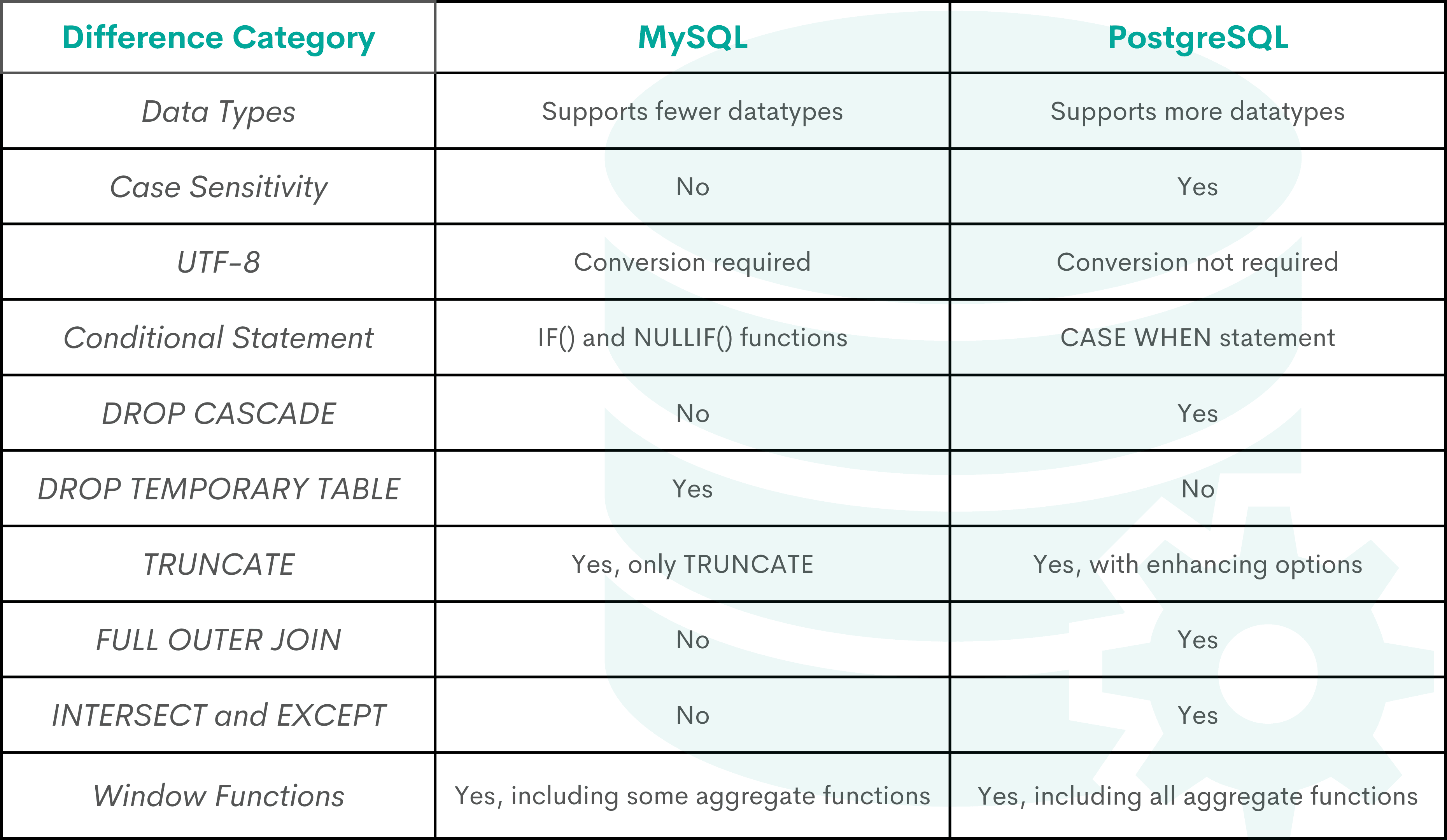
| Aspect | MySQL | PostgreSQL |
|---|---|---|
| Core Philosophy | "Simple and fast" – optimized for straightforward queries | "Advanced and extensible" – built for complex operations |
| SQL Compliance | Good, but with some quirks | High – closer to ANSI SQL standards |
| Extensibility | Limited plugin architecture | Deep extension ecosystem (PostGIS, pgvector, TimescaleDB) |
2. Advanced Features
PostgreSQL offers built-in features that would require separate tools with MySQL:
PostgreSQL strengths:
-
JSONB – fast, indexable JSON storage
-
Full-text search – advanced
tsvector/tsquerycapabilities -
Geospatial data – PostGIS extension for maps and location data
-
Materialized views – pre-calculated results for analytics
-
Partial and expression indexes – more flexible query optimization
-
pgvector – vector similarity search for AI applications
MySQL strengths:
-
Better replication tooling – battle-tested at Facebook, Twitter, and GitHub scale
-
Simple CRUD speed – often faster for high-volume primary-key lookups
-
Mature ecosystem – more documented operational patterns
3. Concurrency and Performance
-
PostgreSQL uses native MVCC (Multi-Version Concurrency Control) for efficient concurrent writes, making it better for systems with heavy write activity.
-
MySQL's InnoDB uses a more locking-heavy approach that can cause delays during high-write scenarios, but it is excellent for read-heavy workloads.
4. Learning Curve
MySQL is generally considered easier to learn first because:
-
It is simpler to install and configure
-
It has an enormous ecosystem of beginner-friendly tutorials
-
It powers common platforms like WordPress—so you can see it working quickly
However, many database professionals suggest learning PostgreSQL first because:
-
It forces you to learn proper SQL standards
-
Its advanced features give you more flexibility later
-
It is increasingly the preferred choice for new projects
Which One Gets You Hired?
MySQL still appears in more job postings overall, especially for web development and traditional companies. But PostgreSQL is rapidly catching up and often pays a premium:
| Certification | Potential Salary Range |
|---|---|
| PostgreSQL DBA | $100,000 – $145,000 |
| MySQL DBA | $85,000 – $125,000 |
The takeaway: both pay well. PostgreSQL skills tend to command slightly higher salaries because fewer developers have deep expertise in its advanced features.
Use Case Decision Matrix
| Use Case | Choose This | Why |
|---|---|---|
| Building a new web app (standard CRUD) | MySQL | Faster to get started, simpler operations |
| Building a data-intensive app with analytics | PostgreSQL | Better for complex queries and concurrency |
| Need JSON flexibility without losing ACID | PostgreSQL | JSONB is much more capable than MySQL's JSON |
| Need location/geospatial features | PostgreSQL | PostGIS is the industry standard |
| Need vector search (AI/embedding workloads) | PostgreSQL | pgvector extension is a huge advantage |
| Your company already uses one | Whatever they use | Consistency matters most |
The Real Answer: Learn SQL, Not Just a Database
Here is the best advice: learn one deeply, and the other will be easy to pick up.
The two systems share about 90% of their core SQL syntax. The real skill employers want is understanding relational theory, data modeling, query optimization, and indexing strategies—all of which transfer between databases.
If you are just starting your career, MySQL is a fantastic first choice—it gets you job-ready fast and builds your confidence. If you are more analytically inclined or building data-heavy applications, PostgreSQL gives you more room to grow.
Many medium-sized teams even use a hybrid approach: MySQL for transactional workloads (orders, payments) and PostgreSQL for analytical queries and data reporting.
Your Action Plan
-
This week: Start with one database—MySQL if you want to build web apps fast, or PostgreSQL if you want to work with data pipelines and advanced analytics.
-
Practice: Set up a local instance and build a simple CRUD app with it.
-
Learn SQL deeply: Focus on joins, subqueries, window functions, and indexing.
-
Then learn the other: Once you know one, you can learn the other in a few days.
Both PostgreSQL and MySQL are fantastic career investments. Pick one, learn it well, and start building—you can always add the other to your toolkit later.