5 Data Engineering Portfolio Projects That Actually Get You Hired in 2026
You have the certifications. You know Python, SQL, and Spark. But when you sit down for a technical interview, the hiring manager asks the same dreaded question: "What have you actually built?"
In data engineering, your resume gets you the call—but your portfolio gets you the job.
However, not all projects are created equal. Building another Titanic survival model or a basic web scraper will not cut it. Recruiters are looking for end-to-end data pipelines that solve real business problems using modern cloud tools.
Here are the 5 portfolio projects that will make hiring managers take notice—and the exact tech stack to use for each.
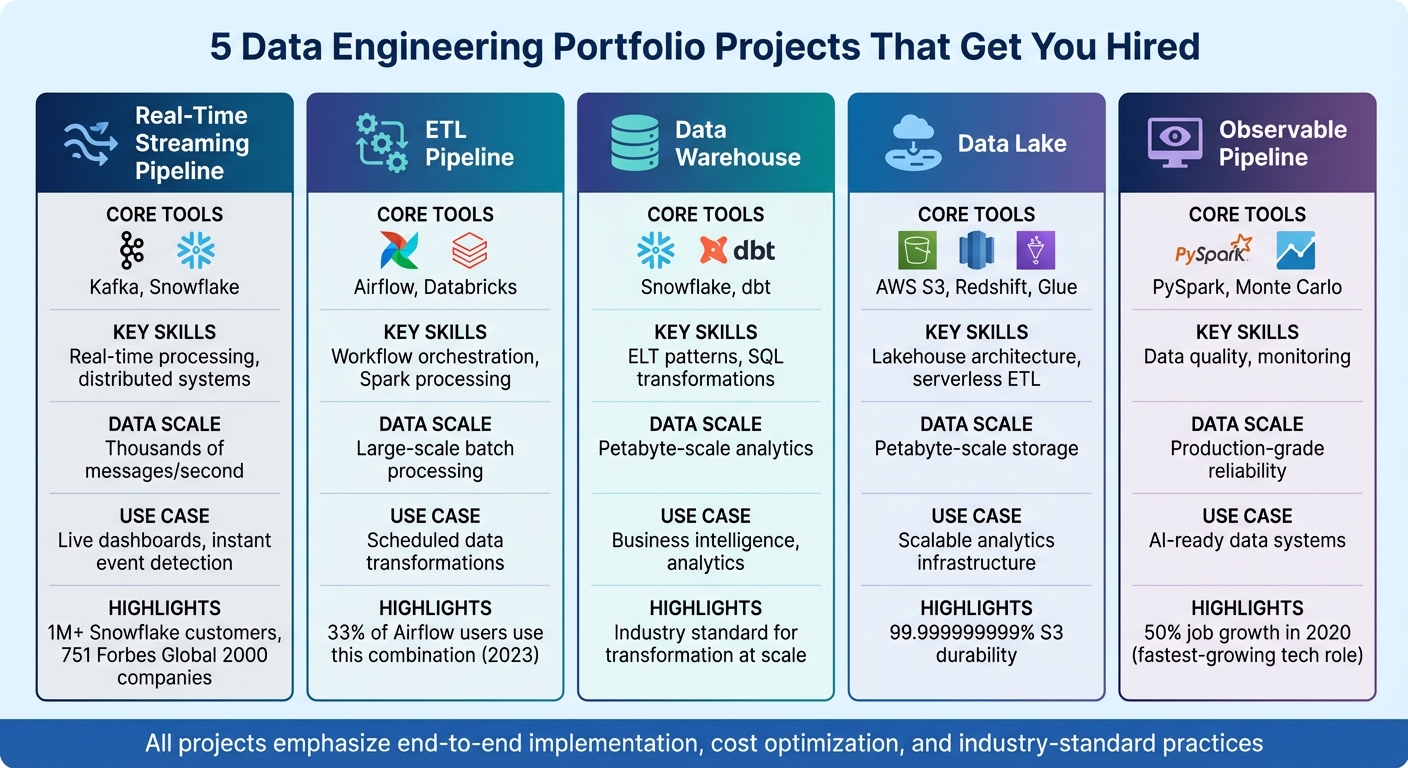
1. The Real-Time Streaming Pipeline (Kafka + Snowflake)
Why it gets you hired: Real-time data is the #1 skill gap in the market. If you can prove you can handle streaming data, you instantly stand out from 80% of candidates who only know batch processing.
The Project: Build a live dashboard that tracks trending topics on Reddit or Twitter (X) in real-time.
-
Use an API to pull streaming data.
-
Push it into Apache Kafka (or AWS Kinesis).
-
Use Spark Structured Streaming to perform windowed aggregations (e.g., "What are the top 5 trending hashtags in the last 5 minutes?").
-
Load the aggregated results into Snowflake or BigQuery.
-
Visualize it with a live-updating Tableau or PowerBI dashboard.
Key Skills Proved: Stream processing, event-driven architecture, window functions, and cloud messaging queues.
2. The "Slowly Changing Dimension" (SCD) Type 2 Pipeline
Why it gets you hired: 90% of enterprise data engineering is managing historical changes in dimensional tables (think: a customer moving from New York to Texas). Most juniors only know how to do "overwrites." Proving you know SCD Type 2 shows you understand data warehousing theory at a senior level.
The Project: Build a pipeline that tracks customer data from a source (e.g., a PostgreSQL OLTP database) and loads it into a data warehouse (like Redshift) while maintaining full historical audit trails.
-
Use Debezium + Kafka for Change Data Capture (CDC) to catch every update.
-
Use dbt (data build tool) to write the SQL logic that handles SCD Type 2 (adding
valid_from,valid_to, andis_currentflags). -
Schedule it with Airflow.
Key Skills Proved: CDC, dimensional modeling (Kimball), incremental loading strategies, and dbt expertise.
3. Cloud-Native ELT Pipeline (The "Modern Stack" Project)
Why it gets you hired: This is the "gold standard" portfolio piece. It mirrors exactly what you would do on Day 1 at a modern tech company (Fivetran + dbt + Snowflake + BI).
The Project: Extract data from three different APIs (e.g., Stripe for payments, HubSpot for CRM, and Google Analytics for web traffic). Load all raw JSON data into a cloud data lake/storage (e.g., AWS S3). Use an orchestrator (Airflow) to trigger transformations inside dbt to create a unified fct_revenue fact table. Finally, build a single executive dashboard showing "Revenue per Marketing Channel."
Tech Stack: Fivetran (or Airbyte) → S3/GCS → Snowflake/BigQuery → dbt → Looker Studio/Superset.
Key Skills Proved: API integration, medallion architecture (Bronze/Silver/Gold layers), data modeling, and orchestrating complex dependencies.
4. Data Quality & Monitoring Framework (The "SRE" Project)
Why it gets you hired: The biggest headache for data teams is broken pipelines and bad data. If you can show you proactively monitor data quality, you are not just an engineer—you are a guardian of trust. This is a "purple unicorn" skill that gets you fast-tracked.
The Project: Build an automated data quality testing framework that runs after every ELT load.
-
Use Great Expectations or dbt-expectations to run tests (e.g., "No null values in
customer_id," "Revenue must be > $0," "Row count must be within 5% of yesterday's count"). -
If a test fails, trigger an alert via Slack or PagerDuty and automatically roll back the data load using Airflow retries.
Key Skills Proved: Data observability, automated alerting, Python scripting, and failure-handling logic.
5. The "Cost-Optimization" Pipeline (Serverless Architecture)
Why it gets you hired: Cloud bills are exploding. Companies are desperate for engineers who can build pipelines cheaply. This project proves you understand cost-efficiency, not just functionality.
The Project: Build a scheduled ETL job that runs completely serverless.
-
Use AWS Lambda or Google Cloud Functions to extract data from an API.
-
Use AWS Glue (serverless Spark) to transform the data.
-
Load it into S3 (Parquet format) and use Athena (serverless query) to allow analysts to run SQL on it.
-
Make sure the entire pipeline only runs on a schedule (e.g., once per hour) and shuts down completely when idle to minimize cost.
Key Skills Proved: Infrastructure-as-Cost awareness, Parquet/columnar file formats, serverless computing, and AWS/GCP native tools.
How to Present These Projects (The "Hiring Manager" Test)
Building the project is only half the battle. To get hired, you need to present it properly:
-
Open Source It: Put the code on GitHub with a detailed
README.md. Include architecture diagrams (draw.io is free) showing boxes, arrows, and data flow. Recruiters love visuals. -
Write a "Post-Mortem" Blog: For your best project, write a 5-minute blog post on Medium or Dev.to detailing one specific problem you faced (e.g., "How I handled API rate limits in my Kafka pipeline") and how you solved it. Link this on your resume.
-
Record a 3-Minute Loom Video: Do not assume the recruiter will read your code. Record a short screen-share walking through the pipeline, showing the data moving from source to final dashboard. Send this link with your job application.
Final Verdict: Start With Project #3
If you are overwhelmed, start with Project #3 (Cloud-Native ELT). It is the most representative of real work, uses the most popular modern tools, and you can build it over a weekend.
Remember: Recruiters are not looking for perfection. They are looking for proof that you can take messy raw data and turn it into clean, trusted, valuable insights. Build one of these projects deeply, and you will walk into your next interview with the confidence—and the receipts—to back it up.
Contact Us
Phone: +91 9667708830
Email: info@codingnow.in
Website: https://codingnowai.in/
Address:
2nd Floor, Kapil Vihar (Opp. Metro Pillar No.354)
Pitampura, New Delhi – 110034
Backlink to main website: Explore Python and AI courses at Coding Now – Gurukul of A