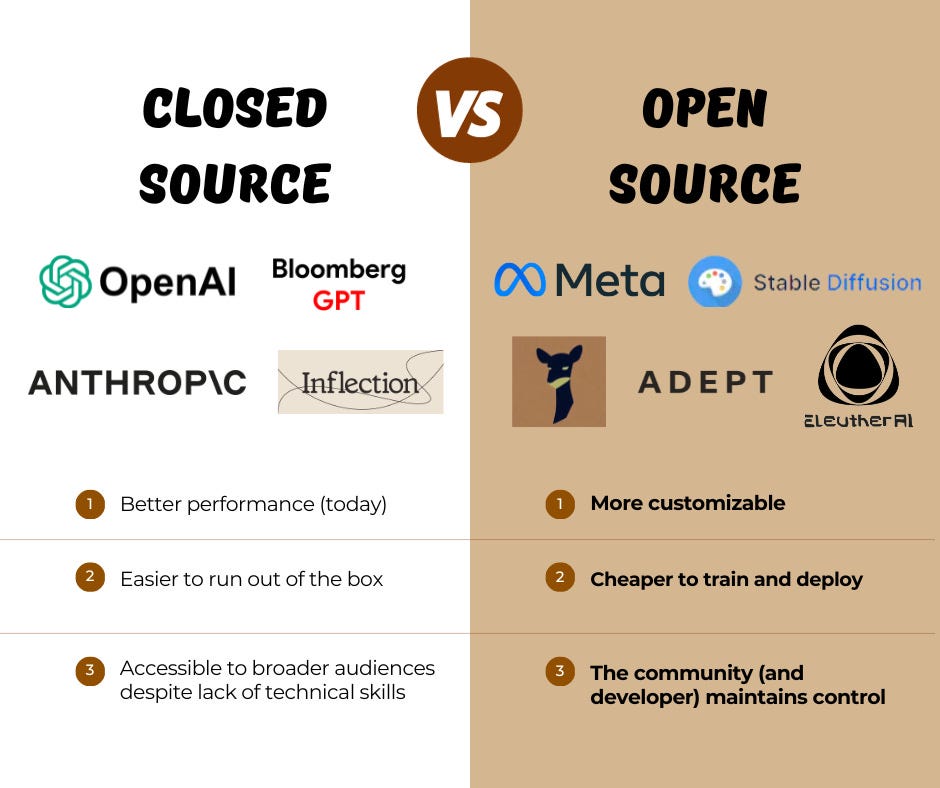
Open Source AI vs Closed AI Models: Which One Should You Choose?
Artificial Intelligence is no longer a futuristic concept—it's here, and it's transforming how businesses operate, create, and innovate. But when it comes to choosing an AI model, organizations face a critical decision: Should they go with open-source models or closed, proprietary ones?
This isn't just a technical choice—it's a strategic one that impacts your budget, data security, flexibility, and long-term growth. Let's dive deep into both worlds and help you make an informed decision.
What Are Closed AI Models?
Closed AI models are proprietary systems developed and controlled by large tech companies. Think of OpenAI's GPT-4, Google's Gemini, Anthropic's Claude, or Microsoft's Copilot. These models are like black boxes—you can use them, but you can't see inside.
How They Work:
-
You access them via APIs or subscription-based applications
-
The source code, training data, and internal architecture remain secret
-
The company handles all maintenance, updates, and infrastructure
-
You pay per token, per request, or via monthly subscriptions
The Good Side
1. Exceptional Performance
Closed models often lead the pack in general-purpose tasks. They excel at creative writing, complex reasoning, multilingual understanding, and nuanced conversations. For most everyday business needs, they deliver top-tier results out of the box.
2. Zero Infrastructure Hassle
You don't need to worry about servers, GPUs, or deployment. Just sign up, get an API key, and start building. This makes closed models perfect for startups and small teams without dedicated AI engineers.
3. Regular Updates
The companies behind these models continuously improve them. You automatically benefit from the latest advancements without lifting a finger.
4. Enterprise-Grade Support
Need help? These companies offer dedicated support, SLAs, and security guarantees—crucial for mission-critical applications.
The Dark Side
1. Sky-High Costs
Running closed models can be 6 to 10 times more expensive than open-source alternatives. Costs scale linearly with usage—the more you use, the more you pay. For high-volume applications, this can quickly become unsustainable.
2. Vendor Lock-In
Once you build your entire application around a specific API, switching providers becomes difficult and costly. You're essentially at the mercy of their pricing changes, feature updates, and even shutdowns.
3. Data Privacy Nightmares
Your data passes through their servers. Even with privacy guarantees, many organizations (especially in healthcare, finance, and government) are uncomfortable sending sensitive information to third-party APIs.
4. The Black Box Problem
You can't see why the model made a particular decision. This lack of transparency raises concerns about bias, hallucinations, and accountability—a critical issue for regulated industries.
5. No Customization
You get what you pay for. Want to fine-tune the model on your proprietary data? Good luck. Most closed models offer limited or no fine-tuning capabilities.
What Are Open Source AI Models?
Open-source AI models are publicly available models whose weights, and sometimes source code and training data, are shared freely. Examples include Meta's Llama, Mistral, DeepSeek, Gemma, and Falcon.
How They Work:
-
You download the model files and run them on your own infrastructure
-
You have full control over deployment, customization, and fine-tuning
-
The community contributes to improvements, bug fixes, and documentation
-
You pay only for the infrastructure you use
The Good Side
1. Dramatic Cost Savings
Open-source models often deliver 90% of the performance of leading closed models at a fraction of the cost. For high-volume, repetitive tasks (like customer support, data extraction, or document processing), the savings can be massive. Research shows that for 1 billion tokens, open-source models can cost around $1,600 compared to $36,000 for closed APIs.
2. Full Data Sovereignty
Your data stays entirely within your infrastructure. No third-party APIs, no compliance headaches, no accidental data leaks. This is a game-changer for industries with strict data regulations like healthcare (HIPAA), banking (GDPR), and defense.
3. Customization Superpowers
You can fine-tune open-source models on your proprietary data, making them experts in your specific domain. This often enables them to outperform general-purpose closed models for dedicated business workflows.
4. Transparency and Auditability
Because you can inspect the code and weights, you can identify and mitigate biases, verify performance claims, and understand how the model reaches its conclusions. This builds trust and accountability.
5. Independence and Control
No vendor lock-in. No sudden price hikes. No "we're discontinuing this API" surprises. You own your AI stack completely.
6. Community Innovation
The open-source community is vibrant and fast-moving. Bugs are fixed quickly, new features are added regularly, and knowledge is shared openly. You benefit from collective intelligence rather than a single corporate roadmap.
The Dark Side
1. Infrastructure Overhead
Running open-source models requires significant technical expertise. You need to manage servers, GPUs, deployment pipelines, scaling, and maintenance. This isn't trivial—it demands skilled AI engineers and DevOps resources.
2. Performance Gap
While the gap is shrinking, open-source models may still lag behind the absolute best closed models for novel, complex, or creative tasks. For most business use cases, however, this difference is negligible.
3. Security and Misuse Concerns
Because the models are freely available, they can be misused by bad actors for generating deepfakes, misinformation, or harmful content. While closed models have similar risks, open-source ones remove the gatekeepers.
4. Fragmentation
With dozens of models, frameworks, and versions, the open-source ecosystem can be confusing. Choosing the right model, optimizing it, and keeping it updated requires ongoing effort.
Head-to-Head Comparison
| Aspect | Closed Models | Open Source Models |
|---|---|---|
| Cost | Very high (pay-per-token) | Low (only infrastructure) |
| Performance | Best for general tasks | 90%+ of closed models, often beats them in domain-specific tasks |
| Customization | Limited or none | Full control, fine-tuning possible |
| Data Privacy | Data passes through third-party servers | Data stays in your infrastructure |
| Transparency | Black box | Fully auditable |
| Vendor Lock-in | High | None |
| Infrastructure | Provided by vendor | You manage it |
| Support | Enterprise-grade | Community-driven |
| Deployment Speed | Minutes (API) | Weeks to months |
| Best For | Quick prototypes, general tasks, small teams | Production systems, high volume, sensitive data, custom workflows |
Real-World Performance: The Numbers
Recent benchmarks show that leading open-source models are catching up fast:
-
DeepSeek-V3 matches GPT-4 on many benchmarks while being significantly cheaper to run
-
Meta's Llama 3 rivals Claude 3.5 Sonnet on reasoning and coding tasks
-
Mistral Large competes directly with GPT-4 Turbo at a fraction of the cost
The gap is shrinking every quarter. For many business applications, the performance difference is now negligible, especially after fine-tuning on domain-specific data.
Who Should Use What?
Choose Closed Models If:
-
You're building a quick prototype or proof-of-concept
-
You have no AI/ML expertise in-house
-
You need immediate, top-tier performance for creative tasks
-
Your usage volume is low (a few thousand tokens per month)
-
You don't handle sensitive data
-
You prefer paying for convenience over building infrastructure
Choose Open Source Models If:
-
You handle sensitive or regulated data (healthcare, finance, government)
-
Your usage volume is high (millions or billions of tokens)
-
You need domain-specific expertise
-
You want long-term cost predictability
-
You have in-house AI/ML talent
-
You value independence and want to avoid vendor lock-in
-
You care about transparency and auditability
The Future: Hybrid is the Way
The future isn't open vs closed—it's both. We're already seeing:
-
"Closed" companies releasing open-weight models (Google's Gemma, Microsoft's Phi)
-
Open-source deployment becoming easier with platforms like Hugging Face, Ollama, and vLLM
-
Hybrid architectures where businesses use closed APIs for experimentation and open-source for production workloads
The smart strategy is to adopt a "right tool for the right job" philosophy:
-
Use closed models for quick experiments and novel tasks
-
Migrate high-volume, repetitive workflows to open-source models
-
Fine-tune open-source models on your proprietary data for competitive advantage
-
Keep your sensitive data out of third-party APIs
Final Verdict
Let's be real: For most serious, production-grade AI applications, open-source is the smarter long-term choice. The cost savings, data sovereignty, customization power, and independence are simply too compelling to ignore.
Closed models still have their place—especially for quick experimentation, creative work, and teams without technical resources. But as open-source models continue to close the performance gap, their dominance in production systems will only grow.
The real question isn't "open or closed?"
It's "how can I strategically use both to maximize value?"
Getting Started with Open Source AI
Ready to explore open-source AI? Here's where to start:
-
Begin with Hugging Face – The largest repository of open-source models
-
Try Ollama – Run models locally with a simple CLI
-
Experiment with vLLM – For high-performance deployment
-
Explore popular models: Llama 3, Mistral, DeepSeek, Gemma
-
Start small – Run a model locally, test it with your data, and scale gradually
Contact Us
Phone: +91 9667708830
Email: info@codingnow.in
Website: https://codingnowai.in/Address:
2nd Floor, Kapil Vihar (Opp. Metro Pillar No.354)
Pitampura, New Delhi – 110034
Backlink to main website: Explore Python and AI courses at Coding Now – Gurukul of AI