OLTP vs. OLAP: The Two Engines Powering Your Data World
Imagine you're at your favorite online store. You add a pair of shoes to your cart, enter your payment details, and click "Place Order." In that instant, a database springs into action, recording the transaction, updating inventory, and confirming your purchase. A few hours later, the store's management runs a report to see which shoe styles are selling best this month, so they can plan their next marketing campaign.
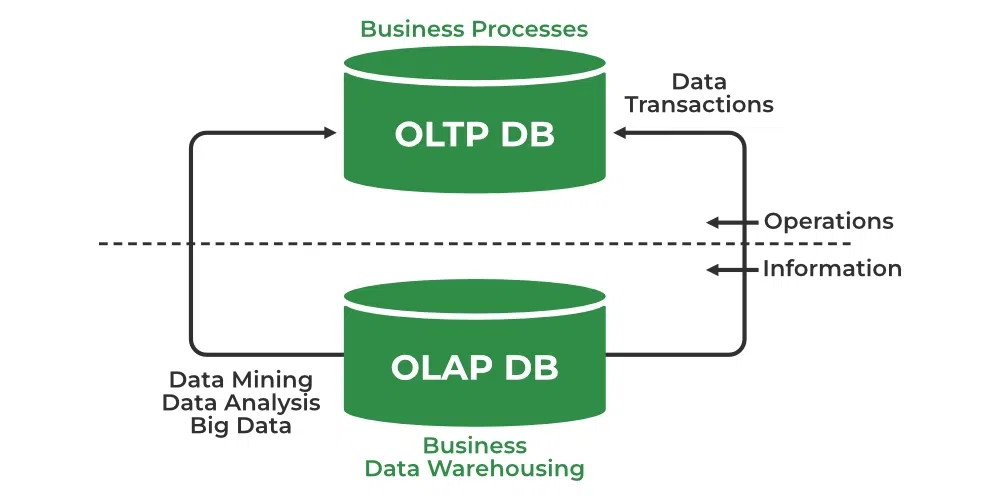
These two scenarios represent the fundamental difference between two types of database systems: OLTP and OLAP. While they both deal with data, they are built for entirely different purposes. In short, OLTP is for running your business, and OLAP is for understanding it .
Let's break down what each one does, why they're different, and why most successful companies use both.
What is OLTP? The Engine of Daily Operations
OLTP stands for Online Transaction Processing . It's the system that powers the day-to-day transactions of a business. Every time you make a purchase, book a flight, withdraw cash from an ATM, or update your profile on a website, you're using an OLTP system .
These systems are designed for speed, reliability, and handling a massive number of simple, short transactions simultaneously . Think of them as the workhorses of the data world, built for:
-
High Volume, Small Transactions: They process thousands of operations per second, like inserting a new order or updating a customer's address . The queries they handle are typically simple, involving just one or a few records .
-
Unwavering Accuracy and Consistency: For a banking system, it's absolutely critical that money isn't lost or double-counted. OLTP systems guarantee this by adhering to ACID principles (Atomicity, Consistency, Isolation, Durability) . This ensures every transaction is processed reliably.
-
Real-Time, Current Data: OLTP databases always reflect the most up-to-date state of your business . They are continuously updated as new transactions occur.
-
Efficient Data Storage: To avoid errors and save space, data in OLTP systems is organized in a highly normalized way. This means information is broken down into many small, related tables to reduce redundancy .
Key Characteristics & Users:
-
Data Focus: Current, real-time data.
-
Typical Users: Customer-facing staff (e.g., cashiers, bank tellers) and end-users like online shoppers .
-
Examples: E-commerce checkout systems, banking transaction processing, hotel reservation systems, ATM withdrawals .
What is OLAP? The Engine of Business Insight
OLAP stands for Online Analytical Processing . While OLTP systems collect data, OLAP systems are designed to analyze it. They are the backbone of business intelligence, data mining, and strategic decision-making .
Instead of handling individual transactions, OLAP systems take large volumes of historical data to help you spot trends, patterns, and anomalies. They are built for complex analysis, not for speed in writing data . Think of them as the brains of your data strategy, optimized for:
-
Complex, Read-Heavy Queries: An analyst might run a query to find "total sales for product X in the Northeast region during the last three holiday seasons." This query needs to sift through millions of records to provide an answer .
-
Multi-Dimensional Analysis: This is where the classic "OLAP cube" comes in. An OLAP cube allows you to view data across multiple dimensions, such as time, geography, product, and customer demographics . This lets you "slice and dice" data to get answers from any perspective.
-
Historical and Aggregated Data: OLAP systems store data over long periods, often years, and often pre-summarize or aggregate it to make queries run faster .
-
Specialized Data Structures: Instead of the normalized tables of OLTP, OLAP systems use denormalized or dimensional schemas (like star or snowflake schemas) and often use column-oriented storage which is much faster for scanning large amounts of data for specific attributes .
Key Characteristics & Users:
-
Data Focus: Historical, aggregated, summarized data.
-
Typical Users: Data analysts, data scientists, business intelligence professionals, and executives making strategic decisions .
-
Examples: Sales forecasting, financial analysis, market research, customer behavior analysis, and strategic planning .
The Key Differences at a Glance
| Feature | OLTP (Transactional) | OLAP (Analytical) |
|---|---|---|
| Primary Purpose | Record and manage everyday transactions | Analyze data to support business decisions |
| Data Focus | Current, operational data | Historical, consolidated data |
| Query Type | Simple, fast inserts, updates, and deletes | Complex, read-heavy aggregations and joins |
| Data Structure | Highly normalized | Denormalized, dimensional (e.g., star schemas) |
| Storage Method | Row-oriented | Column-oriented or cube-based |
| Performance Goal | Speed and data integrity for every transaction | Fast processing of complex analytical queries |
| Typical Users | Customer-facing staff & end-users | Data analysts, scientists, and business leaders |
They're Better Together
Historically, OLTP and OLAP systems have been separate. An organization's operational data is generated in OLTP systems, and then that data is extracted, transformed, and loaded (ETL) into a separate OLAP data warehouse for analysis .
This separation prevents complex analytical queries from slowing down the critical, real-time operations of the business . However, the trend is moving toward HTAP (Hybrid Transactional/Analytical Processing) systems that can handle both workloads in a single platform, offering the promise of real-time analytics on transactional data .
Ultimately, choosing between OLTP and OLAP isn't about which one is "better." It's about using the right tool for the right job. You need OLTP to keep your business running smoothly today, and you need OLAP to make smart decisions for a better tomorrow.
Contact Us
Phone: +91 9667708830
Email: info@codingnow.in
Website: https://codingnowai.in/
Address:
2nd Floor, Kapil Vihar (Opp. Metro Pillar No.354)
Pitampura, New Delhi – 110034
Backlink to main website: Explore Python and AI courses at Coding Now – Gurukul of AI