The Big Question
Let us ask you something directly.
You are trying to build a career in AI. You see job postings for "Prompt Engineers" with attractive salaries. You also see roles for "Machine Learning Engineers" that require fine-tuning models. You think to yourself: "Which skill should I learn? Which one pays more? Which is more future-proof?"
We hear these questions every week from students and professionals who visit our center near Pitampura Metro.
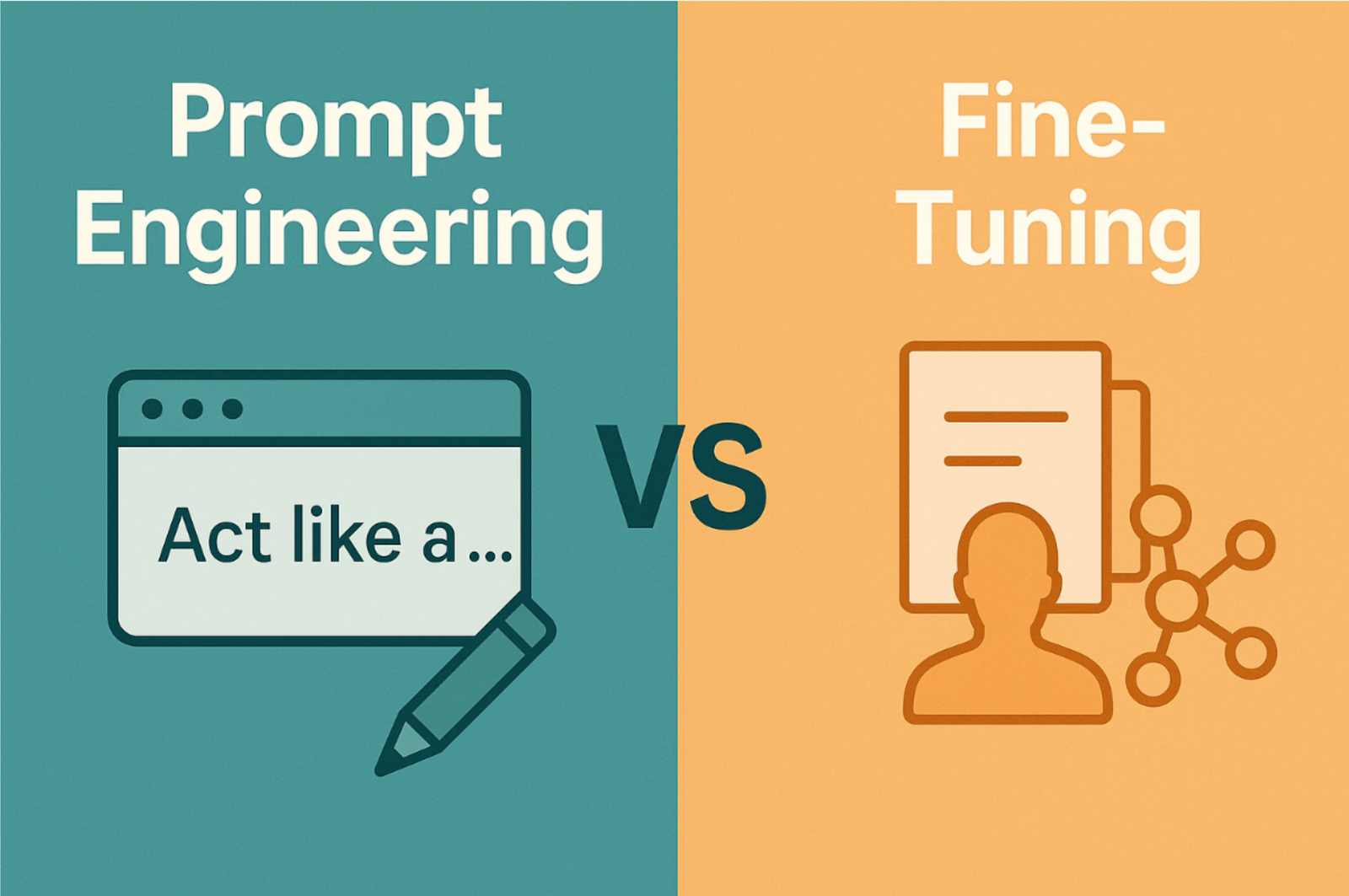
Here is the honest answer: prompt engineering is easier to learn and can get you quick results. Fine-tuning requires more technical knowledge but offers deeper control over model behavior. The best AI professionals learn both and understand when to use each .
Step 3: What is Prompt Engineering? (The Simple Explanation)
The Simple Definition:
Prompt engineering is the practice of designing and refining the inputs (prompts) you give to a large language model to get better, more accurate, and more relevant outputs . You are not changing the model itself. You are learning to communicate with it more effectively.
Think of It Like This:
Imagine you have a very capable but literal assistant. If you say "Write a marketing plan," you get something generic. If you say "Write a one-page marketing plan for a new coffee subscription service called 'Bean Box.' Target young professionals aged 25-35. Focus on Instagram and TikTok strategies," you get something useful . Prompt engineering is learning to give better instructions.
What Prompt Engineering Actually Involves:
| Technique | What It Does |
|---|---|
| Clear Instructions | Being specific about what you want |
| Role Definition | Telling the model to act as an expert (e.g., "You are a cybersecurity expert") |
| Few-Shot Examples | Showing examples of the desired output |
| Output Formatting | Specifying JSON, bullet points, or other formats |
| Chain-of-Thought | Asking the model to reason step-by-step |
Advantages of Prompt Engineering:
| Advantage | Why It Matters |
|---|---|
| Fast and Flexible | You can modify prompts instantly without retraining |
| Low Cost | No need for GPUs or large datasets |
| No Technical Skills Required | Anyone with clear communication skills can learn it |
| Works Across Models | Prompts can be adapted for different LLMs |
Limitations of Prompt Engineering:
| Limitation | What It Means |
|---|---|
| Inconsistent Results | Small wording changes can produce different outputs |
| Limited Customization | Cannot teach the model new knowledge |
| Context Window Limits | Long prompts consume token budget |
| No Fix for Knowledge Gaps | If the model lacks specific domain knowledge, prompts won't fix it |
Step 4: What is Fine-Tuning? (The Simple Explanation)
The Simple Definition:
Fine-tuning is the process of retraining a pre-trained language model on a specific dataset to adapt its behavior for a specialized task or domain . Unlike prompt engineering, fine-tuning changes the model itself by adjusting its internal weights .
Think of It Like This:
If prompt engineering is giving better instructions to a generalist assistant, fine-tuning is like sending that assistant to a specialized training program. After fine-tuning, the model becomes an expert in your specific domain—whether that is medical terminology, legal documents, or your company's brand voice .
What Fine-Tuning Actually Involves:
| Step | What It Does |
|---|---|
| Data Preparation | Creating a labeled dataset for your specific task |
| Model Training | Retraining the model on your data (often using LoRA/QLoRA) |
| Evaluation | Testing the fine-tuned model for accuracy and consistency |
| Deployment | Hosting the custom model for inference |
Advantages of Fine-Tuning:
| Advantage | Why It Matters |
|---|---|
| Consistent Output | Once trained, the model behaves predictably |
| Domain Expertise | The model learns specialized vocabulary and knowledge |
| Lower Inference Cost | Shorter prompts needed after fine-tuning |
| No Prompt Fragility | Less sensitive to wording variations |
Limitations of Fine-Tuning:
| Limitation | What It Means |
|---|---|
| High Cost | Requires GPUs, infrastructure, and technical expertise |
| Time-Consuming | Weeks to months to deploy |
| Data Requirements | Needs large, high-quality labeled datasets |
| Catastrophic Forgetting | Model may lose some general reasoning ability |
| Less Flexible | To adapt to new tasks, you need to retrain |
Step 5: The Head-to-Head Comparison
Let us put everything side by side.
| Aspect | Prompt Engineering | Fine-Tuning |
|---|---|---|
| What It Changes | The input (prompt) | The model itself (weights) |
| Time to Implement | Hours to days | Weeks to months |
| Cost | Low (API tokens only) | High (GPUs, infrastructure) |
| Technical Skill Needed | Low | High (ML expertise) |
| Consistency | Variable | Stable and predictable |
| Flexibility | High (change anytime) | Low (needs retraining) |
| Data Needed | Examples and instructions | Large labeled datasets |
| Best For | Prototyping, multiple tasks | Specialized, high-volume tasks |
Step 6: The 2026 Reality—The Question Is Wrong
According to a detailed 2026 analysis of the latest research, the question "Should I fine-tune or prompt engineer?" is actually the wrong question .
Why the Question Is Wrong:
| Misconception | Reality |
|---|---|
| "Prompt engineering is just typing" | In 2026, prompt engineering is a real engineering discipline with programmatic optimization frameworks like DSPy and GEPA |
| "Fine-tuning is only for labs" | Fine-tuning has become dramatically cheaper and more accessible. Tools like Unsloth now run GRPO fine-tuning on a single GPU |
| "You have to choose one" | The best applications use both, along with RAG and tool use |
The Truth:
Prompt engineering and fine-tuning optimize different objects:
-
Prompt engineering edits the input. It is fast, cheap, and flexible.
-
Fine-tuning updates the weights. It is expensive, slow, but permanent .
According to a 2026 ICLR Oral paper on GEPA (a prompt optimization framework), natural language is actually a higher-bandwidth feedback signal than a scalar reward . A sentence like "the JSON parser failed because line 4 had a trailing comma" tells the model more than a reward of 0.43 .
Step 7: The Decision Framework—Which Should You Learn?
According to the latest guidance, the smartest order is simple: start with prompting. Only consider fine-tuning when prompting, retrieval (RAG), and tool use have been tested .
The Diagnostic Question:
One question separates the levers clearly: "Is the gap about what the model knows, or how the model behaves?"
| If the Gap Is About... | Use This |
|---|---|
| What the model knows (missing facts, outdated facts, proprietary information) | RAG (Retrieval-Augmented Generation) |
| How the model behaves (tone, format, consistency) | Start with Prompt Engineering |
| How the model behaves and prompting is not enough | Fine-Tuning |
When to Start with Prompt Engineering:
| Use Case | Why |
|---|---|
| Quick prototyping | Fast iteration without infrastructure |
| Multiple tasks with one model | Easy to switch between different use cases |
| Limited data or budget | No training data or GPUs needed |
| Creative or flexible tasks | Inconsistency is acceptable |
When to Invest in Fine-Tuning:
| Use Case | Why |
|---|---|
| High-stakes applications | Errors are costly (healthcare, finance, legal) |
| Domain expertise needed | Medical, legal, or proprietary knowledge |
| Consistent behavior required | Brand voice, tone, format |
| High volume at scale | Reduced per-request costs over time |
Step 8: What This Means for Your Career
| If You Are... | Recommended Focus |
|---|---|
| A beginner | Start with prompt engineering. It is the fastest way to get results and build confidence |
| A developer | Learn both. Start with prompting, then add fine-tuning for specialized tasks |
| A student | Build a portfolio with real projects. A public demo of a retrieval system or a fine-tuned model demonstrates competence more directly than any course completion |
Top Skills to Learn in 2026:
| Skill | Why It Matters |
|---|---|
| Prompt Engineering | The first lever any LLM engineer reaches for |
| Programmatic Prompt Optimization | Frameworks like DSPy treat prompt construction as an optimization problem |
| Parameter-Efficient Fine-Tuning | LoRA and QLoRA are standard starting points |
| RAG and Vector Databases | Connects models to external knowledge |
| Tool Calling and Agents | Building systems that act, not just respond |
The Harsh Reality:
As one developer noted, "fine-tuning should not be the default starting point. It should enter the conversation only when prompting, retrieval, and tool use have been tested and a measurable behavior or format gap still remains" . The biggest mistake organizations make is fine-tuning to fix a knowledge problem .
Step 9: How Coding Now Prepares You
At Coding Now – Gurukul of AI, we teach both prompt engineering and fine-tuning as part of our programs.
Our Relevant Programs:
| Program | Duration | Skills Covered |
|---|---|---|
| AI Engineering Diploma | 6 months | Python, ML, LLMs, RAG, LangChain, Fine-Tuning, Multi-Agent Systems |
| Data Science | 4 months | Python, Pandas, NumPy, Statistics, ML, SQL |
What We Teach:
| Skill Area | Specific Skills |
|---|---|
| Prompt Engineering | System messages, few-shot examples, chain-of-thought |
| RAG and Vector Databases | Retrieving external knowledge |
| Fine-Tuning | LoRA, QLoRA, parameter-efficient training |
| Agentic AI | LangChain, tool calling, multi-agent systems |
Our Location: 2nd Floor, Kapil Vihar, opposite Metro Pillar No.354, Pitampura, New Delhi – 110034
Step 10: Frequently Asked Questions
Q1: Which is more important: prompt engineering or fine-tuning?
Both are important. In most cases, you should start with prompt engineering. Fine-tuning is only needed when prompting alone cannot solve the behavior gap reliably .
Q2: Is prompt engineering a real skill?
Yes. In 2026, prompt engineering is a craft that can yield 10x better results. It is not just a job title—it is a skill that differentiates effective AI users from average ones .
Q3: Do I need to learn fine-tuning to get an AI job?
Not necessarily. Many LLM engineers spend most of their time on prompting, retrieval, and tool calling. However, understanding fine-tuning is valuable for roles that require consistent, domain-specific behavior .
Q4: Which is cheaper: prompt engineering or fine-tuning?
Prompt engineering is much cheaper. You only pay for API tokens. Fine-tuning requires GPUs, infrastructure, and data preparation .
Q5: Can I combine prompt engineering and fine-tuning?
Yes. The most effective generative AI applications often use multiple strategies together .
Step 11: Final Tagline
"Start with Prompt Engineering. Add Fine-Tuning Only When Needed. Master Both and Master AI."
Hashtags:
#PromptEngineering #FineTuning #AI #LLM #AICareers #AIEngineering #CodingNow #GurukulOfAI
Step 12: A Note on Your AI Learning Journey
The evidence is clear: fine-tuning and prompt engineering are not mutually exclusive. They are complementary methods that you can combine to meet different optimization goals .
Prompt engineering is the quickest and least expensive optimization strategy. You can start immediately without any infrastructure changes. Fine-tuning produces the most consistent model behavior because the desired patterns are embedded in the model's weights .
The best AI professionals learn both. They start with prompting, add RAG for knowledge gaps, and only fine-tune when consistent behavior is required and prompting cannot solve the problem .
At Coding Now, we teach the skills that matter for the AI era. Come visit us. Take a free demo class. See what is possible.
Your AI learning journey starts now.
Contact Us
Phone: +91 9667708830
Email: info@codingnow.in
Website: https://codingnowai.in/
Address:
2nd Floor, Kapil Vihar (Opp. Metro Pillar No.354)
Pitampura, New Delhi – 110034
Backlink to main website: Explore AI Engineering Diploma and other courses at Coding Now – Gurukul of AI