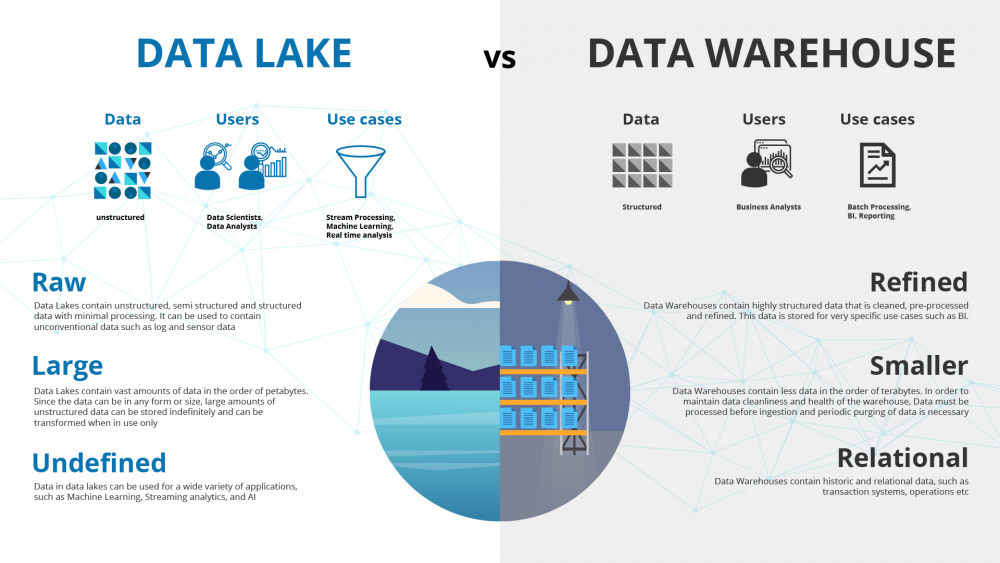
Data Warehouses vs Data Lakes
Imagine you're moving to a new house. You have two options for storing your belongings:
Option A: A sleek, modern apartment with labeled closets, shelves, and drawers. Everything has a designated place. Your clothes are folded, books are alphabetized, and kitchen utensils are neatly arranged. Finding your coffee maker takes 10 seconds.
Option B: A massive warehouse where you can dump everything—furniture, boxes, old photo albums, sports equipment—in huge piles. There's no organization, but you can store anything, and you can throw it in there instantly. Finding your coffee maker might take 2 hours, but at least you have room for that antique couch you inherited.
This is the core difference between a Data Warehouse (Option A) and a Data Lake (Option B).
Both are storage solutions for data, but they serve fundamentally different purposes. Choosing the wrong one can cost your company millions in wasted time, money, and missed opportunities.
In this guide, we'll break down what each is, their key differences, when to use which, and why the modern trend is to use both together.
What is a Data Warehouse? (The "Structured" Home)
A Data Warehouse is a centralized repository designed to store structured, processed, and highly organized data. It is optimized for analysis and reporting.
Think of it as a giant, well-organized library.
Key Characteristics:
-
Schema-on-Write: You define the structure (the "schema") before you load the data. You decide what columns exist, what data types they are, and how they relate to each other. If the data doesn't fit the format, it gets rejected.
-
Cleaned and Transformed: Data is heavily processed (ETL/ELT) before it enters the warehouse. It is cleaned, deduplicated, and transformed into a consistent format.
-
Query Performance: Because the data is structured and optimized, queries run incredibly fast. You can ask complex questions ("Show me total sales by region for the last 5 years") and get answers in seconds.
-
Users: Business analysts, data analysts, and decision-makers who need reliable, consistent reports and dashboards (e.g., Tableau, PowerBI).
Popular Tools:
-
Snowflake
-
Google BigQuery
-
Amazon Redshift
-
Azure Synapse
Best For:
-
Business Intelligence (BI): Dashboards, weekly sales reports, financial reconciliation.
-
Operational Reporting: "How many orders shipped yesterday?"
-
Historical Analysis: Comparing performance across consistent, clean datasets.
What is a Data Lake? (The "Raw" Warehouse)
A Data Lake is a massive storage repository that holds raw, unprocessed, and unstructured data in its native format. It is designed for storage and flexibility.
Think of it as a huge, open field where you can dump everything—and figure out what to do with it later.
Key Characteristics:
-
Schema-on-Read: You don't define a structure when you store the data. You apply structure only when you read or query it. This allows you to store data without knowing exactly how you'll use it later.
-
Raw and Unprocessed: Data is stored exactly as it comes from the source—whether it's JSON files, CSV logs, images, video, audio, or sensor data.
-
Cost-Effective Storage: Data lakes are typically built on cheap, scalable object storage (like Amazon S3). You can store massive amounts of data for a fraction of the cost of a data warehouse.
-
Users: Data scientists, data engineers, and machine learning engineers who need access to raw data for experimentation, exploration, and building models.
Popular Tools:
-
Amazon S3 (with services like Athena or Glue)
-
Azure Data Lake Storage (ADLS)
-
Google Cloud Storage (with Dataproc)
-
Apache Hadoop / HDFS
Best For:
-
Data Science & Machine Learning: Training AI models often requires massive, raw datasets—including images, audio, and unstructured text.
-
Data Exploration: "I don't know what this data contains yet, but let's store it and figure it out."
-
Archiving: Storing historical data that you might need in the future but don't query often.
The Head-to-Head Comparison
Let's put them side-by-side so you can see the differences clearly.
| Feature | Data Warehouse | Data Lake |
|---|---|---|
| Data Type | Structured only (tabular, rows & columns) | All types: Structured, Semi-structured (JSON, XML), and Unstructured (images, video, logs) |
| Processing | Schema-on-Write (Structure defined before loading) | Schema-on-Read (Structure defined when reading) |
| Data Quality | High—Cleaned, transformed, and validated | Low—Raw and unprocessed (may contain garbage) |
| Users | Business Analysts, Executives, BI Teams | Data Scientists, Engineers, AI/ML Teams |
| Query Speed | Fast—Optimized for complex SQL queries | Slower—Requires processing to read and structure data |
| Storage Cost | Expensive (per GB) | Cheap (per GB) |
| Agility | Rigid—Changing the schema is difficult | Flexible—Easy to store new types of data |
The Classic Analogy: A Bottled Water Factory
To really cement the difference, think of a bottled water factory.
-
Data Lake: This is the river. It contains everything—water, fish, leaves, mud, and minerals. It's raw, unfiltered, and massive. You can take water from the river for any purpose, but you need to filter it first.
-
Data Warehouse: This is the bottled water on the store shelf. It's been filtered, purified, tested for quality, and placed in a standardized bottle. It's ready to drink (consume) immediately. It's reliable, clean, and consistent, but it costs more to produce.
The Rise of the "Data Lakehouse" (Why You Need Both)
For a long time, companies had to choose: Warehouse or Lake?
But today, the smartest companies realize they need both. You can't build a data warehouse without data, and you can't analyze a data lake without structure.
This is where the Data Lakehouse comes in. It's a modern architecture that combines the best of both worlds:
-
The low-cost, flexible storage of a data lake.
-
The fast query performance, data governance, and ACID transactions of a data warehouse—built on top of the lake.
The Modern Workflow:
-
Ingest: All raw data flows into the Data Lake (cheap, unlimited storage).
-
Transform: Data engineers use tools like dbt or Spark to clean and transform the raw data inside the lake.
-
Serve: The processed, clean data is then presented to analysts as a "table" (like a data warehouse) using query engines like Trino or Databricks SQL.
-
Analyze: Analysts query the clean data, while data scientists explore the raw data—all from the same storage layer.
-
Databricks (Lakehouse Platform)
-
Apache Iceberg / Delta Lake / Apache Hudi (Open table formats that enable lakehouse architecture)
How to Choose: A Decision Framework
Still not sure which to choose? Answer these questions:
| Ask Yourself... | If Yes → |
|---|---|
| Do I need to store images, videos, audio, or JSON logs? | Data Lake (or Lakehouse) |
| Are my end-users business analysts who need dashboards? | Data Warehouse |
| Do I need lightning-fast SQL queries on clean data? | Data Warehouse |
| Am I building machine learning models that need massive raw datasets? | Data Lake |
| Do I have a tight budget but tons of data? | Data Lake (cheaper storage) |
| Do I need high data quality and governance for compliance (GDPR, HIPAA)? | Data Warehouse (or a well-governed Lakehouse) |
| Am I unsure what questions I'll ask of this data in the future? | Data Lake (store it raw, figure it out later) |
Common Pitfalls to Avoid
1. The "Data Swamp"
This is what happens when a data lake has no governance, no metadata, and no organization. It becomes a "swamp"—a giant, unusable mess where nobody can find anything. Always catalog your data!
2. The "Over-Engineered Warehouse"
Don't put all your messy, experimental data into a warehouse. It's too expensive and rigid. Use the lake for exploration and the warehouse for production-grade reporting.
3. Ignoring Security
Both warehouses and lakes need strict access controls. Not everyone needs to see PII (Personally Identifiable Information) or raw logs.
Final Thoughts
The debate isn't really "Warehouse vs Lake" anymore. It's "Warehouse, Lake, or Lakehouse?"
-
If you are a small business that just needs clean sales reports—start with a Data Warehouse.
-
If you are a startup building an AI product with massive, varied data—start with a Data Lake.
-
If you are an enterprise that needs to do both at scale—build a Data Lakehouse.
The key is to understand your data strategy first. What problems are you trying to solve? Who are your users? How fast do they need answers?
Get that right, and the storage architecture will follow.
Still have questions about which solution is right for you? Drop a comment below or reach out to our team for a consultation. We'd love to help you design the right data strategy for your business.
Quick Summary (TL;DR)
| Data Warehouse | Data Lake | |
|---|---|---|
| In one sentence | Clean, structured, and ready for analysis. | Raw, massive, and flexible for experimentation. |
| Stores | Structured data only. | Everything (text, images, video, logs). |
| Users | Analysts & business teams. | Data scientists & engineers. |
| Performance | Fast queries. | Slower queries (requires processing). |
| Cost | Expensive storage. | Cheap storage. |
Contact Us
Phone: +91 9667708830
Email: info@codingnow.in
Website: https://codingnowai.in/
Address:
2nd Floor, Kapil Vihar (Opp. Metro Pillar No.354)
Pitampura, New Delhi – 110034
Backlink to main website: Explore Python and AI courses at Coding Now – Gurukul of AI