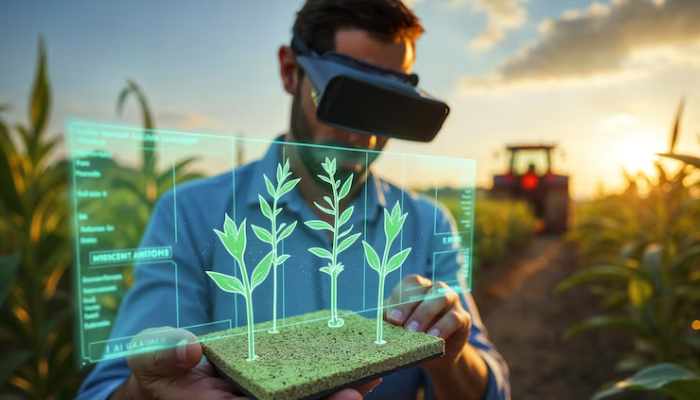
Agriculture—one of humanity’s oldest professions—has become one of the most high-tech industries. "Farming used to be all about horsepower. Now it’s just as much about computing power," says Justin Rose, president of John Deere’s agriculture division . In 2026, the industry is facing a labor shortage as farmers retire, and new enrollments in high-tech agriculture programs are growing faster than other programs .
AI is transforming agriculture from a labor-intensive industry into one that is data-driven and tech-enabled. Sixty percent of U.S. farms now employ AI, requiring drone operators, automation engineers, and other technical roles . This guide covers the key AI agriculture roles, the skills you need, and how to position yourself for this rapidly growing field.
The New Agriculture AI Roles
1. Geospatial Analyst (Agriculture Focus)
What they do:
These roles sit at the intersection of geospatial science, deep learning, and agriculture. They develop, train, and deploy ML/AI models to extract insights from multi-dimensional satellite data, with a strong focus on crop mapping, yield estimation, and stress detection .
Key responsibilities:
-
Develop and operationalize agroecosystem models and geospatial AI tools using hyperspectral, multispectral, and SAR satellite imagery
-
Design deep learning models (CNNs, Vision Transformers, U-Nets) for crop type classification, crop stress detection, and yield estimation
-
Execute end-to-end client projects from requirement scoping through model training and delivery of actionable intelligence
Key skills:
-
Solid understanding of cropping patterns, crop phenological cycles, and farming practices
-
Proficiency in Python with geospatial libraries (Rasterio, GeoPandas, xarray, GDAL/OGR) and ML libraries (PyTorch/TensorFlow)
-
Hands-on experience with large raster (GeoTIFF, NetCDF) and vector datasets
-
Strong understanding of remote sensing and spectral analysis
Who's hiring: Pixxel, AgriTech startups, agricultural research institutes
Salary (US): $83,842 average for data analysts in agriculture
2. Cognitive Analytics Engineer
What they do:
This is a systems-minded AI engineer role building agentic AI systems for breeding pipelines. They work at the intersection of agentic AI systems, simulation, and reinforcement learning to enable breeding teams to optimize complex, multi-stage decisions .
Key responsibilities:
-
Build and maintain agentic AI systems that orchestrate analytics, simulation, and decision workflows for breeding pipelines
-
Implement and optimize digital twin components for use with agentic inference systems and reinforcement learning training pipelines
-
Develop and train reinforcement learning agents that optimize breeding pipeline strategy
-
Architect for scale and deployment—distributed training, efficient orchestration, and production-grade reliability
Key skills:
-
Master's in CS, ML, or related field with 3–5 years relevant experience
-
Strong Python skills with deep learning frameworks (PyTorch, JAX)
-
Experience with reinforcement learning frameworks, simulation environments, and digital twin systems
-
Experience with deployment of orchestrated agents (MCP, ACP)
-
Background in plant breeding, genetics, or agriculture is a plus
Who's hiring: Corteva Agriscience
3. AI Scientist / Computer Vision Engineer (Agriculture)
What they do:
These roles drive innovation at the intersection of advanced AI research and agricultural applications. They lead applied AI research to develop novel approaches for agricultural challenges such as crop monitoring, yield forecasting, and sustainability .
Key responsibilities:
-
Lead applied AI research for agriculture challenges
-
Design and evaluate state-of-the-art models across computer vision, NLP, time-series, and multimodal learning
-
Build and operate large-scale image processing pipelines—processing hundreds of terabytes of aerial imagery annually
-
Design ML models for plant counting, height measurement, health assessment, and disease/weed detection
Key skills:
-
PhD or Master's in CS, ML, or related field with 4+ years experience
-
Deep expertise in computer vision, deep learning frameworks, and multimodal architectures
-
Experience with transfer learning, self-supervised learning, domain generalization
-
Strong Python skills with solid software engineering best practices
-
Experience with large-scale datasets and MLOps practices
Who's hiring: Precision AI, Syngenta
Senior salary (Switzerland/Global): Competitive R&D leadership compensation
4. Data Scientist (AgTech)
What they do:
Data Scientists in agriculture solve real-world problems to enable informed decisions in crop protection development and related R&D. They build various data science solutions by collecting, analyzing, and interpreting large datasets including images, and by building models using deep learning/machine learning predictive algorithms .
Key responsibilities:
-
Utilize crop protection trial data (text, numeric, images) to generate insights via dashboards, ML/DL/AI/LLM models
-
Perform statistical analyses of product performance data
-
Build deep learning/image recognition-based advisory tools for farmers via mobile apps
-
Collaborate with data engineering teams to transition ML/AI innovations into scalable operational solutions
Key skills:
-
PhD or Master's in Data Science, Computer Vision, ML, Statistics, or related field
-
4+ years experience in Python/R, ML, Deep Learning, Computer Vision
-
Experience with CNNs, Object Detection Algorithms, and Deep Learning Frameworks
-
Experience in web scraping, data wrangling, data visualization
-
Experience in the agrochemical industry is a plus
Who's hiring: Syngenta
5. Precision Agriculture Specialist
What they do:
Precision Agriculture Specialists use AI tools, drones, and sensors to optimize planting, irrigation, and pest management. They are the bridge between technology and the farm .
Key responsibilities:
-
Record research or operational data
-
Collect geographical or geological field data
-
Analyze environmental data
-
Research crop management methods
-
Advise customers on the use of products or services
Key skills:
-
Knowledge of computers and electronics, mathematics, and biology
-
Customer and personal service skills
-
Critical thinking and complex problem solving
-
Reading comprehension and active listening
Who's hiring: Farm equipment dealerships, agricultural technology companies, precision ag consultants
Education: Associate in Science degree in precision agriculture (available fall 2026, College of Central Florida)
6. Agricultural Drone Operator
What they do:
Drone operators in agriculture use AI-powered drones for crop health monitoring, aerial spraying, and field mapping. They are the "grunt laborers" of modern farming—one drone operator can replace a team of manual workers .
Key responsibilities:
-
Operate drones for crop health imagery
-
Provide maps and custom prescriptions for variable-rate applications
-
Conduct aerial spraying with precision (drones fly at 10-12 feet, creating a vortex that pushes chemicals down into the canopy)
Key skills:
-
Drone piloting certification
-
Understanding of AI and computer vision
-
Ability to interpret data and provide actionable insights
-
Physical stamina and attention to detail
The Skills That Differentiate Candidates
Systems Thinking
The most valuable candidates understand how different tools serve different purposes—and how research, software engineering, and production systems connect in agriculture .
Dual Competency
The sector needs people who understand both soil and software. The most valuable AI professionals combine plant science or agronomy expertise with machine learning and data science .
Cross-Functional Communication
You need to translate complex technical concepts for farmers, agronomists, and policymakers. This is consistently cited as a critical need .
Evaluation and Deployment
The agricultural industry needs models that work in the real world, not just in the lab. Production-grade AI deployment and evaluation skills are essential .
How to Position Yourself
1. Build Domain Knowledge First
If you come from agriculture, learn AI. If you come from tech, study plant science, agronomy, or crop systems. The most valuable professionals are those who combine AI fluency with agricultural domain expertise.
2. Learn the Core Technical Skills
Python is non-negotiable across agriculture AI roles. PyTorch and TensorFlow are the primary deep learning frameworks. Geospatial libraries (Rasterio, GeoPandas, xarray) are critical for remote sensing work.
3. Build a Portfolio
The practitioners who get hired are the ones who can show working projects. Build an AI model for crop mapping, yield estimation, or disease detection using public satellite data. Publish your work.
4. Get Hands-On Experience
Don't just work from a desk. Spend time in the field, talking to farmers, seeing real-world constraints. Employers value candidates who understand both the data and the dirt.
5. Stay Current
Agriculture AI is evolving rapidly. Stay current with new model architectures, benchmark datasets, and cloud-native geospatial standards .
Industry Snapshot: Agriculture AI Roles
| Role | Key Responsibilities | Key Skills | Who's Hiring |
|---|---|---|---|
| Geospatial Analyst | Satellite imagery analysis, crop mapping, yield estimation | Python, PyTorch, GeoPandas, Remote Sensing | Pixxel, AgriTech startups |
| Cognitive Analytics Engineer | Agentic AI systems, digital twins, reinforcement learning | Python, PyTorch, RL frameworks, MCP | Corteva Agriscience |
| AI Scientist (Agriculture) | Computer vision, model research, crop monitoring | PhD, CV, deep learning, multimodal AI | Precision AI, Syngenta |
| Data Scientist (AgTech) | Crop protection data, dashboards, ML models | Python, R, CNNs, object detection | Syngenta, agritech firms |
| Precision Agriculture Specialist | Farm tech implementation, drone operations | Agronomy, computers, customer service | Dealerships, agtech companies |
| Agricultural Drone Operator | Aerial imagery, spraying, crop mapping | Drone certification, AI understanding | Farms, service companies |
Frequently Asked Questions (FAQs)
What is the most in-demand AI agriculture role?
Geospatial Analysts and Cognitive Analytics Engineers are in high demand, with roles at major companies like Corteva Agriscience and Pixxel .
Do I need an agricultural degree to work in AI in agriculture?
Not necessarily. Technical roles require AI/ML skills first. However, agricultural domain knowledge is a significant differentiator. 64% of agriculture graduates in 2023 were women, and the field is becoming more diverse .
What is the salary potential in AI agriculture?
Data analysts in agriculture average $83,842. Flavor technologists command almost $70,000 annually. Senior roles at companies like Syngenta offer competitive leadership compensation .
Is AI replacing agricultural workers?
AI is replacing labor-intensive tasks but creating new technical roles. The average age of a farmer is 58, and the sector needs new talent. AI makes farming appealing to young people who are excited about drones, ML tools, and robotics .
How long does it take to transition into an AI agriculture role?
If you already have AI skills, building agricultural domain knowledge takes 6–12 months. If you have agricultural expertise, learning AI takes 6–12 months of focused effort.
Build Your AI Agriculture Career with Coding Now – Gurukul of AI
AI is transforming agriculture, creating unprecedented demand for professionals who can bridge technology and food production. At Coding Now – Gurukul of AI, we offer industry-oriented programs designed to equip you with the AI skills that employers in agtech and agriculture are actively seeking.