Home›Community›How does LangChain work with vector databases like FAISS, C…
How does LangChain work with vector databases like FAISS, ChromaDB, and Pinecone?
jeeva •
Jun 29, 2026 •
41 views
I'm learning semantic search and RAG systems.
Can someone explain how LangChain integrates with popular vector databases and when each one should be used?
0
1 Answers
nishtha
Jul 04, 2026
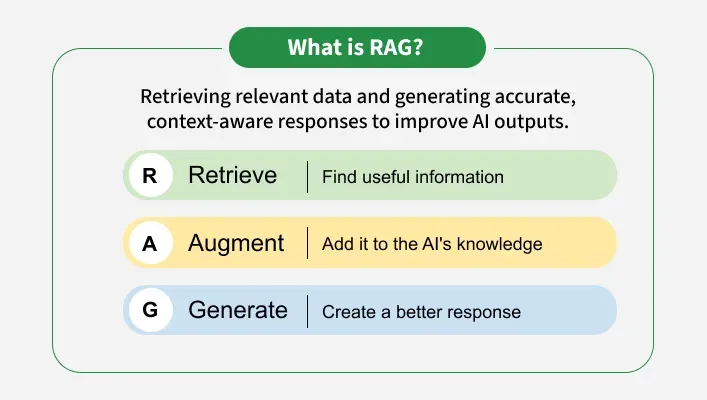
LangChain integrates with vector databases such as FAISS, ChromaDB, and Pinecone to enable efficient semantic search and Retrieval-Augmented Generation (RAG). The process works as follows:
Convert text into embeddings: LangChain uses an embedding model (e.g., OpenAI or Hugging Face) to convert documents into numerical vectors.
Store embeddings: These vectors are stored in a vector database like FAISS (local and fast), ChromaDB (lightweight and open-source), or Pinecone (managed cloud service).
Search by similarity: When a user asks a question, LangChain converts the query into an embedding and performs a similarity search to find the most relevant documents.
Generate a response: The retrieved documents are passed to a large language model (LLM), which uses them as context to generate an accurate and relevant answer.
In summary: LangChain acts as the bridge between the LLM and the vector database, handling embedding generation, document retrieval, and passing the retrieved context to the LLM for response generation.